
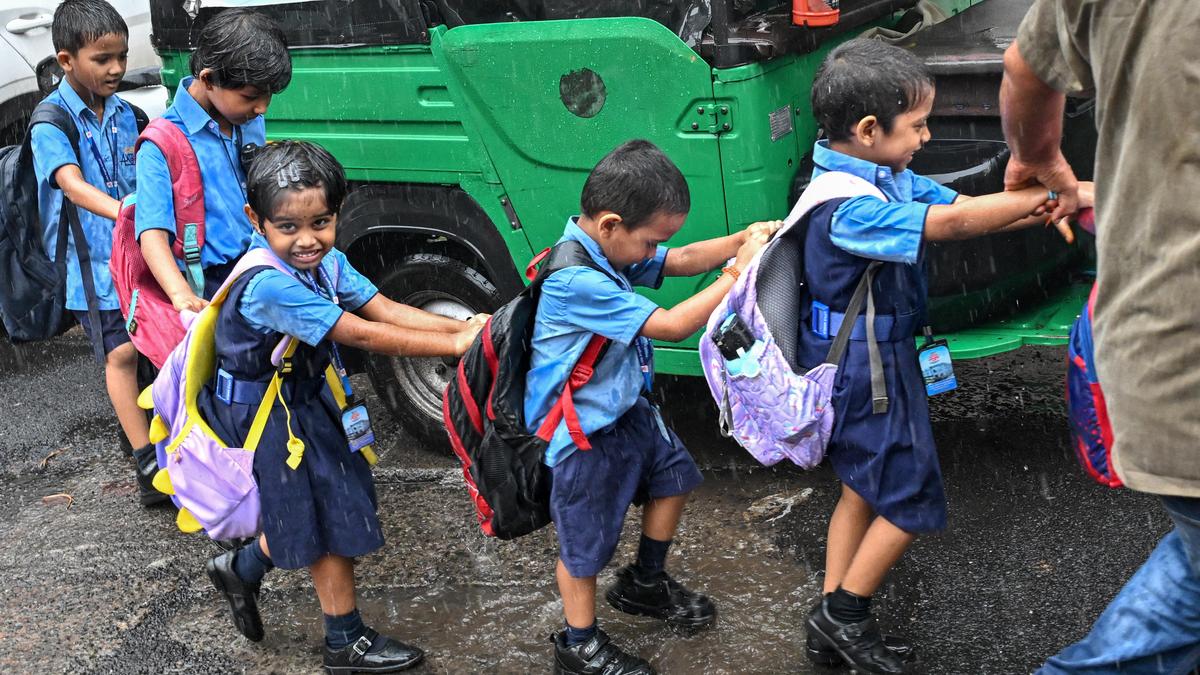
In August 2026, Tina Vaikunthe, a Class 9 student from Khetapur village in Nagpur, Maharashtra, went viral on social media for documenting her daily seven-kilometer-long trek to her school. In her village, there is no school that offers secondary education; hence, most students have to go to Dongargaon. Following the video, the government introduced a State transport bus service to ease their journey.(Sign up for THEdge, The Hindu’s weekly education newsletter.)Tina’s commute trek may not be typical, but commuting long distances to school primarily by walking is common across the country. As per the RTE Act of 2009, the appropriate governments and local authorities have to provide schools within a walking distance of one kilometer for children in Classes 1 to 5 and within three kilometers for children in Classes 6 to 8. This is known as the neighbourhood school. The Act allows State governments to have the flexibility to define the distance and limits according to local geography, density of population, and other factors.Join THEdge LinkedIn groupThe government’s first-of-its-kind National Household Travel Survey (NHTS), conducted by the National Statistics Office (NSO), found that three out of five (60.6%) students between the ages of 6 and 14 travel over one kilometer to reach their educational institutions. The survey covered over 14,000 villages and over 10,000 urban blocks. It collected information from 4,92,023 households covering over 20 lakh persons.The survey found that the proportion of students travelling over a kilometer is higher in urban areas than in rural areas. It was also found that the proportion of female students travelling over a kilometer to an educational institution was slightly less than male students in both urban and rural areas.For higher education, a little over three-fourths of the students between the ages of 15 and 29 travel more than a kilometer every day. The gap between rural and urban students is nearly five percentage points, with students in rural areas (79.1%) travelling more than those in urban areas (73.3%). This could be because schools providing secondary education, colleges, and universities are more concentrated in cities and towns across the country. The 2026 Economic Survey showed that only 17.1% of schools in rural areas offer secondary education, whereas it is over double in urban areas, at 38.1%.Walking is the primary mode of travel for students between the ages of 6 and 14, with nearly half of all students walking over one kilometer to reach their schools. The Supreme Court, in a 2017 judgment, has held that expecting children to walk long distances to school is against the spirit of the RTE Act. Long commutes cause physical fatigue and stress to students.Buses (31%), including school-affiliated ones, are the most common mode of transport used by older students between the ages of 15 and 29. Among private modes of transport, bicycles are the most common mode of travel, with one-sixth of students aged six and above using them. However, the proportion of those using cycles is higher in rural areas than in urban areas. Autorickshaws come second and are used by 10% of students.The survey found that peak travel hours among students are 8 a.m. to 9 a.m. and 3 p.m. to 4 p.m. The average time taken by a student to reach their educational institution is 22 minutes in urban areas and just a minute longer in rural areas. For 11% of students surveyed, the trip to school takes half hour to an hour.Across States, the average time taken to reach school is 22.34 minutes. In Northeastern States, the travel time is considerably less, ranging between 15 and 20 minutes. The highest travel time, of 31 minutes, was recorded in Himachal Pradesh. The five Southern States – Keralam, Karnataka, Andhra Pradesh, Telangana and Tamil Nadu – recorded an average of 26 minutes.Chart: The average time taken to reach educational institutions State-wise for students of age 6 and aboveFamilies in urban areas spend almost double on travel compared to rural areas per student, with monthly expenditure being ₹617 and ₹361, respectively. This could be a significant sum for many families, as according to the latest Comprehensive Modular Survey (Education), the average family’s yearly expenditure on education per child is ₹2,863 in government schools and ₹25,002 in private schools. The NHTS has not included travel to private tuition or coaching centers.Ensuring safe, quick, and affordable transport is essential to reduce student dropouts and improve productivity. According to the Ministry of Road Transport and Highways, in 2024, over 10,000 minors died in road accidents. As a large number of students walk and cycle to school, building accessible footpaths and designated cycle paths can ensure an easier and safer commute. Preventing overcrowding in buses and autos, as well as enforcing speed limits in school zones, particularly during peak hours, can help prevent fatalities. Identifying gaps in the transit system and increasing the availability of public transport will also help reduce travel time for students.
RTE Act mandates short school distances, but most students commute longer: govt. data
Full Article
Original Source
Read the full article at Thehindu →KhanList aggregates and links to publicly available news content. We do not host full articles from third-party sources. Always verify important information with original sources.