
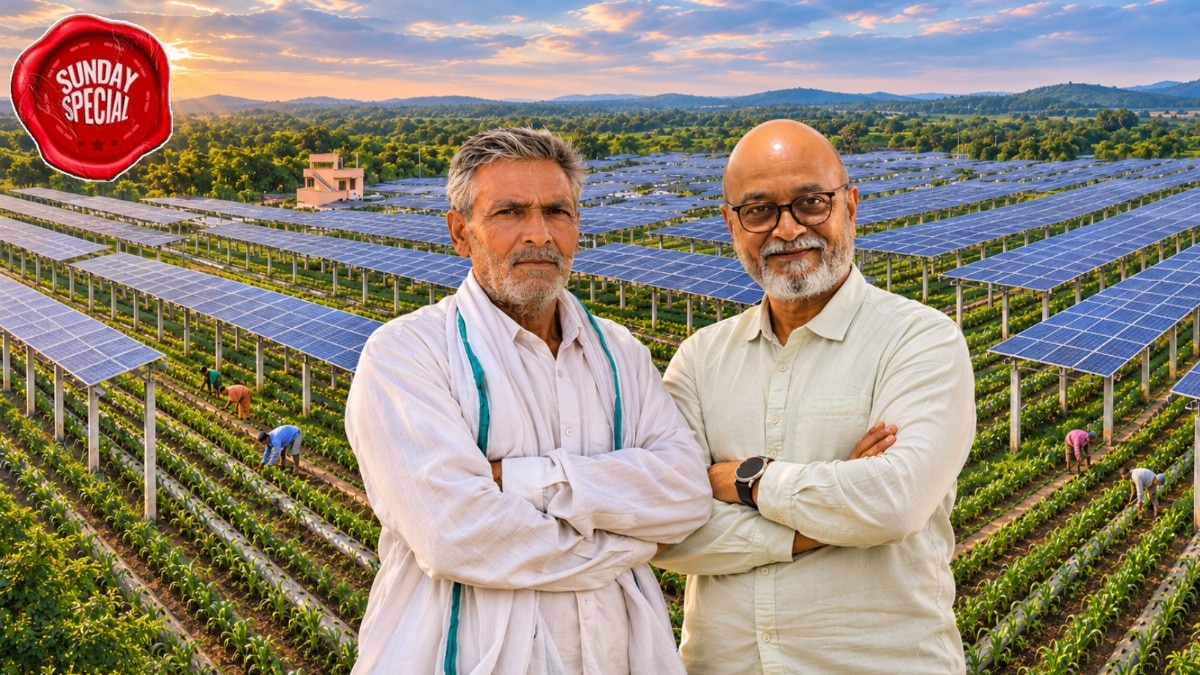
A couple of years back, Kajod Mal Jat, a farmer from rural Jaipur in Rajasthan, having become an urjadata (energy provider), missed being an annadata (food provider). The solar panels he had put up on his field were generating electricity and money. But the land beneath them could no longer grow crops. Similarly, hundreds of kilometres away, in Madhya Pradesh's Sagar district, innovator-farmer Anand Jain was determined not to let solar panels take away his joy of farming.Today, both farmers are growing cash crops on their farms beneath and generating electricity from solar panels above, which they are selling to the government and earning big. Jat and Jain are annadatas and urjadatas at the same time. And, this has been made possible by a technology called agriphotovoltaics, or Agri-PV, or agrivoltaics, which combines farming and solar power generation on the same piece of land. The technology, now taking its first steps on the ground in India, promises to revolutionise agriculture by boosting farmers' incomes severalfold. It's already doing so."I used to earn around Rs 40,000 per acre annually from conventional farming. Now, I earn nearly Rs 15 lakh a year from selling solar electricity alone, besides growing three crops of vegetables annually," Kajod Mal Jat says.Moreover, agrivoltaics could end the growing tug-of-war between solar power expansion and food farming, which allows India to harvest both food and energy without sacrificing either. Kajod Mal Jat, who was celebrated as a Krishi Veer at India Today Group's inaugural Bharat Agriculture Conference, and Anand Jain are among a small but growing number of Indian farmers adopting agrivoltaics.Agrivoltaics involves raising or rearranging solar panels so that crops can grow underneath or between them. Experts say agrivoltaics has the potential to increase farmers' earnings by eight to 10 times. However, at the same time, they warn that the monetary gains depend on land ownership, electricity tariffs in the states, crop productivity and costs of investment. Prime Minister Narendra Modi, addressing the India Today Group's inaugural Bharat Agriculture Conference on November 12, hailed the growing role of solar power in transforming farmers' livelihoods. Calling it a solar power revolution, he said, it turned India's annadatas into urjadatas under the PM-KUSUM scheme.At the same conference, Israeli Ambassador to India Reuven Azar, warning that solar expansion could leave less land for agriculture, highlighted Israel's advances in agrivoltaics. Reacting to the envoy's remarks, ICRIER economist Subhodeep Basu says India isn't behind in this technology and is developing agrivoltaic models suited to its own farming conditions.The Indian Council for Research on International Economic Relations (ICRIER) is a Delhi-based economic policy think tank.Basu says agrivoltaics is already delivering promising gains and gathering momentum as India races to achieve its target of 500 gigawatts of non-fossil electricity capacity by 2030, while suggesting a solution to the threat that expanding solar farms could eat into fertile farmland, and jeopardise food security."The technology is still at a nascent stage, with most projects operating as pilots. But the potential is enormous," New Delhi-based Basu, a Fellow at ICRIER, tells India Today Digital.Agricultural economist Ashok Gulati, who has been advocating agrivoltaics in India for nearly a decade, believes the country has made a start but needs to move beyond experimental projects."So far, we have put up some pilots that need scaling up with the right policy support," Gulati tells India Today Digital.He stresses that the "dual use of land for cultivation and for producing clean power is the essence of agri-photovoltaic", and that PM-KUSUM Component A needs to be revised for the technology to flourish.For a group of small farmers, like the one Basu and his team are working with in Odisha, Gulati advocates setting up solar cooperatives along the lines of milk cooperatives to replicate the success of Operation Flood. He says it would not just multiply farm incomes, but also "deliver political dividends". Rajasthan farmer Kajod Mal Jat was congratulated by Prime Minister Narendra Modi at the India Today Group's Kisan Tak Bharat Agriculture Conference in New Delhi on November 12. (Photo: Subhodeep Basu) Implemented by the Union Ministry of New and Renewable Energy (MNRE) through designated state agencies and power distribution companies (DISCOMs), PM-KUSUM helps farmers set up grid-connected solar plants, install solar irrigation pumps and solarise existing agricultural pumps. The aim is to enable the farmers to reduce energy costs and earn from the sale of electricity.The story of agrivoltaics in India, therefore, is not just about erecting solar panels and filling up the coffers. It is also about ensuring that farmers get their fair share of the earnings from solar power, retain control over their land, and continue growing food even as India expands its clean energy capacity.HOW AGRIVOLTAICS IS TAKING ROOT IN INDIAAgrivoltaics is not a new invention. The concept was proposed in 1981 by German scientists Adolf Goetzberger and Armin Zastrow, who explored combining photovoltaic electricity generation with agricultural cultivation.In India, agricultural economist Ashok Gulati has been among its pioneering advocates, says ICRIER's Basu, adding that its adoption has gathered momentum only over the past one or two years.In a September 2016 column in The Indian Express, Gulati and his co-authors proposed installing solar panels above farmland while allowing conventional crops to grow below. Gulati also described electricity as a farmer's additional or "third crop".According to an October PIB backgrounder, India had 36 operational agrivoltaic projects with a combined capacity of 37.54 MW as of August 2025. Another 10 pilots were under development.Basu tells India Today Digital that India now has around 40 installations, alongside a wider range of pilot and demonstration initiatives. However, genuinely farmer-owned projects — like Rajasthan's Kajod Mal Jat and Madhya Pradesh's Anand Jain — are uncommon.India also hosted the seventh AgriVoltaics World Conference in New Delhi from October 21 to 23 this year, which brought researchers, policymakers and industry representatives together.Even as farmer-owned projects are rare, the growing number of pilots and agrivoltaic projects in institutions and farmer-producer organisations show that India is pulling out all the stops to unlock the technology's potential. Innovator-farmer Anand Jain at his Jeevan Solar Farms in Sagar, Madhya Pradesh, where he is growing strawberries and other high-value crops beneath elevated solar panels. (Photos: Anand Jain) HOW FARMERS GROW CROPS UNDER SOLAR PANELSIn conventional ground-mounted solar plants, panels are installed relatively close to the ground. So that leaves no scope for cultivation. Basically, the land is gone. Agrivoltaics changes the arrangement by elevating the panels, increasing the spacing between rows or using alternative configurations that allow sunlight to reach crops.The structures can range from around 10 feet to nearly 20 feet, depending on the crops, agricultural machinery and technology involved.In March 2025, the ICRIER research team, of which Subhodeep Basu was a part of, was exploring an agrivoltaics opportunity in Rajasthan, they came across Kajod Mal Jat, and his land parcel in Jaipur's Bassi block. He already owned a 600-kW solar plant under the Centre's PM-KUSUM scheme, but its ground-mounted panels had left much of his farmland uncultivable.Kajod Mal Jat's 600-kW solar installation generated electricity, but had effectively taken productive farmland out of cultivation. For Kajod Mal Jat, a lifelong farmer, the steady income from electricity came at an emotional cost. He missed growing crops on the land his family had cultivated for generations.The researchers proposed raising the panels to approximately 10-11 feet. With financial support from Kotak Mahindra Bank's CSR initiative, the plant was retrofitted into an approximately 550-kW agrivoltaic installation and inaugurated in June 2026."I now grow maize, chillies, tomatoes and cucumbers beneath the solar panels, while continuing to generate electricity above," said Jat at the Kisan Tak conference.Madhya Pradesh's Sagar-based Anand Jain has also elevated solar panels to around 11-13 feet, which allows cultivation of crops and heavy machinery like tractors to operate underneath. He said his experimentation was part of his "love for farming and innovation"."We have experimented with 16 crops, including strawberries, broccoli, capsicum, chillies and wheat," Jain tells India Today Digital. His experiments have shown promising results, and he now aims to increase his annual agricultural earnings to Rs 40 lakh.Apart from the individual farmer-owned agrivoltaic power plants, institutions, private developers and farmer-producer organisations are also experimenting with agrivoltaics across India. According to an October 12 report in The Hindu BusinessLine, projects in Uttar Pradesh and Maharashtra are cultivating crops ranging from wheat, spinach and cauliflower to horticultural produce and table grapes beneath solar panels.One thing to note is that not every crop responds equally well to shade. The arrangement of the overhead solar panels, thus, must be designed around local climatic conditions, sunlight, shade, soil conditions and other requirements. Agrivoltaics has been adopted or tested in countries including Germany, Japan, China, France, Italy, South Korea, the United States and India. Its scale and commercial maturity varies widely, according to a 2025 report by the International Energy Agency's Photovoltaic Power Systems Programme. CAN FARMERS REALLY EARN TEN TIMES MORE WITH SOLAR ENERGY?Under PM-KUSUM Component A, eligible farmers can establish grid-connected solar power plants and sell electricity to local power distribution companies, or Dsicoms, through power purchase agreements.Kajod Mal says he sells electricity to the local Discom at Rs 3.14 per unit. The rate is specific to his agreement and varies across projects and states. Before installing solar panels, he cultivated wheat and millet and earned around Rs 40,000 per acre annually. The agrivoltaic model could take his combined annual earnings from crops and electricity to over Rs 4 lakh per acre, nearly ten times his earlier income, according to ICRIER's Basu."I earn around Rs 15 lakh annually from selling electricity. Apart from that, I grow three crops of vegetables every year," Kajod Mal Jat said at the Kisan Tak conference on November 11.Research on agrivoltaics in India and elsewhere also offers encouraging results.A two-year study conducted between 2022 and 2024 at Professor Jayashankar Telangana State Agricultural University in Hyderabad, assessed by The Energy and Resources Institute (TERI), found that average crop yields beneath an experimental agrivoltaic installation were 97.8% of open-field yields.According to a PIB backgrounder, India has the potential to generate between 3,000 GW and nearly 14,000 GW of solar power through agrivoltaics. The Centre has also identified around 4.73 crore hectares of farmland as potentially suitable for agrivoltaics technology.Yes, the potential is enormous. Farmers' incomes get a boost, and India stands to gain through better food security, greater clean energy capacity and reduced dependence on costly energy imports. However, agrivoltaics still faces significant hurdles. Most of these projects are institution-or developer-led projects. Individually farmer-owned agrivoltaic installations are rare. Agrivoltaics has an enormous potential. It's in its infancy stage in India. AGRIVOLTAICS' COSTLY ROAD FROM PILOT PROJECTS TO FARMSDespite its promise, agrivoltaics is an expensive proposition, as of now. High installation costs, difficulties with financing, challenges with maintenance and bureaucratic delays can discourage farmers to take the innovation. Part of the problem is that the technology is still in its infancy in India. Experts believe that as adoption increases and projects become commercially viable at scale, costs could come down and many of these hurdles could gradually ease.ICRIER's Basu explains that "elevated agrivoltaic structures can cost approximately 10-15% more than conventional ground-mounted solar installations, depending on their design."Kajod Mal Jat's first solar plant in Rajasthan cost around Rs 2 crore. Retrofitting it to accommodate farming underneath required another Rs 35.3 lakh, which took the total investment to approximately Rs 2.35 crore. Banks generally finance 70-75% of conventional solar projects. This leaves farmers to arrange the remaining 25-30%.Innovator-farmer Anand Jain, who has developed an agrivoltaic project on 14 acres of his 20-acre farm in Sagar, says he has experienced these challenges firsthand."Raising solar panels to allow farming underneath requires taller supporting structures, additional materials like columns, heavy machinery and skilled labour. All this pushes up the installation cost considerably. On top of that, domestically manufactured DCR-compliant solar panels can cost 30-40% more, which makes the initial investment even more expensive for farmers," Jain explains."The investment also comes with a decade-long repayment period," says Jain, adding, "servicing bank loans and interest could stretch over 12-13 years. This leaves farmers with considerably less disposable income during the initial years of operation".Maintaining the installations is another challenge, highlight Jain and Basu. Elevated solar panels are harder to access for cleaning and repairs, particularly in dusty regions. Additionally, electrical inspections, inverter servicing, cable checks and structural maintenance add to the cost.According to ICRIER economist Subhodeep Basu, approximately Rs 1.5 lakh has been budgeted annually for the operation and maintenance of Kajod Mal's installation, including cleaning, electrical servicing and structural inspections.Basu recalls seeing a jugaad (ingenious hack) developed by Kajor Mal Jat. "Workers stand on tractors and use agricultural spray guns, normally employed for applying pesticides, to wash the elevated panels," Basu says. Kajod Mal Jat's solar panels before and after retrofitting (top left and bottom left). The crops are growing beneath the elevated panels. The transformation was undertaken by an ICRIER team, including Subhodeep Basu. The project was inaugurated in June (top right). (Photos: Subhodeep Basu/ICRIER) HOW AGRIVOLTAICS CAN TAKE OFF IN INDIA, BECOME MAINSTREAM?The difficulties, however, begin well before the solar panels start generating electricity. Experts and stakeholders demand these problems be streamlined.Basu tells India Today Digital, "While installing the physical infrastructure may take just two to three months, completing the entire process can take nearly a year because of paperwork, loan approvals, certificates, regulatory clearances and coordination between different state-government agencies."Jain also points to the absence of a streamlined approval mechanism. "Farmers have to deal with multiple government departments, banks and electricity distribution companies. They often have to navigate procedures that are unfamiliar even to local authorities," Anand Jain tells India Today Digital.Jain, cites examples of Rajasthan and Odisha and calls for "a single-window clearance system to simplify approvals, financing and grid connectivity, reducing bureaucratic delays." He also raises concerns about delayed payments and deductions by DISCOMs from the amount owed to farmers for the electricity they supply, which can further strain the farmers already burdened with big loan repayments.Another important consideration is the economic viability of grid connectivity for solar projects on agricultural land. "Under PM-KUSUM Component A, projects are required to be located within a five-kilometre radius of a suitable power substation. This ensures manageable transmission costs, as projects beyond this distance are unlikely to remain economically viable and would not qualify for sanction under the scheme," ICRIER economist Subhodeep Basu tells India Today Digital. Crops, including maize, wheat, strawberries, broccoli, chillies, tomatoes and dragon fruit, are being grown or experimented with beneath solar panels in India. (Photos: Subhodeep Basu/ Anand Jain) For small farmers, however, the high initial investment, complicated approvals and operational challenges can make individual ownership of agrivoltaic projects difficult without institutional support."Agrivoltaics needs dedicated financial support, accessible institutional credit and a place in PM-KUSUM 2.0 to make farmer-owned projects commercially viable," ICRIER economist Subhodeep Basu tells India Today Digital.At the October 2026 AgriVoltaics World Conference, Union Minister of New and Renewable Energy Pralhad Joshi announced plans to introduce a dedicated agrivoltaics component under the proposed second phase of PM-KUSUM.Economist Ashok Gulati, however, wants the government to go a step further by extending capital subsidies to farmer-owned agrivoltaic projects, on the lines of those available under the PM-Surya Ghar scheme."PM-KUSUM component A should get a similar capital subsidy as the PM-Surya Ghar scheme gets. We may call it PM Surya Khet Kranti. It will help increase farmers' incomes many fold and totally transform the agricultural landscape," Gulati tells India Today Digital.Basu also calls for capital subsidies, more remunerative electricity tariffs and farmer-led solar cooperatives to ensure that farmers, rather than just large developers, benefit from India's solar expansion. "The goal is to make agrivoltaics viable and scalable so that more farmers can benefit," Basu tells India Today Digital.But what about small and marginal farmers who cannot afford such expensive installations individually? Gulati believes the answer lies in cooperation, drawing inspiration from India's dairy revolution. "Small and marginal farmers can come together under solar cooperatives on the lines of milk cooperatives, similar to what we adopted in Operation Flood that unleashed the White Revolution in milk. It can do wonders for solar power generation in rural areas. It is very much feasible and desirable," he tells India Today Digital.Gulati also believes that such a farmer-led solar revolution could bring political benefits to governments by significantly improving farmers' livelihoods. "It will also bring rich political dividends as farmers would gain a lot," he says.So, to sum it all up, for farmers like Kajod Mal Jat and Anand Jain, the money their farms and solar plants generate is not the only achievement. It's about returning to farming on land they had given up cultivating for a steady income through power generation. Farmers can become urjadata by harvesting sunlight, selling the electricity while continuing to feed the country as annadata. It's a win-win situation for all.- Ends
Rs 40k to Rs 4 lakh: How farmers grow food below, generate power above, earn 10x
Full Article
Original Source
Read the full article at Indiatoday →KhanList aggregates and links to publicly available news content. We do not host full articles from third-party sources. Always verify important information with original sources.