
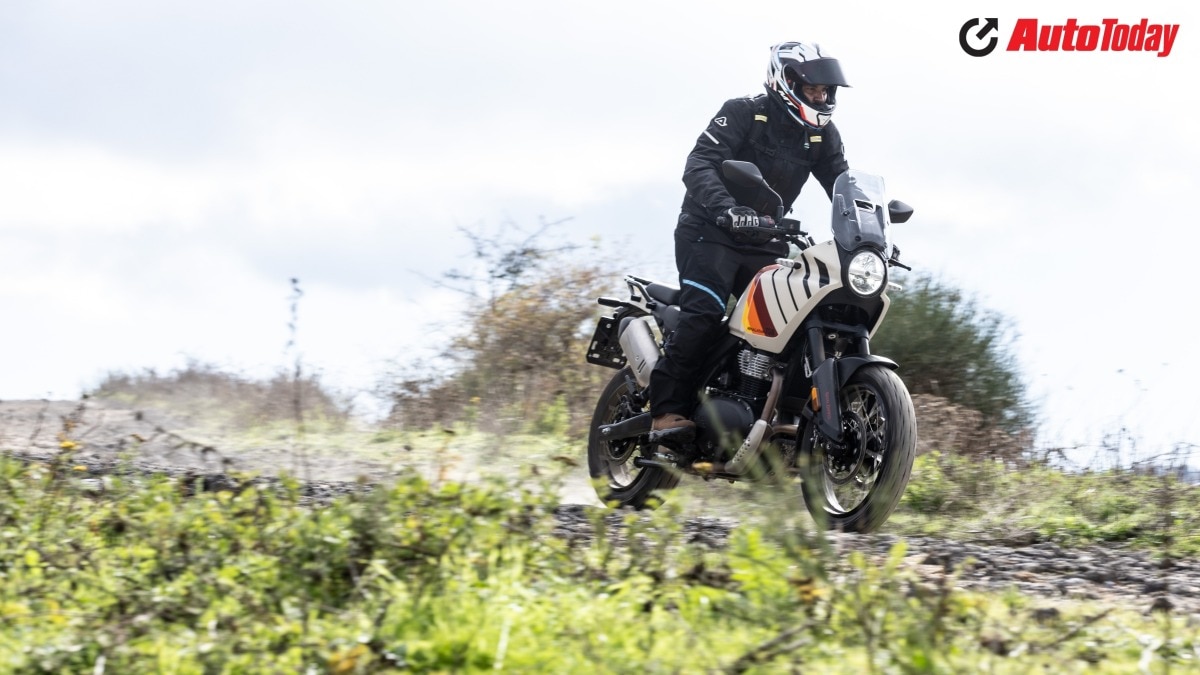
Adventure motorcycling has changed considerably over the past decade, and few manufacturers have been as closely associated with its growth in India as Royal Enfield. From the Bullet 350 and its military origins to the Classic and Thunderbird, generations of riders have taken to the road on motorcycles built around simplicity, character, and the promise of going further. The Himalayan, introduced in 2016, took that philosophy a step further, giving riders a purpose-built machine for exploring beyond the beaten path. Then came the 450 in 2023, another essential part of the adventure puzzle for RE. The Himalayan 750 is available in five colour options. This one is called Aztec Green. Now, almost a decade after the OG’s arrival, Royal Enfield has taken its biggest leap yet. Meet the Himalayan 750, a motorcycle that adds an entirely new dimension to the brand’s adventure-touring ambitions. With an all-new parallel-twin engine, upgraded chassis hardware and an electronics package that would have been unimaginable on a Royal Enfield not too long ago, the Himalayan 750 has a lot to prove. We headed down to Sicily, Italy, to get our first taste of the Royal Enfield’s new 750 chapter.Heart of the matterLet’s start with the biggest change, quite literally. The Himalayan 750 gets an all-new 743cc, air-oil-cooled, parallel-twin, four-valve SOHC motor. It produces 55bhp@7,000rpm and 63Nm@5,000rpm. In terms of changes from the 650 motor, there’s a larger bore, up from 78mm to 83.5mm. In fact, RE says that 90 per cent of the parts on the 750 differ from the 650. There’s higher valve lift, improved oil cooling, shorter cylinder fins, a plated cylinder bore, a more powerful alternator, magnesium covers and a 2-in-1 exhaust system (45 per cent lighter). Additionally, there’s now a DBW throttle body as well. That’s a 17 per cent increase in peak power and a 21 per cent increase in peak torque compared to the 650 engine. Royal Enfield has also made use of a lighter piston along with a slimmer and coated barrel for maximising weight reduction. A bigger motor and a huge step-up in terms of hardware. There’s an improvement in the port injection and intake tract, along with a larger assist and slip clutch. That brings us neatly to the six-speed gearbox, which has seen a significant improvement as well. The first two ratios remain the same as the 650, but the next four are tuned for the 750. The manufacturer claims that 90 per cent of the available torque comes in at just 3,500rpm. That makes a considerable difference to the way an adventure tourer should deliver its performance. Rather than having to constantly chase the rev counter, the idea is to have enough pulling power available lower down the rev range, particularly when negotiating climbs, carrying luggage or making progress over loose surfaces. It is an approach that suits the Himalayan’s touring-oriented character. The graphics could've been better. 2-in-1 exhaust saves weight. The engine itself is remarkably smooth. There is very little in the way of unwanted vibration, and whatever makes its way through to the rider is well controlled. This is particularly noticeable when cruising at highway speeds, where the motorcycle feels relaxed rather than strained. Royal Enfield claims a top speed of around 170kmph, while the motorcycle comfortably cruises at 114kmph at approximately 4,500rpm. There is enough performance here to make longer highway stints considerably less demanding, and that is precisely what an adventure tourer should deliver. The 743cc unit has a bore and stroke of 83.5mm and 67.8mm respectively, with a compression ratio of 9.5:1. It uses a single overhead camshaft arrangement and wet-sump lubrication. Gearbox feels smoother than the 650, although could've been better overall. The six-speed gearbox complements the engine, although it does take some familiarisation to get the best out of the available performance. This is particularly apparent when riding enthusiastically. The motorcycle has selectable riding modes and electronic interventions that influence how it responds, so getting the gearing right and keeping the engine within its optimal torque band becomes important. It isn’t necessarily difficult, but riders looking to extract every bit of performance will need to spend some time understanding the engine and its gearing.Strengthening the foundation An engine of this size and performance requires an equally capable platform, and Royal Enfield has made significant changes here as well. The Himalayan 750 uses a box-section spine frame with pressed-steel outriggers, with the engine serving as a stressed member. It is a substantial departure in terms of the overall package, and the motorcycle has been engineered to accommodate the additional performance without compromising its adventure touring credentials. The Himalayan 750 is no slouch on the rough stuff! The suspension setup is particularly interesting. Up front are 43mm Showa USD forks with 190mm of travel. These offer preload, compression and rebound adjustment, allowing riders to tailor the front-end response to different riding conditions. At the rear is a Showa floating piston monoshock with 175mm of travel (80mm stroke), rebound adjustment and a hand-operated preload adjuster. It has a 10mm range and 35 clicks for the intended setting on hand. The latter will be especially useful when the motorcycle is carrying luggage or a pillion, allowing the suspension to be adjusted without having to struggle with conventional preload settings. Adjustability really adds to the premium factor. Wheel sizes remain in keeping with the Himalayan’s intended purpose, with a 19-inch front and 17-inch rear. Buyers can choose between cast-alloy and spoked wheel options, both paired with tubeless tyres. The tyre sizes are 110/80 R19 at the front and 150/70 R17 at the rear. Tyre pressure monitoring is standard, which is a welcome addition on a motorcycle expected to cover considerable distances. Furthermore, there’s a cast alloy wheel option with Ceat on-road tyre patterns, while the tubeless spoked wheels come with Vredestein adventure-type tyre patterns. In my experience, the latter was more up to the task on all fronts. Brake and clutch levers are adjustable, with a hand-operated adjuster for pre-load for the monoshock. Braking hardware has also received attention. The Himalayan 750 gets twin 280mm floating discs at the front, with two-piston floating callipers, while the rear uses a 255mm disc. More importantly, the braking package is supported by dual-channel ABS, with switchable rear ABS, cornering ABS and lean-sensitive traction control.The weight questionAt approximately 224kg kerb weight, the Himalayan 750 is certainly not a lightweight motorcycle. In fact, it feels a little cumbersome when manoeuvring it at a complete standstill. Moving it around in a parking space or pushing it backwards will require some effort, particularly for riders who are not accustomed to motorcycles of this size. However, that initial impression changes remarkably once you get moving. The weight seems to disappear, and the Himalayan becomes surprisingly easy to manoeuvre. The balance and weight distribution make it feel considerably more manageable than its kerb weight would suggest. Although 224kg is considerable, on the move it dissipates well. The Himalayan 750 also feels reassuringly planted through corners. Riding through the twisty sections of Sicily, the motorcycle demonstrated good stability and precision. The tyres offer good levels of grip, and the chassis feels composed when changing direction. There is a reassuring sense of control when leaning into corners, allowing you to carry a decent amount of pace without feeling that the motorcycle is fighting you. The Himalayan 750 is a fun handler, which was a real surprise. It didn’t feel particularly cumbersome once I found my rhythm, and that is perhaps one of its biggest strengths. It has the stability expected of a large-capacity adventure tourer without becoming intimidating when the road starts getting interesting. In the brief off-road section I encountered, the Himalayan tracked straight and true, giving a novice like me considerable confidence despite this bike’s appearance.New dawnIf the engine represents the biggest mechanical change, the electronics package is arguably the biggest technological leap. Royal Enfield has equipped the Himalayan 750 with five selectable riding modes: Road, Road Sport, Rain, Trail and Custom. These alter engine mapping, ABS and traction control settings depending on the selected mode and riding conditions. For example, in Trail mode, the rear ABS is turned off, and traction control is at its lowest intrusion level. Do note, one has to come to a halt to switch into Trail or Custom, but not Road or Road Sport. Four-inch TFT gets significant upgrades. Could analogue dials have looked better though? The Custom mode allows riders to configure their preferred throttle maps and ABS settings, while traction control can be adjusted across four levels: Low, Medium, High and Off. This gives the rider considerably more control over how the motorcycle behaves, particularly when moving between paved roads and loose surfaces. Cornering ABS and lean-sensitive traction control are significant additions, too. These systems account for the motorcycle’s lean angle when intervening, offering an additional layer of assistance when braking or managing traction through a corner. Moreover, Royal Enfield will provide this as standard across the range. A big plus! Switchgear feels superior; cruise control is easy to operate. Cruise control is another welcome feature, especially considering the Himalayan’s long-distance touring focus. It allows riders to maintain a set speed on highways without constantly working the throttle. The new switch cubes and joystick make navigating the electronics relatively straightforward, although there is naturally a learning curve when familiarising yourself with the various settings. I would’ve appreciated a hill-hold assist as well, since RE has gone the distance with the electronics package.Stay connectedThe technology upgrade extends to the instrument console as well. The Himalayan 750 gets a 4-inch TFT display with Wi-Fi and Bluetooth connectivity, navigation, phone and music controls. It brings together several functions that are increasingly becoming important to modern touring motorcycles. There are also dual Type-C USB charging ports, one offering 27W fast charging and the other providing 10W standard charging. This is a practical addition for riders who rely on their phones for navigation and communication over long distances. That back-end looks familiar, doesn't it? Something different would've been appreciated. Tyre pressure monitoring is also integrated into the package, allowing riders to keep an eye on tyre pressures without having to rely solely on manual checks. The lighting package is all LED, with a new seven-inch LED headlight. These are thoughtful additions that improve everyday usability and safety. Also, there’s adjustability for the LED headlamp, which should be useful when the 750 is loaded up and needs a bit of corrective action with regard to the beam. Taken together, the electronics package makes the Himalayan 750 the most technologically advanced motorcycle from the brand.Taking the longer routeAn adventure tourer needs to be comfortable over several hours in the saddle, and Royal Enfield appears to have paid considerable attention to the ergonomics. The standard seat height is 815mm, which should be manageable for a reasonable proportion of riders, although seat options allow it to be lowered to 795mm or raised to 835mm through official accessories. Handlebar risers can also increase the bar height by up to 18mm. Five-step adjustable windscreen is a great addition for touring. The riding position itself is neutral, with comfortable footpeg placement and a handlebar position that doesn’t force the rider into an unnatural posture. The ergonomics feel spot-on for long-distance touring, and not much effort was needed to settle into a comfortable riding position. Flat-footing it for a person of my size (5’10) wasn’t an issue at all. Furthermore, there is also an adjustable windscreen that can be set in five positions, offering up to 60mm of adjustment without having to pull over. This should allow riders to find a suitable balance between wind protection and visibility depending on their height and riding conditions. Optional handlebar risers can bring up the height by 18mm. The Himalayan 750 has a 17.8-litre fuel tank, a wheelbase of 1,522mm and ground clearance of 205mm. Overall dimensions stand at 2,185mm in length, 840mm in width and 1,450mm in height. The motorcycle has a payload capacity of 194kg, which is useful when factoring in a pillion and luggage for extended trips. Another small detail that caught my eye is the fact that the gearshift and rear brake levers are made from forged aluminium and designed to spring back after an impact. Royal Enfield has tied up with Givi for the optional gear. Bespoke for the Himalayan 750. For those who want to take the touring proposition further, Royal Enfield is also offering bespoke Givi accessories. Royal Enfield had one on display with a top box, hard panniers with mounts and inner bags, heated grips, hand guards and an aluminium skid plate. All very promising, and deeply reassuring.A new adventure beginsThere is no doubt that the Himalayan 750 represents a significant shift in Royal Enfield’s approach to adventure motorcycling. The original Himalayan was built around the idea of simplicity and accessibility, giving riders an uncomplicated motorcycle that could take them places they might otherwise have hesitated to explore. The 450 followed by taking that a few steps further with modern engineering and more power. The 750 builds on that philosophy but adds a much more sophisticated mechanical and technological package. Even with the 19-17 setup, the Himalayan 750 felt sure-footed off-road. As for the feel of the whole experience, these are my honest first impressions. First off, the Italian roads are immaculate. So, judging ride quality for Indian conditions will be reserved for later. Also, we didn’t get a chance to hit a long straight highway during our first ride in Sicily, Italy. That is another factor we will bring you more on once we ride this on our shores. The Himalayan 750 has spot-on ergonomics, and the saddle feels engineered for long stints. The padding felt comfortable without being too hard or too soft. The nature of the power delivery is more akin to the 440 than the 450. This is a motorcycle that can torque the talk, and how. The sound of that exhaust at lower speeds and higher gear is also epic. It has a deep burble that will be characteristic of the 750 in the future. Riding position is a commanding one, even when standing up. It masks its weight beautifully around corners, and this is one aspect that left me genuinely stunned. It did not feel as heavy as I expected, and was a delight around the twisties. The brakes felt progressive and didn’t have a strong initial bite, which I feel is accurate for the application. The clutch lever, though, did feel on the harder side for me. The adjustability did help, but not as much as I would’ve liked. Also, given the terrain, constant gear shifts were a must, and I did find the correct one not slotting in now and then. This, although, was greatly reduced when I rode the tubeless spoked variant. Speaking of which, that is the version to go for if it were my money on the line. The Vredesteins inspired more confidence, hands down. The five-step adjustable windscreen did make a difference to the buffeting at higher speeds. Twisities in Sicily, Italy, proved to be a fun affair with the 750. In the end, the whole experience boiled down to that motor. This engine exhibits vast tractability, pulling strongly when kept inside its mid-range torque band while emitting a deep, resonant mechanical exhaust note. Rather than demanding high-rpm chasing, the engine thrives when riding its wave of low-end torque. This is a motorcycle I want to lazily trundle along with on a mesmerising coastal road, enjoying the moment and taking it all in. And that is its calling card. The adventure calling card with a sense of calm, peace and tranquillity. When it comes to feel, the Himalayan 750 has it in spades. Combine that with its exploring-the-world persona, and this could well be that one bike for all your needs.VerdictThe Royal Enfield Himalayan 750 represents a monumental leap forward, establishing a true long-distance flagship adventure tourer. Its flexible 743cc, parallel-twin engine, nimble handling, and an extensive tech package create a deeply engaging motorcycle with a distinct character. All in all, the Himalayan 750 has character in spades. While definitive evaluations regarding highway cruising and broken Indian road conditions remain reserved for local testing, its dynamic balance makes an impressive initial impression. If Royal Enfield prices this motorcycle competitively, targeting an aggressive sub-Rs 4.5 lakh ex-showroom price, it will undoubtedly redefine the middleweight adventure touring segment.Subscribe to Auto Today Magazine - Ends
Royal Enfield Himalayan 750 first ride: A new adventure begins
Full Article
Original Source
Read the full article at Indiatoday →KhanList aggregates and links to publicly available news content. We do not host full articles from third-party sources. Always verify important information with original sources.