
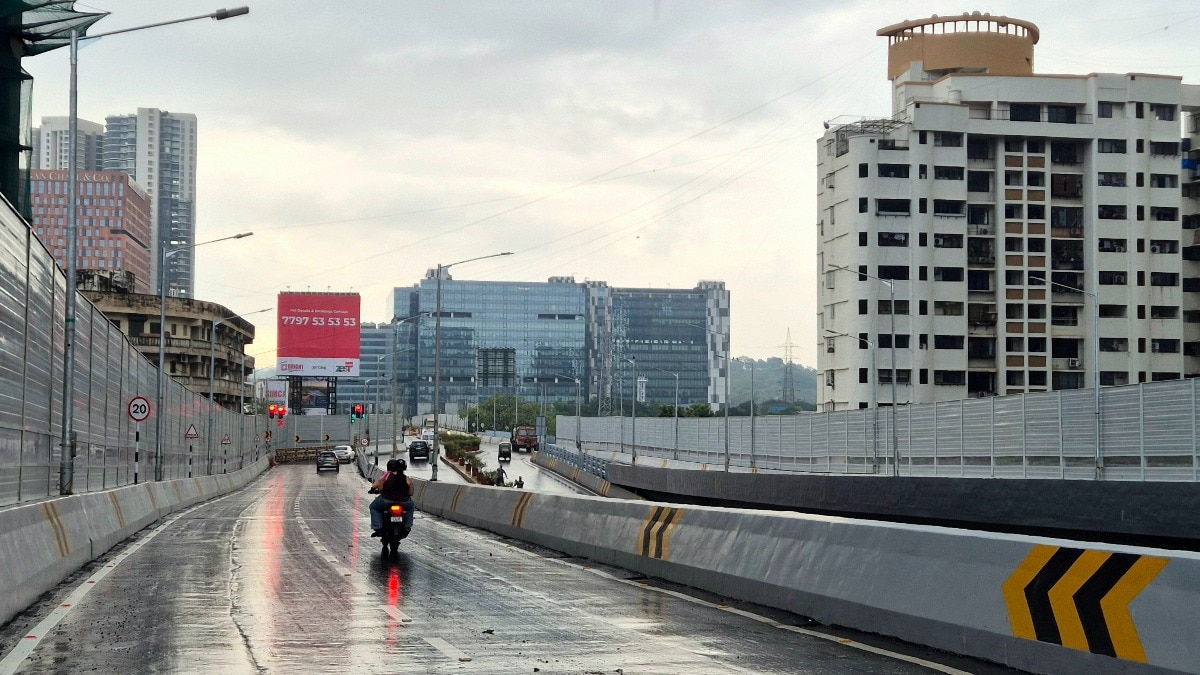
It's been less than three months since Mumbai's Mrinaltai Gore Flyover was inaugurated on June 6, and it's the third time it has made the headlines, for all the wrong reasons. The flyover was first in the news for its terribly pothole-ridden condition. Now, it's in the news because its unusually smooth surface has become a problem for two-wheeler riders.Bikers are reportedly skidding and falling on the flyover, particularly when the road is wet.Videos circulating widely on social media show bikers losing control and skidding as they come down the flyover and negotiate the turn towards Relief Road, with some riders seen falling after their two-wheelers suddenly lose grip on the smooth surface.The complaints have drawn attention to a peculiar feature of Mumbai's roads that motorists have long noticed — stretches of pavement that develop a dark, almost glass-like sheen after years of heavy use. They might look smooth and aesthetically pleasing, especially when wet, but the loss of surface texture can reduce the grip of tyres. Speaking to India Today Digital, transport planner Vivek Pai said Mumbai's combination of heavy traffic and weather helps explain why some roads develop this polished appearance."The slippery roads are basically polished 'aggregate'," Pai said, referring to the road material that gets exposed on the surface and provides texture for tyres to grip. In simple terms, "aggregate" is the crushed stone and other mineral material used in a road and held together by bitumen, the black, sticky material that acts as a binder. "The aggregate's fine texture wears down over time. Mumbai has extremely high traffic, and the weather adds to the wear. Eventually, the tiny rough edges on the road surface get polished smooth," Pai, who is also the director at Sustainancy Consultants Pvt Ltd, a traffic, transportation and urban planning consultancy, said.Eventually, the road surface becomes smoother and loses some of the texture that helps the tyres grip it. This is why roads that carry heavy traffic for years can develop the distinctive shiny appearance seen in parts of Mumbai.The effect becomes more important when vehicles are turning. A motorcycle needs adequate grip to remain stable while braking or negotiating a bend. If the road surface has become smooth and is wet, the available grip can fall further.The Federal Highway Administration identifies "polished aggregate" as a condition that can reduce pavement friction, while wet conditions can further reduce the grip between tyres and the road.Mrinal tai flyover in Mumbai also comes with the revolutionary “Smooth Ride” technology that apparently improve your vehicle’s mileageOnly small issue: the technology is so advanced that bikers haven’t learnt how to use it yet so they keep falling. https://t.co/vQIHgFQyvw pic.twitter.com/LpBMFBVgQ5— Mohammed Futurewala (@MFuturewala) August 30, 2026WHAT IS HAPPENING AT MRINALTAI GORE FLYOVER?The newly opened Mrinaltai Gore Flyover presents a somewhat different case from older Mumbai roads.The flyover has a smooth asphalt surface made with a material called mastic asphalt. BMC, Mumbai's civic body, has said stone chippings are spread over the 40-mm-thick mastic asphalt layer to provide friction and skid resistance.The flyover's surface has nevertheless been described by motorists as extremely smooth, with skidding reported on the arm towards Relief Road. The affected stretch is on a turn, making adequate tyre grip particularly important.Pai said the flyover's problem should not simply be attributed to the same process that produces polished surfaces on older roads."Every kind of road is different," he said. "When you talk about Bandra-Kurla Complex, it is a different kind of road. When you talk about Mrinaltai Gore Flyover, it's a different kind of road. Each one has its own kind of issues," he told India Today Digital.In the case of Mrinaltai Gore flyover, Pai pointed to the mastic surface becoming particularly slick, along with other surface problems. "The mastic surface was getting very, very slick. And in addition, you also had this kind of patchiness," he said.There were also reports of loose stones and uneven portions on the flyover soon after its opening. Pai said these factors can be particularly problematic for two-wheelers.The distinction matters because the Mrinaltai Gore Flyover is new. Its smoothness cannot simply be explained by years of vehicles polishing its surface.THE ROLE OF BITUMEN IN GOREGAON FLYOVER'S SMOOTHNESSThere is another reason an asphalt road can develop a shiny appearance: bleeding.Bitumen is the material that binds the stones in an asphalt road together. Under certain conditions, excess bitumen can move towards the surface and cover some of the rough texture of the aggregate. This can leave the road looking dark, smooth and glossy.The process is known as bleeding of bitumen."Generally, wherever you have this kind of stickiness, it is because of the asphalt being used," Pai said. "In technical terms, we call it bleeding of bitumen because of traffic. The bitumen goes to the surface and forms a glossy coat on top, because of which it becomes really smooth," he added.The two processes — aggregate polishing and bitumen bleeding — are different. Polishing happens when repeated traffic wears down the rough texture of the aggregate. Bleeding occurs when excess bitumen reaches the surface and covers that texture. But both can leave a road with less surface texture and, consequently, less friction."So, generally, if you sum it up, it's basically that the bitumen and the aggregate are actually going out. That is the problem," Pai said.Pai said roads across Mumbai are built using different materials and technologies, which means they can develop different problems."Contractors keep experimenting with new materials," he said. "Sometimes to save money, sometimes something new has come and they think, let's try this, let's try that," Pai added.Regardless of the technicalities, a newly constructed road or flyover should not be expected to behave like an old, worn-out surface.- EndsPublished By: Anand SinghPublished On: Sep 2, 2026 07:00 IST
Rough to super-smooth in 90 days, Mumbai's Rs 248-cr flyover has bikers skidding
Full Article
Original Source
Read the full article at Indiatoday →KhanList aggregates and links to publicly available news content. We do not host full articles from third-party sources. Always verify important information with original sources.