
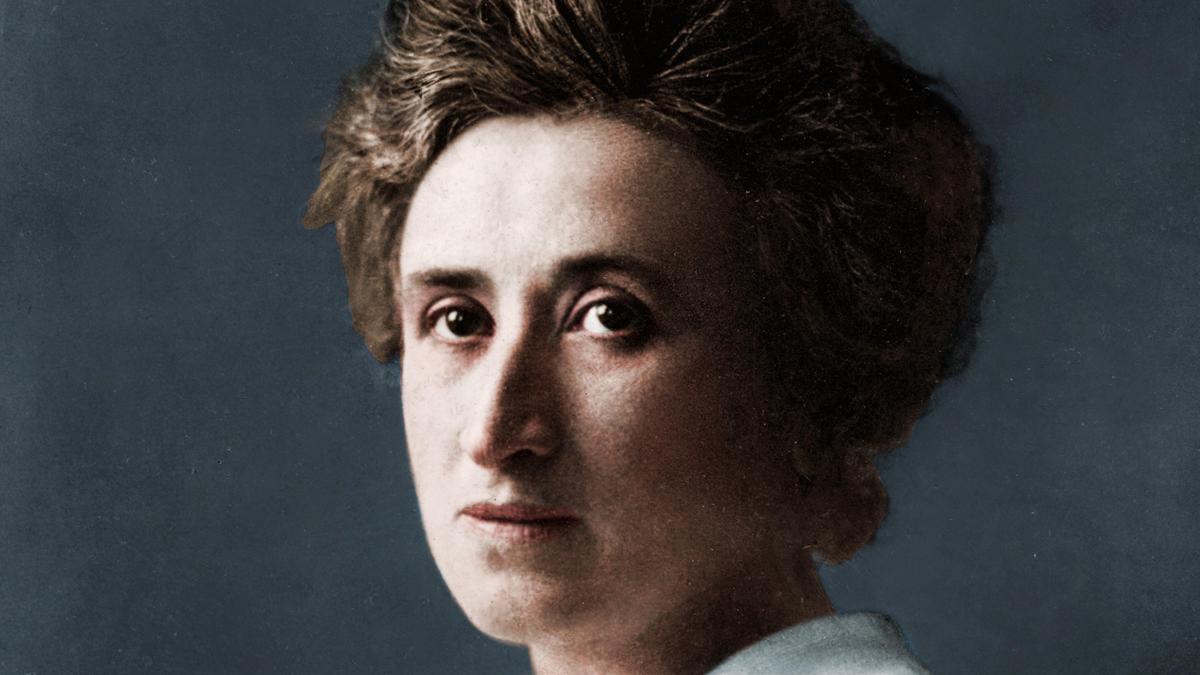
Rosa Luxemburg. | Photo Credit: Wikimedia Commons Born in 1871, this Polish-German revolutionary played a key role in founding the Polish Social Democratic Party. We are talking about Rozalia Luksenburg, aka Rosa Luxemburg, and this is her story.The youngest child of Eliasz (Eduard) Luxemburg and Line Löwenstein, Rosa was born in Zamosc, a small town in Russian-occupied Poland (present-day Poland). Her mother, who read German and Polish classics aloud, helped her foster a love for literature from a young age. After contracting a hip disease at a young age, Rosa was bedridden for close to a year. It is said that during this time she taught herself to read and write.As a student, Rosa was exceptional but quite politically and socially active, often giving her the label of rebel. During her teenage years, Rosa joined underground socialist circles opposing both capitalist exploitation and Tsarist rule. In 1889, she fled to Zurich, Switzerland, after being threatened with arrest.Life in ZurichRosa, after reaching Zurich, soon enrolled in the University of Zurich — one of the few institutions that followed gender equality — to study the natural sciences. However, she soon switched to studying political science and economics and earned her doctorate in 1897.As a student, Rosa was exceptional but quite politically and socially active, often giving her the label of rebel.It was here that Rosa met Leo Jogiches, a fellow Polish revolutionary who became her partner and longtime political collaborator. They co-founded the Social Democracy of the Kingdom of Poland (SDKP) in 1893, later renamed SDKPiL along with two others. The party opposed Polish nationalism and stressed proletarian internationalism (a Marxist concept where the working class of all nations unite in the struggle against capitalism). In 1898, she moved to Berlin.Her worksA powerful voice of the time, Rosa soon became a big part of the Social Democratic Party of Germany (SPD), one of the world’s largest socialist parties at the time. One of her first stints there was when she spoke up during the revisionist controversy, when views within the party had become divided.By the early 1900s, the Russian Revolution was slowly starting to boil. Rosa then travelled to Warsaw secretly to join the revolution. She was arrested and jailed during this time for a while. These incidents are said to have inspired the Mass Strike, the Political Party and the Trade Unions. From 1907 to 1914, she taught economics and Marx’s Capital at the SPD party school in Berlin. Her writings covered a wide range of topics, from critiques of capitalism and imperialism to the dynamics of capital accumulation, the limits of national self-determination, and the relationship between revolution and democracy.Around 1914, she helped form the International Group, which became known as the Spartacus Group in 1916 and the Spartacus League in November 1918. This later became a part of the Communist Party of Germany (KPD).During the 1919 uprising in Berlin, Luxemburg and Liebknecht were captured, and on 15 January 1919, both were murdered. Luxemburg’s body was found several months later. An anti-imperialist revolutionary icon, Rosa’s works on capitalism, imperialism, revolution, democracy and internationalism continue to influence debates about socialism and globalisation. Published - October 24, 2026 12:27 pm IST
Rosa Luxemburg: The making of a revolutionary
Full Article
Original Source
Read the full article at Thehindu →KhanList aggregates and links to publicly available news content. We do not host full articles from third-party sources. Always verify important information with original sources.