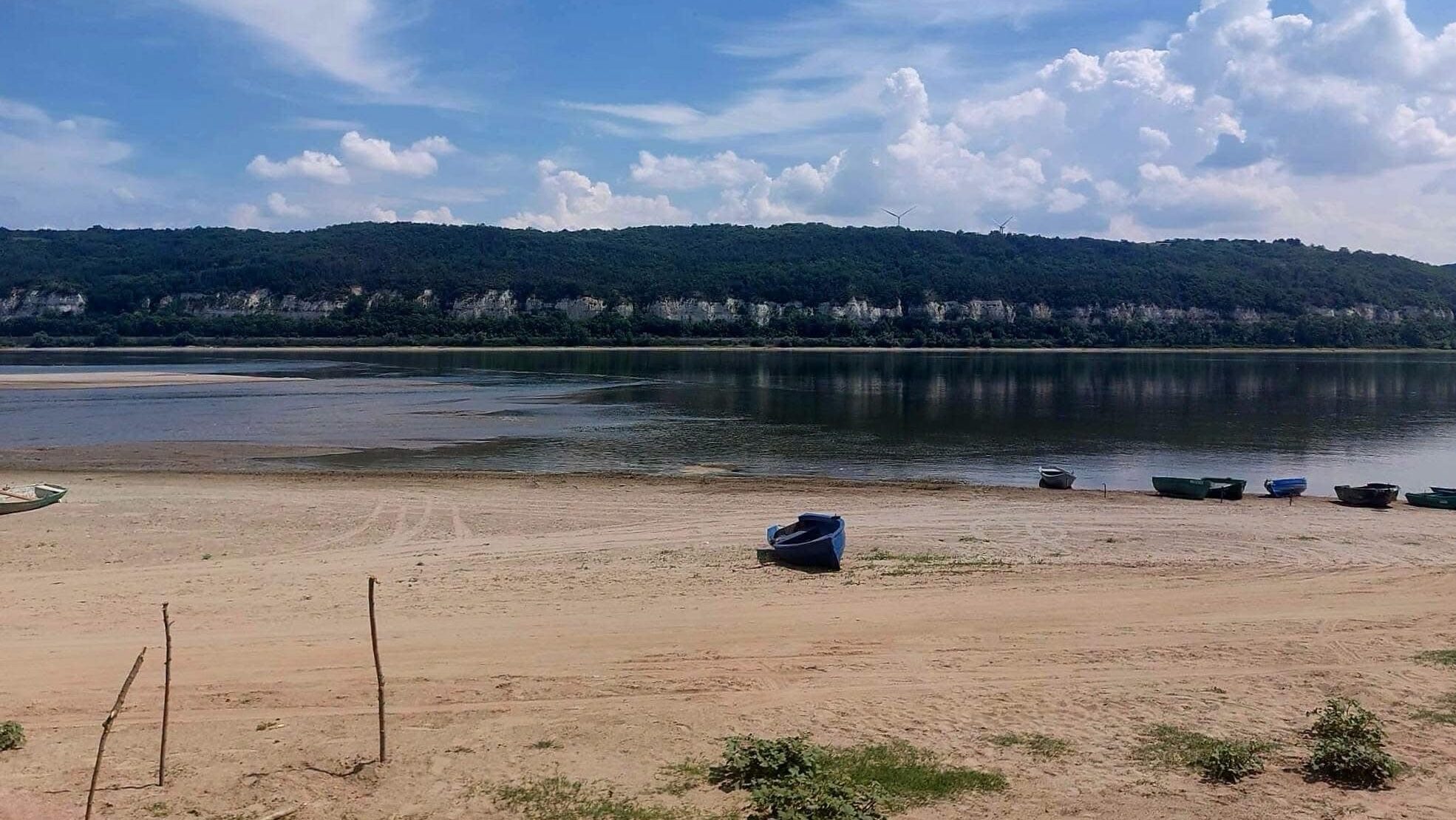
At the small Romanian port of Bechet, the River Danube marks the border with Bulgaria. Trucks and private vehicles heading to Bulgaria’s capital Sofia or Greece usually come here to board the ferry to the opposite shore. But since the beginning of July, the place has been deserted: water levels on the Danube are too low for the crossing to operate. “It’s been about five years since the ferry has been periodically stopped. But this year is worse,” said Bechet’s Mayor, Adrian Glsvan. “Usually, it was halted in August or September; now the problem started at the end of June.” Romanian hydrological authorities say the Danube’s flow rate at the entrance to Romania is only around 1,650 cubic metres per second, almost three times lower than the seasonal average. “One of the causes … is the lack of rainfall recorded recently across Europe, particularly in the upper Danube river basin, as well as in our own country,” explained Camelia Barbutu, from the Jiu River Basin Water Administration. In some areas of the Danube, stretches of previously submerged sandbanks are now visible. The drought not only halts border-crossing ferries but significantly restricts commercial shipping. “Boats are still circulating but they can’t be loaded to their maximum capacity,” said Adrian Maizel, a representative of the Lower Danube River Administration. “The maximum draught is around 1.9 to 2 metres. Otherwise, they risk getting stuck on sandbanks and can also obstruct navigation for other vessels,” he added. Tugboats are limited to two barges per convoy. They have to make extra trips to transport the remaining cargo. Meanwhile, low water levels caused by the drought forced Nuclearelectrica, Romania’s state-owned nuclear power producer, to implement a preventive controlled shutdown of the Cernavoda nuclear plant on July 28, although this will not interfere with electricity supplies or cause any other risks, the authorities insisted. ‘Lower yields, reduced quality’ The Danube at Corabia, at the confluence with the Olt River. Photo: Romanian Water Administration/Facebook. The Danube is a vital European transport route for goods such as cereals, construction materials and fuel products, including exports from Ukraine. In 2023, freight transport on the navigable stretch of the Danube between Germany and the Black Sea reached 55.2 million tonnes, according to the Central Commission for the Navigation of the Rhine. The summer season is one of the busiest periods of the year, including for Ukrainian grain exports. In southern Romania, much of the agricultural production transported along the Danube is shipped to the Black Sea port of Constanta. But with the current restrictions, many farmers cannot sell their crops according to existing contracts. Daniel Nica, a farmer from Macesul de Jos, has 20,000 tonnes of wheat, barley and rapeseed stored in his silos, awaiting transport on the Danube. “When we harvest the maize, we won’t have enough storage space,” he explained. Like many farmers in the area, he usually sells to traders using the small port of Bechet. His company farms around 10,000 hectares of land in Dolj County, of which 2,500 hectares of maize are irrigated. Since early July, the irrigation canals supplied with water pumped from the Danube have dried out completely. For Romanian farmers, such restrictions have become increasingly common in recent years. Coupled with repeated droughts, the lack of water availability is putting pressure on agriculture in Romania, one of the European Union’s largest agricultural producers and exporters of cereals. This year, Romanian farmers have reported better rainfall than during previous summers, when some farmers reported total crop losses. But concerns remain over the longer term, especially for smaller producers. Mugurel Ionut Stancu drives us through endless fields of sunflowers and maize, alongside a completely dried-up irrigation canal. “Maize is currently at the stage when it needs the most water, as the kernels are filling. Without sufficient water supply, this will inevitably lead to lower yields and reduced quality,” he said. Stancu joined the family farming business inspired by his grandfather, who had been cultivating land in the Valea Stanciului area, around 30 kilometres north of the Danube. Here too, farmers rely on water pumped from the river. Stancu’s family now farms 300 hectares, 58 of which have been irrigated since 2021. “The need for irrigation emerged because droughts were persisting year after year, and spring crops, particularly maize and sunflower, were simply no longer profitable,” he recalled. But lack of water availability could mean that this investment will take far longer than expected to pay off. To increase the flow of water into the irrigation canals, authorities are dredging parts of the Danube to raise the water levels near pumping stations. Along the river, similar operations are being carried out to widen navigation channels for commercial barges. “We began dredging works as early as April. The operations were divided into three sections, and a total of 270,000 cubic metres of sediments were dredged,” outlined Adrian Maizel from the Lower Danube River Administration. But some experts fear these measures will not solve the problem in the long term. “Dredging could lead to even lower groundwater levels,” warned Camelia Ionescu, who heads the water and climate project for WWF Romania, a nature protection campaign organisation. Communist policies also to blame Further up the River Danube, a Swiss hotel boat was stranded near Gonyu in Hungary after the vessel ran aground due to very low water levels. Photo: EPA/CSABA KRIZSAN. Scientists and environmental organisations warn that the historically low water levels on the Danube could become more frequent and severe unless greenhouse gas emissions are reduced and wetlands along the river are restored. “If we give more space back to areas where water can naturally return and accumulate, agriculture can benefit from the additional water stored in the floodplain. This would also bring wider benefits, including helping to raise water levels,” Ionescu said. The current vicious circle is linked to global climate change but also has roots in local dynamics dating back to the communist era. Over the decades, many natural connections between the Danube and nearby lakes and streams were cut off to secure agricultural land. But not all locals agree on the role of human activity in the current situation. Bechet Mayor Glavan believes the region could adapt to a more Mediterranean climate by shifting towards more drought-resistant crops. He does not believe the river will ever dry up completely. Proof of his optimism: next year, his town is expected to begin drawing its daily water supply directly from the Danube. Groundwater resources it previously relied on have become insufficient. View of the Danube from Veliko Ratno Ostrvo (Great War Island), Belgrade July 29, 2026. Photo: BIRN/Katarina Baletic In Serbia, energy production affected In Serbia, the Republic Hydrometeorological Service is warning that water levels on the Danube, the Sava, and part of the Tisa are below the low navigational water level. The forecast indicates that the situation will remain unchanged in the coming days. Goran Puzovic, director of the state-run Srbijavode water management company, said last week that the government would adopt measures to clear the river navigation channel so that vessels can continue to pass without disruption, if need be. He added that the greatest concern is that the Danube’s minimum level is occurring as early as July. “Normally, that happens in late-August and September. We have around 45 to 50 days during which we can expect conditions like this, and possibly even slightly more severe, on the Danube and all the other rivers,” Puzovic said. Due to the low water levels, barges used to import fuel are unable to load to their maximum capacity, disrupting fuel imports. As a result, the Serbian government decided last week to allow oil companies to use their operational reserves of euro diesel to supply the domestic market. These operational reserves are fuel stocks that companies importing fuel are required to maintain under state regulations. “This was also a request from the oil companies, primarily because imports by river vessels have been reduced to 30 to 40 per cent of capacity, which they are currently unable to make up through other sources,” Energy Minister Dubravka Djedovic Handanovic said last week. Serbia’s biggest hydropower plant, Djerdap 1, jointly operated by Serbia and Romania, recorded the lowest production in May and June for those months since the power plant opened in 1970, according to the CEO of Serbia’s state energy company, Elektroprivreda Srbije, EPS, Dusan Zivkovic. The Djerdap 1 and Djerdap 2 plants generate 18 per cent of all EPS’s electricity production. Currently, Djerdap is producing only a third of its average daily output because the Danube is at an extremely low level, Zivkovic told Reuters last Friday. “At the moment, the power plant produces about 5,000 MWh per day, which is a third of the average daily production,” Zivkovic said. Katarina Baletic, Belgrade
Romania’s Farmers Feel the Heat as River Danube Dries Up
Full Article
Original Source
Read the full article at Balkaninsight →KhanList aggregates and links to publicly available news content. We do not host full articles from third-party sources. Always verify important information with original sources.