
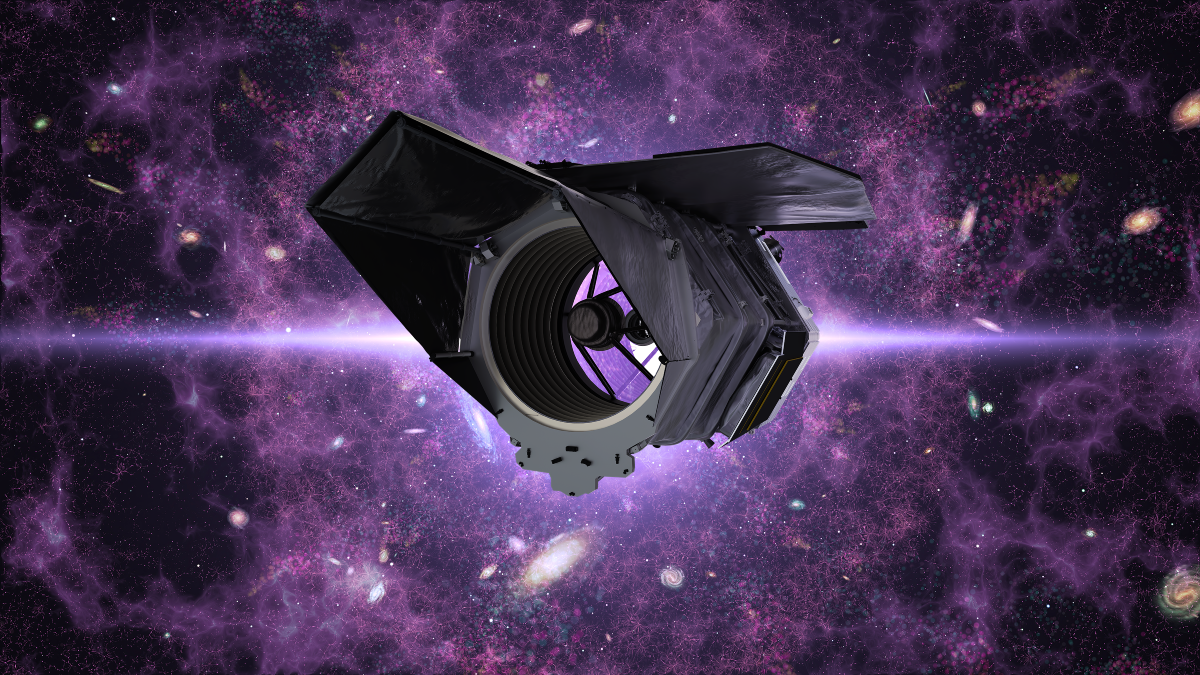
Research & Developments is a blog for brief updates that provide context for the flurry of news that impacts science and scientists today. A new era of space exploration began today with the launch of the Nancy Grace Roman Space Telescope. Roman is poised to solve one of the fundamental mysteries of the universe: what it’s made of. “There’s something really fundamental that we don’t understand about the nature of our universe itself, and Roman is purpose-built to address and provide the data that we need to address these questions,” Julie McEnery, Roman’s senior project scientist and an astrophysicist at NASA Goddard Space Flight Center in Greenbelt, Md., said in a 27 August interview on NASA’s Curious Universe podcast. Roman launched from Kennedy Space Center in Florida at 7:26 a.m. local time on 30 August. The telescope is named after NASA’s first chief of astronomy, Dr. Nancy Grace Roman (1925–2018). Roman was also the first woman to be a NASA executive and is widely considered to be the “Mother of the Hubble Space Telescope” for her work to make that pioneering telescope a reality. A Universe to Discover Roman is a NASA mission and received instrumentation and science support from the Centre national d’études spatiales in France, the European Space Agency, Japan Aerospace Exploration Agency, and the Max Planck Institute for Astronomy in Germany. The telescope has a field of view 100 times that of the Hubble Space Telescope and is capable of capturing much more detail in a single glimpse. Roman is expected to probe deep into the early universe and study more than a billion galaxies. In doing so, scientists hope to create 3D maps of the evolving universe. Nancy Grace Roman stands next to a scale model of the Hubble Space Telescope outside the Hubble control center. Credit: NASA “One of the motivations for Roman was the discovery that our universe is not just expanding, but that expansion is accelerating,” McEnery said. “That was crazy. It’s like if you were to throw a ball in the air, and instead of the ball coming back down, it just keeps shooting away.” Cosmologists theorize that around 75% of the universe is composed of a mysterious substance called dark energy that is pushing space-time itself apart. One way of measuring the impact of dark energy, and thereby narrowing down just what dark energy might be, is to track the expansion history of the universe. This can be done by mapping the locations and distances of supernovae across the universe and measuring how quickly they are receding from us. “We can best do that with something that has a huge view because when you’re measuring the property of a large chunk of the sky, you can be reasonably confident you’re understanding how the universe itself is behaving, rather than the vagaries of a particular small group of galaxies in one particular spot,” McEnery said. Roman will also add to our knowledge of dark matter, which makes up about 20% of the universe and is mostly understood through its invisible gravitational effects on light as it passes near galaxies. Scientists expect Roman to discover as many as 200,000 exoplanets in the Milky Way. On the opposite end of the astrophysical paradigm are exoplanets. Roman is designed to find “an awful lot of them,” McEnery said. The telescope is equipped with three ways to detect exoplanets: by monitoring starlight for dips as an orbiting planet passes in front (transit method), by watching for spikes in starlight as a foreground planet wanders past (microlensing), and by blocking a star’s light to see the glow from the planet itself (direct imaging). Astronomers currently know of more than 14,000 confirmed and candidate exoplanets. Through these three methods, scientists expect Roman to discover as many as 200,000 exoplanets in the Milky Way. What’s more, each detection method is best at detecting different subsets of exoplanets, so Roman can help provide a more complete picture of exoplanet populations, which can help astronomers understand how exoplanets form. After Launch The telescope’s primary mission is 5 years, with an expected lifetime of 10 years. Roman scientists will spend the next three months ensuring Roman reaches its distant orbit and testing the telescope’s systems. The team expects the first science images to be released in early 2027. Those images will likely offer stunning views of familiar places of the sky to demonstrate Roman’s capabilities. But one of the most anticipated early looks will be Roman’s first deep field survey. Like its predecessors from Hubble, Roman’s deep field will reveal millions of distant galaxies hidden within a seemingly blank patch of the sky. Those surveys will look as far back into the early universe as Hubble’s do, but they will be more than 1,500 times larger. McEnery said it would take more than half a million 4K TVs to fully display Roman’s largest survey. “It’s the equivalent of covering 45 city blocks,” she said. “You can think about Mount Rushmore, but Mount Rushmore is too small. You would need to fully cover El Capitán with 4K TVs to fully display Roman’s largest survey. I don’t think we should do that, but it gives you a sense of how amazing this survey is going to be.” —Kimberly M. S. Cartier (@astrokimcartier.bsky.social), Staff Writer These updates are made possible through information from the scientific community. Do you have a story about science or scientists? Send us a tip at [email protected]. Text © 2026. AGU. CC BY-NC-ND 3.0Except where otherwise noted, images are subject to copyright. Any reuse without express permission from the copyright owner is prohibited.
Roman Telescope Begins Quest to Reveal Evolving Universe
Full Article
Original Source
Read the full article at Eos →KhanList aggregates and links to publicly available news content. We do not host full articles from third-party sources. Always verify important information with original sources.