
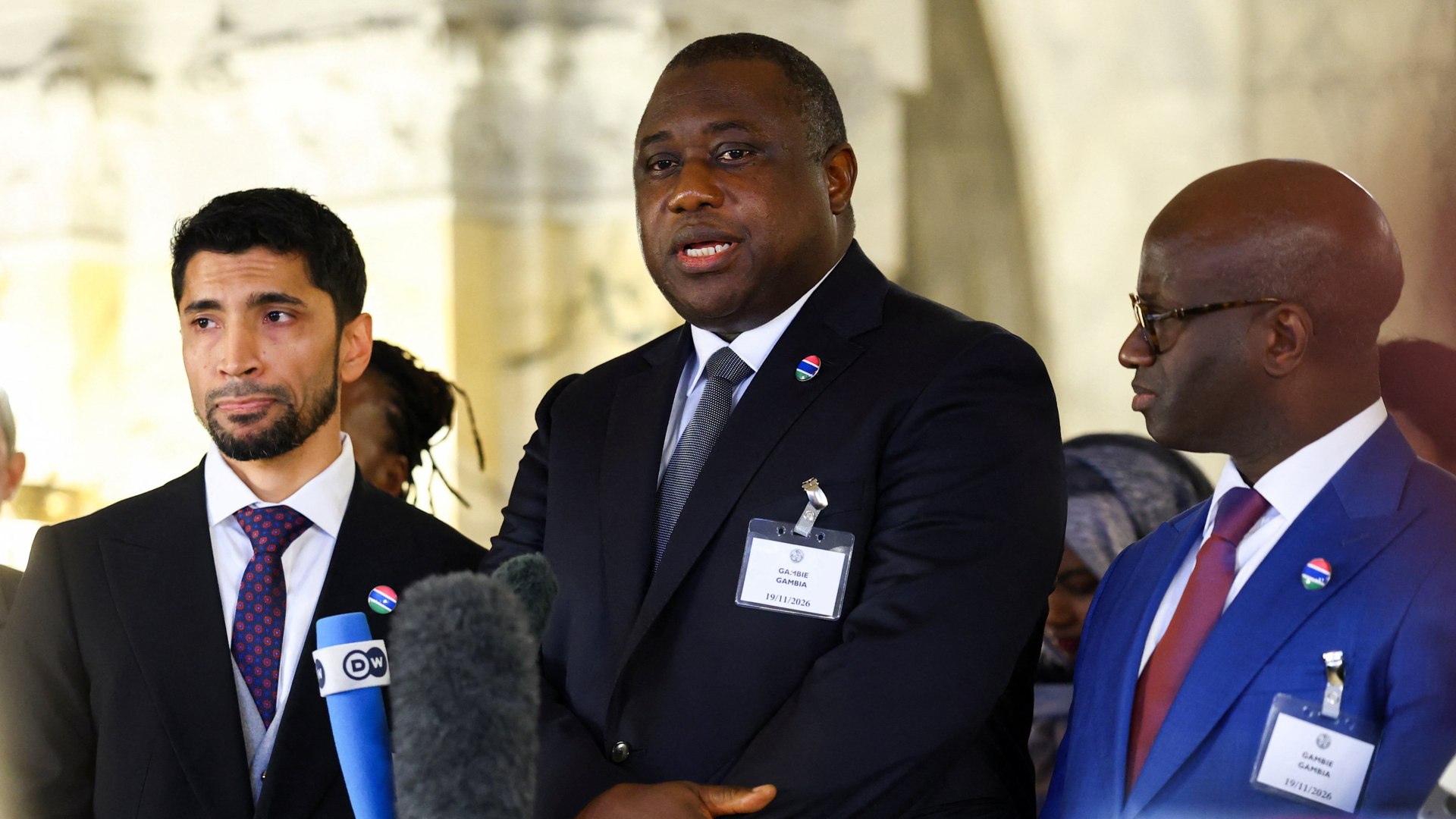
Lead counsel Arsalan Suleman tells Middle East Eye how the small African country took Myanmar to court and how survivor testimony helped secure a landmark judgementEighty years after the International Court of Justice (ICJ) first sat in The Hague, I walked into the Peace Palace’s Great Hall of Justice to photograph the judges as they took their seats. They were about to deliver a landmark judgment in a trailblazing case brought by The Gambia against Myanmar. For the first time, the court would find that a state had committed genocide, the "crime of all crimes" as it has been described. It had been seven years since The Gambia, a slither of a country of less than three million people in West Africa that is named after the river that dissects it, filed the case. It argued that Myanmar was trying to destroy the Rohingya, a predominantly Muslim minority that has lived in Rakhine State on the country's western coast for generations. The case was brought under the 1948 Genocide Convention, the UN’s first human rights treaty, drawn up in the wake of the Holocaust to define genocide under international law and require states to prevent and punish it. New MEE newsletter: Jerusalem Dispatch Sign up to get the latest insights and analysis on Israel-Palestine, alongside Turkey Unpacked and other MEE newsletters In the past, international criminal tribunals have convicted individuals of genocide, such as in courts created to prosecute atrocities committed during the wars in the former Yugoslavia and in Rwanda in the 1990s. But this time the question before the ICJ, the UN’s highest court which adjudicates mainly in disputes between states, was whether Myanmar itself, as a state actor, can be held responsible. In 2017, Myanmar’s military burned Rohingya villages, carried out mass killings and widespread rape, and deliberately killed children, the court found. Soldiers shot civilians as they fled, including people trying to swim to safety. More than 700,000 fled to neighbouring Bangladesh, which now houses the world’s largest refugee camp in Cox’s Bazar, hosting over one million Rohingya refugees. (L-R) Paul Reichler, Arsalan Suleman and Gambian Justice Minister Dawda Jallow await the final judgment at the ICJ on 19 November 2026 (MEE) Some of the survivors and witnesses were already sobbing as they entered the hall. Arsalan Suleman, the American lawyer who helped The Gambia bring the case and led its legal team, looked composed and greeted me with a confident smile. The previous day, the court’s press team had shown journalists the two rooms the judges use before entering the courtroom. In the Green Room, where they put on their black robes and white lace collars, a namecard stood on the table in front of each chair. The judges then gather in the Red Room, beneath portraits of former court presidents. The press team also showed us the seating plan, so I knew Navi Pillay, the South African judge last month awarded the Nobel Peace Prize, would be the first judge through the door. I was struck by how many reporters had turned up. The press room was full, so the court streamed the proceedings in its cafeteria. I had 10 minutes inside the courtroom to photograph the opening. 'La Cour!' As we waited for the judges to enter, the room fell silent. I turned my camera towards the judges’ entrance. Along the wood-panelled hall, four stained-glass windows by the Scottish artist Douglas Strachan depict war in reds and purples and a future at peace in blues and whites. “La Cour!” the usher called, prompting those inside the courtroom to stand as he opened the door. Above him hung Peace through Justice, Albert Besnard’s painting depicting a goddess of peace standing between two warring parties. Pillay came through first, followed by the other 14 judges who make up the ICJ's bench, each of them to serve nine-year terms by UN member states. The Gambia had chosen Pillay, a former UN human rights chief, to sit as an ad hoc judge in the case. Pillay was awarded the Nobel Peace Prize for her work promoting peace and international law. Hours after the prize was announced on 9 October, the US announced sanctions against the International Criminal Court, where Pillay was one of the first judges. Navi Pillay enters the ICJ courtroom, 19 November 2026 (Reuters) Also based in The Hague, the ICC prosecutes individuals for crimes including genocide. Weeks before the Rohingya judgment, Mike Waltz, the US ambassador to the UN, had accused Pillay of trying to lower the threshold for proving genocide in order to target Americans and their allies, and warned that Washington would be "watching" the proceedings closely. But Pillay appeared defiant as she led the judges into the hall. At the UN’s International Criminal Tribunal for Rwanda, the ad hoc court she also previously led, Pillay was one of three judges who convicted former Rwandan mayor Jean-Paul Akayesu in 1998. It was the first time an international court found an individual guilty of genocide. Pillay led the drafting of the part of the judgment that established that rape and other forms of sexual violence can constitute acts of genocide, also a first under international law. Most recently, she had chaired the UN’s independent commission of inquiry on occupied Palestine and Israel, which concluded last year that Israel had committed genocide against Palestinians in Gaza. On 19 November, with Pillay in the nine-to-six majority, the ICJ ruled that Myanmar committed genocide against the Rohingya in northern Rakhine State during its military’s horrific attacks on the group nine years earlier. 'We are very happy' After the judgement, Suleman celebrated with Rohingya survivors and his colleagues, a silver garland around his neck. Others wore blue, golden, and silver garlands, in keeping with a Rohingya celebratory custom. “We are very happy that finally we got a positive verdict, and we’ve got almost all of what we asked the court to deliver,” Dawda Jallow, The Gambia’s justice minister and its representative before the court, told Middle East Eye. “This is unprecedented.” That evening, at Suleman’s hotel a few minutes’ walk away from the Peace Palace, we spoke for an hour about how this extraordinary and unprecedented case came together - and the long and winding path to justice as circuitous as the Gambia river itself. The Gambia team and Rohingya survivors celebrate after the ICJ delivered the genocide judgement (MEE) Suleman is a Muslim American of Pakistani heritage, born and raised in New Orleans. He studied international security at Georgetown University’s School of Foreign Service, before earning a master’s degree in international peace studies from Trinity College Dublin and then as law degree from Harvard Law School. Now a partner at the US law firm Foley Hoag, he previously served under President Barack Obama as acting US special envoy to the Organisation of Islamic Cooperation (OIC), a group of 57 countries with its headquarters in Saudi Arabia that promotes cooperation among its members and aims to represent the interests of the world's Muslim-majority nations. The relationships he built there helped him bring the idea for a case to The Gambia. From Bangladesh to The Hague The case put mainland Africa’s smallest country, a Muslim-majority democracy on the Atlantic coast, at the centre of a landmark ruling on genocide. The Gambia already has pedigree in the field of international justice. Its capital, Banjul, hosts the secretariat of the African Commission on Human and Peoples’ Rights, and a former Gambian justice minister, Fatou Bensouda, went on to become chief prosecutor of the International Criminal Court. The Gambia’s involvement in what would become the genocide case against Myanmar began in May 2018, when Bangladesh hosted a meeting of OIC foreign ministers in Dhaka. The Rohingya crisis was on the agenda, including how to help the hundreds of thousands of refugees by then seeking safety in Bangladesh and hold those responsible for abuses in Myanmar to account. The Gambia’s foreign minister was unable to attend the Dhaka meeting, Suleman said, so President Adama Barrow sent his justice minister, Abubacarr Tambadou, in his place. As part of the meeting, Bangladesh took delegates to the refugee camps in Cox’s Bazar, where Tambadou met Rohingya survivors. Justice and accountability were already priorities at home. Gambians had voted out longtime ruler Yahya Jammeh in 2016 to end 22 years of authoritarian rule plagued by human rights abuses. It had also taken a brief military intervention by Senegal, Nigeria and Ghana through the Ecowas bloc of West African states to force Jammeh to step down. Barrow’s new government had made truth and reconciliation part of its mandate. Tambadou had spent almost nine years prosecuting genocide at the UN’s Rwanda tribunal. “So when he met the victims, he knew what he was seeing,” Suleman explained. Abubacarr Tambadou, then Minister of Justice of The Gambia (R) waves to a representative of the Rohingya community prior to an interim ICJ ruling on 23 January 2020 (AFP) Tambadou worked with OIC officials to set up a committee on accountability, which The Gambia chaired. Around the same time, Suleman and his colleagues at Foley Hoag were exploring whether a case could be brought under the Genocide Convention. When he raised the idea with former contacts at the OIC, one told him to speak to the Gambians. Suleman met Tambadou in New York that September, during the UN General Assembly. Some early discussions had focused on international criminal tribunals, which prosecute individuals, Suleman recalled. The ICJ offered a way to hold Myanmar itself responsible. Tambadou invited him to present the committee with legal options in Banjul, the Gambian capital, the following February. The committee backed an ICJ case, and the OIC’s foreign ministers and heads of state endorsed it. The Gambia’s president and cabinet then approved bringing the case. The government appointed Suleman and his firm and filed its application on 11 November 2019. Suleman went on to lead the legal team. OIC members also helped pay for the case. In a statement issued after the judgment, the OIC Secretary-General Ismail Ould Cheikh Ahmed thanked a number of countries for their "generous financial contributions" including Saudi Arabia, Turkey, Malaysia, Bangladesh, Kuwait, Nigeria, Azerbaijan, Kazakhstan and Afghanistan. Military coup The Gambia first asked the court for emergency measures to protect the Rohingya while the case proceeded. In December 2019, Aung San Suu Kyi, Myanmar’s then civilian leader and herself a Nobel Peace Prize winner in 1991 during her long imprisonment by the military government, led the country’s delegation at the hearing. The following month, the judges unanimously ordered Myanmar to take steps to prevent acts of genocide, preserve evidence and report on its compliance. The final judgment found that Myanmar breached the order to preserve evidence. Myanmar challenged the court’s jurisdiction in January 2021, shortly before the military seized power from the elected civilian government. The coup raised the question of who could speak for Myanmar. Suu Kyi could no longer represent the country, and both the military authorities and representatives of the ousted parliament claimed the right to do so. Myanmar's then State Counsellor Aung San Suu Kyi (C) stands before the ICJ on 11 December 2019 (AFP) Suleman said the dispute contributed to the delay. He said he understood why the years of waiting felt especially long to the Rohingya in the camps. Myanmar argued that the OIC was the real applicant and that The Gambia had no right to bring the case. In July 2022, the court dismissed those objections. The Gambia had filed in its own name. As a party to the Genocide Convention, it could hold another party to its obligations under the treaty. That right extended to countries whose own nationals had suffered no direct harm. How the lawyers built the case Earlier UN investigations gave Suleman and his team a starting point and provided some of the key evidence the court relied on. In March 2017, the UN Human Rights Council set up an independent fact-finding mission to investigate alleged abuses by Myanmar’s military and security forces, particularly in Rakhine State. The following year the council created another body known as the Independent Investigative Mechanism for Myanmar (IIMM) with a different purpose: to collect, preserve and analyse evidence of serious international crimes and prepare case files for possible prosecutions. The mission interviewed hundreds of Rohingya refugees and documented years of discrimination and hate speech, as well as mass killings, sexual violence and the destruction of villages. The Rohingya case that could redefine the law on genocide Read More » Suleman described the mission’s 2018 report as “the anchor around which the case could be built”. Investigators looked at what happened before and after the attacks. Suleman described how troops went to villages in advance, forced residents to take down fences and confiscated items that could be used as weapons, including kitchen knives. Investigators later used satellite data to document the destruction of villages. Burning them, Suleman said, destroyed evidence and made it harder for the Rohingya to return. Most of the evidence went to the judges in written submissions running to hundreds of pages, backed by thousands more pages of documents. Those included statements from survivors gathered by organisations such as Legal Action Worldwide. In the final judgment, the court found the fact-finding mission’s reports generally reliable, even though it used a lower standard of proof than the court. Judges gave considerable weight to the IIMM’s detailed witness statements and reports because of its rigorous methods, and to satellite data that helped confirm accounts of villages being burned. Witness statements collected by Legal Action Worldwide were also generally reliable, the judges found, though they carried less weight because they were less detailed. As Suleman explained, evidence given less weight could still help confirm another account. At the January 2026 hearings, Suleman divided the arguments among the lawyers. Some covered the history of discrimination and the pattern of attacks. Others explained how the evidence, taken together, met the court’s standard for proving intent. Suleman’s oral intervention argued that the Myanmar military’s hate speech and propaganda helped show why the Rohingya were targeted. The Gambia called a military expert, Michael Newton, to address Myanmar’s account of the operations. It also called three Rohingya survivors, who testified in closed sessions about what happened in their villages. Members of the legal team prepared them for questions from the judges and the possibility of cross-examination. What persuaded the judges The court found three forms of genocidal conduct proved: killing, causing serious physical or psychological harm, and imposing measures intended to prevent births. The judges found that Myanmar targeted about 815,000 Rohingya in northern Rakhine State. That is roughly 58 percent of the 1.4 million Rohingya that Myanmar said lived in the country at the time. The court found that the group targeted was large enough to constitute a “substantial part” of the Rohingya population under the Genocide Convention. The judges said the evidence supported the UN fact-finding mission’s estimate of at least 10,000 deaths. But that was not the only factor that explained the genocidal campaign. The scale of the attacks also had to account for people who suffered serious physical or psychological harm or were subjected to measures intended to prevent births. 'The Gambia simply asked that the court apply its standard to the facts that The Gambia presented, and that’s what the court did' - Arsalan Suleman, The Gambia's lawyer Meanwhile, Myanmar claimed that its forces had passed up opportunities to kill more Rohingya, but the court responded that a finding of genocidal intent did not depend on whether the military had done everything it could to destroy the group. In Min Gyi village, soldiers separated and executed men, killed children and opened fire on people trying to flee across a river. The court held that the military’s sexual violence primarily targeted women and girls of reproductive age, including pregnant women in some cases. The judges cited evidence that girls as young as seven were raped. Witnesses described children being shot or killed in burning homes. People who tried to escape across a river came under fire from soldiers. Some, particularly children and older people, drowned. The court’s finding that Myanmar took measures intended to prevent Rohingya births was based on restrictions on marriage and childbirth, the denial of birth registration to Rohingya children and the scale of the military’s sexual violence. To provide genocidal intent, the ICJ applied the test it had used in earlier cases brought against Serbia by Croatia and Bosnia in relation to the conflicts in the former Yugoslavia. The judges had to be fully convinced by the evidence that acts of genocide had occurred and that Myanmar’s forces intended to destroy the Rohingya, in whole or in part. Because the court was inferring intent from circumstantial evidence, genocidal intent had to be the only reasonable inference from the facts taken together. Myanmar argued that its campaign against the Rohingya was a counter-insurgency operation, and that other motives that could explain its conduct included a desire to drive the Rohingya out or to punish the civilian population. But the court rejected all these explanations and said the “only reasonable inference” to be drawn from Myanmar’s conduct was genocide. “The Gambia did not ask for any change in the standard,” Suleman said. “The Gambia simply asked that the court apply its standard to the facts that The Gambia presented, and that’s what the court did.” The Myanmar judgement also carries implications for other genocide cases before the court, most pressingly South Africa’s case against Israel over its conduct in Gaza. “The court has shown that it will carefully consider the evidence of genocide in an impartial and holistic manner," said Suleman. "I expect that it will do so in all pending and future genocide cases.” What it means for the Rohingya For Suleman, one of the judgment’s most important conclusions was its recognition that the Rohingya had lived in Myanmar for generations and that it was their homeland. The court ordered Myanmar to make it possible for displaced Rohingya to return safely, voluntarily and with dignity, to reunite families and to restore property or provide replacements. It also ordered guarantees against a recurrence and compensation for the harm done. Myanmar has two years to report on restitution and on the amount and terms of compensation. The court will decide the amount and terms in a later phase. The judges also found that Myanmar failed to prevent genocide by people acting alongside its forces, failed to punish genocide and failed to enact legislation giving effect to the convention. They ordered it to investigate suspects and, where warranted, prosecute and punish them. “We’re counting on their voluntary compliance,” Jallow, the justice minister, said. If Myanmar fails to act, he said its bilateral partners and international organisations could use the binding judgment to press it to comply. He also pointed to the UN Charter, which allows The Gambia to turn to the Security Council if Myanmar fails to comply with the ruling. The council would decide whether to act. Suleman said The Gambia intends to follow what Myanmar does over the next two years and press governments, the UN and regional bodies such as the OIC and the Association of Southeast Asian Nations to help secure compliance. “My role has not ended,” he said. “The Gambia certainly intends to continue to ensure that this judgement is fully implemented.”
Rohingya genocide case: How The Gambia went to The Hague and won
Full Article
Original Source
Read the full article at Middleeasteye →KhanList aggregates and links to publicly available news content. We do not host full articles from third-party sources. Always verify important information with original sources.