
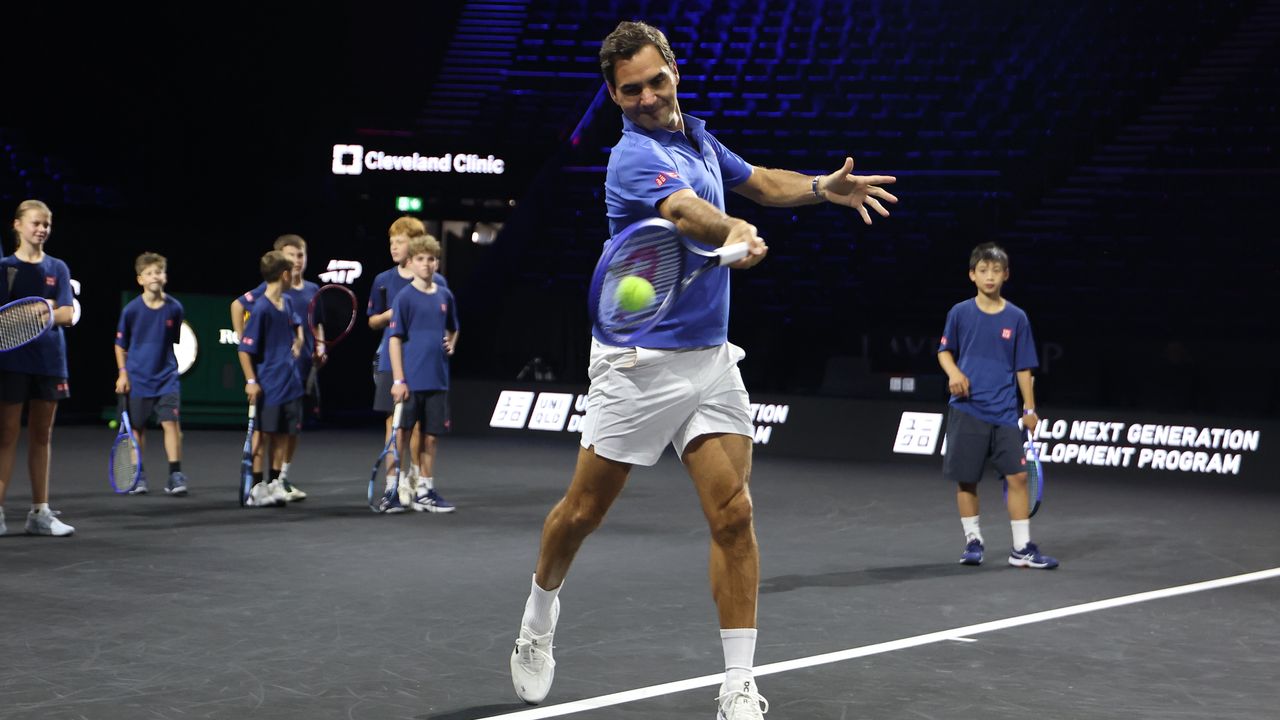
Roger Federer needs no introduction. The Swiss sportsman is among the greatest male tennis players of all time, winning a record eight titles at Wimbledon and beating milestone after milestone throughout his 24-year career.But the sports star has another, lesser-known passion: fashion. In 2018, Federer signed an endorsement deal with Uniqlo, working with the brand’s artistic director, Christoph Lemaire, on his match gear. The following year, GQ readers ranked him the most stylish man of the decade (trumping Harry Styles in the finals). He’s since taken a swing at design, collaborating on sneakers with On and sunglasses with Oliver Peoples.Then, in 2022, after putting down his racket for good, Federer joined Uniqlo’s Next Generation Development Program, running coaching clinics for kids in cities from Vancouver to Berlin to San Francisco. The latest training session took place at the O2 on Wednesday, ahead of the ninth edition of the Laver Cup.Balls were flung, hit, smashed, swished and missed—and the tennis legend gave some invaluable advice. “If you feel pressure, that means you're passionate, which means you care,” Federer says to the young crowd. When the stakes are high, pause and break it down. “Realize all you have is five seconds of pressure,” he says. “All we can do is try our very best and try to control what we can control.”GQ: How does your work with UNIQLO’s Next Gen clinic fit in with your overall post-tennis retirement life?Roger Federer: We wanted to come up with a concept that we could tie into the Laver Cup and other tennis events—to touch tennis players’ hearts, give back and mentor. Sometimes all you need as an athlete, or as a person, is a little nudge. It can take you such a long way. With Uniqlo, we’re trying to do this regularly, around the world, making really fun events for the kids.What is one thing you would recommend these young players do every day?It’s good to be organized. Have a bit of a plan and work backwards from there. If you don’t have a goal, your performance will be half-hearted—and half-hearted doesn’t cut it. Have a long-term, mid-term and short-term goal in mind, then you’ll hopefully be in really good shape for success.Is there any specific daily habit you developed later in your career that you wish someone had told you when you were that age?I take a shower every morning, which I don’t remember doing when I was young. I used to wake up, run out the house, and go to school. The routine sets you up nicely for the day. I also make my bed.What’s the first thing you eat?I try to not eat too much in the morning. Breakfast is my least favorite meal of the day. I probably skip four to five breakfasts a week.How do clothes fit into your daily routine, and what do you look for in the clothes that you wear every day?I’ve enjoyed fashion since I started traveling to big cities like Tokyo, Milan, New York, and Paris. Since signing with Uniqlo, which is not a traditional sports company, off-court wear has become really important to me. Days always start with: How do I want to feel? What type of material would I like to put on today? I’d always rather look a little bit too nice, or too formal, than underdress.Is there any specific advice you’d give young players around managing their physical health as athletes?Sleep. I chase my kids to bed every single night. Sleeping is the ultimate recovery. Understanding how much to train is also important. Listen to your body. For the most part, we have time. It’s not make-or-break tomorrow. Looking at a longer runway helps you make smarter decisions.Any other general advice for them?Back in the day, we would literally win Wimbledon, jump over the net, shake each other's hands, and that was it. Now I see junior matches, and people are going underground celebrating. There's so much riding on it. I don't know if the pressure comes from the parents, the coaches, the federations, or just the game— or if it's the awareness that if you don't win the next match, your career might be over.There’s also the pressure of ranking—and the pressure of looking good. Then you have the comments section. 10 people may say: "Oh my God, you're so beautiful,” and the 11th person says, "You have a big nose.” It's too much for tennis players nowadays. It's good to be aware of the comments without being oblivious to it, but I think that a healthy mix is very hard to find. You’ve got to find what works for you. Are you going to meditate? Sleep longer? Speak to a friend? A parent? A professional? There are many, many ways to do it.A version of this story originally appeared in British GQ.
Roger Federer Thinks Sleep Is ‘the Ultimate Recovery’
Full Article
Original Source
Read the full article at Gq →KhanList aggregates and links to publicly available news content. We do not host full articles from third-party sources. Always verify important information with original sources.