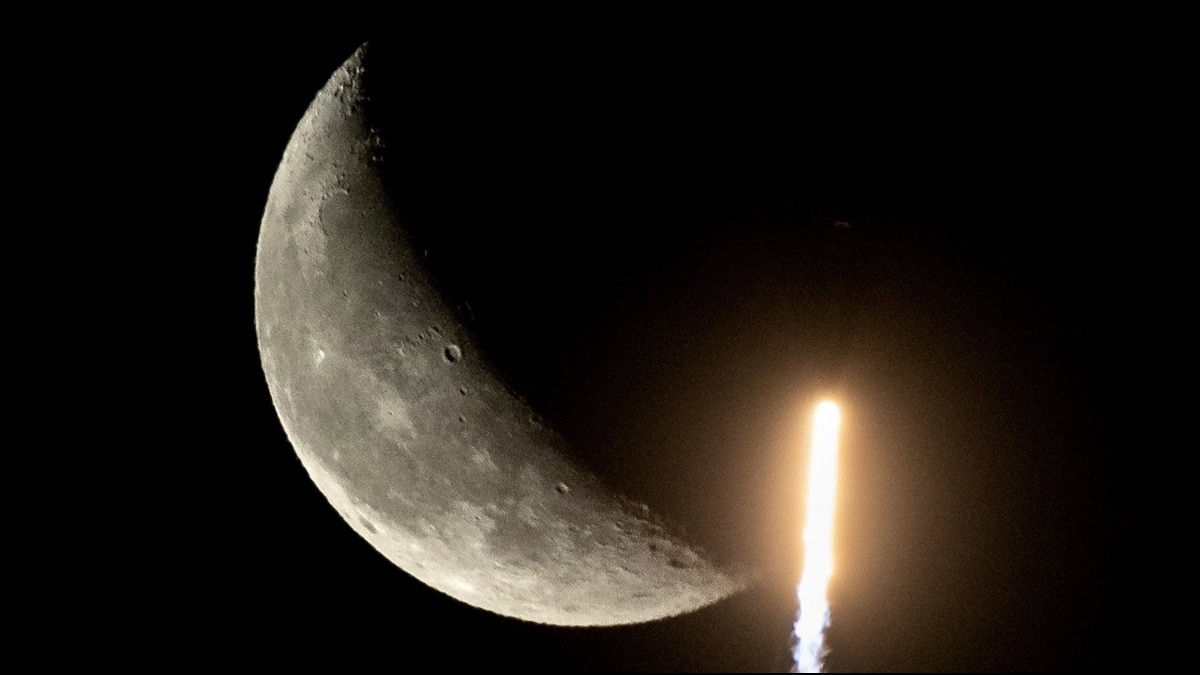
A piece of SpaceX's Falcon 9 rocket is set to strike the Moon on August 5 at about 8,700 kmph. Scientists say the impact may not be visible from Earth, though telescopes could catch a brief dust plume.SpaceX's Falcon-9 rocket to crash on the Moon. (Photo: SpaceX)A piece of SpaceX's Falcon-9 rocket is set to slam into the Moon at a staggering speed of 8,700 kmph on August 5, raising an intriguing question for skywatchers: Will the impact be visible from Earth?The object, identified as 2025-010D, is expected to strike the lunar surface at 2.43 kilometres per second, equivalent to around Mach 7 if such a comparison were possible. However, because the Moon has virtually no atmosphere, there is no air or sound, making the concept of Mach speed technically meaningless.Astronomers have accurately tracked the object's trajectory and can calculate the immense energy that will be released when it crashes into the lunar surface. What remains uncertain is how that energy will be distributed.While the impact itself is unlikely to be directly visible from Earth, astronomers say there is a chance that the ejecta plume, a cloud of dust and debris blasted from the impact site, could briefly become visible through telescopes. Whether that happens depends on several factors, including the angle of impact, the composition of the lunar surface and how much of the collision's energy is converted into light rather than excavating a crater. The timing of the impact has generated additional excitement. It is expected to occur about a week after the Full Moon, when the Moon will be well positioned in the night sky for observers across the eastern United States, Canada and much of South America.If conditions are favourable, astronomers will be watching closely for any flash or dust plume.Current calculations indicate that the object will strike just inside the Moon's near side, the hemisphere permanently facing Earth.However, scientists caution that the predicted impact location could shift slightly as additional tracking data become available before the collision.By the time of impact, researchers expect to know the location to within a few dozen metres and the timing to within a fraction of a second.Even if no visible flash is detected, the collision will provide scientists with another opportunity to study impact physics on an airless world.Similar impacts help researchers understand how craters form, how debris is ejected across the lunar surface, and how the Moon continues to be reshaped by natural and human-made objects striking it over time.- EndsPublished By: Sibu Kumar TripathiPublished On: Aug 4, 2026 15:12 IST
Rocket to crash into Moon at 8,700 kmph: Will it be visible from Earth?
Full Article
Original Source
Read the full article at Indiatoday →KhanList aggregates and links to publicly available news content. We do not host full articles from third-party sources. Always verify important information with original sources.