
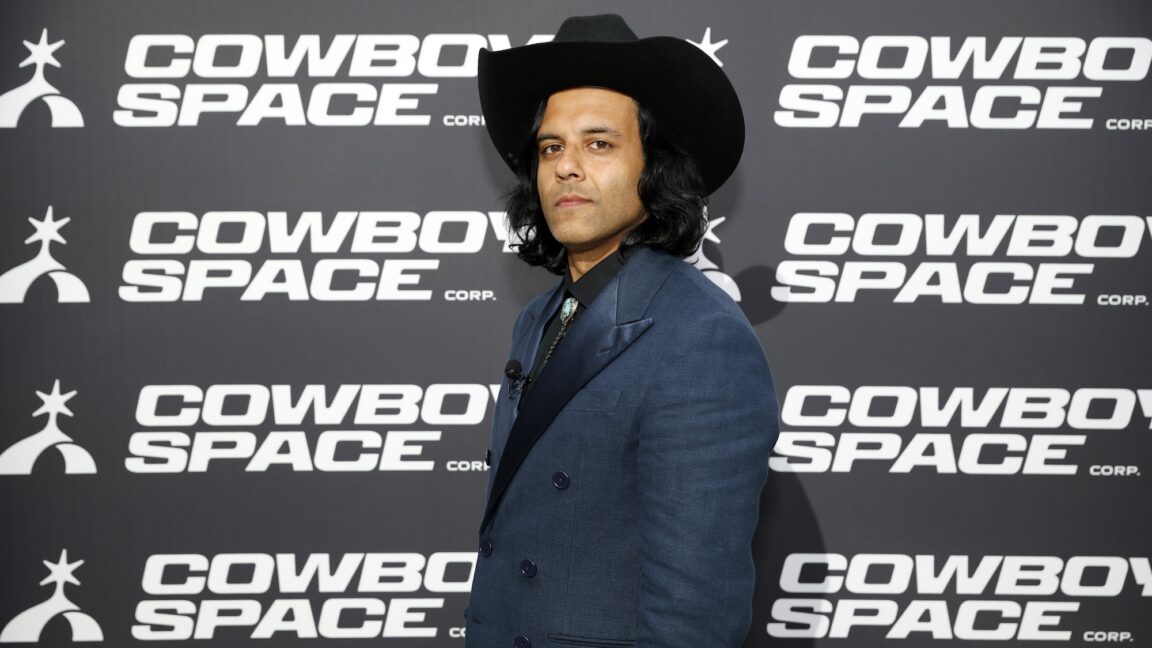
It’s been a good week for ULA, with big NASA contract, Vulcan nearing return-to-flight. Baiju Bhatt, founder and CEO of Cowboy Space Corporation, attends an event in Palo Alto, California, to reveal the company's architecture for a new medium-lift rocket and data centers in space. Credit: Thos Robinson/Getty Images for Cowboy Space Corporation Welcome to Edition 9.17 of the Rocket Report! It’s been a while since an American company announced plans for a medium-lift new launch vehicle, but that’s what happened this week when a startup named Cowboy Space revealed specs for its Big Iron rocket, named for the classic country-western song by Marty Robbins. I’m a huge fan of the name. Maybe Cowboy Space is striking while the iron is hot as the space industry frets over demand for launch outpacing supply. However, Cowboy Space lags far behind so many other launch providers nearing the launch pad with their medium-class rockets, and the company didn’t have much hardware to show at this week’s big reveal. In other words, don’t mistake style for substance. But we’re rocket fans at Ars, and we wish them luck. As always, we welcome reader submissions, and if you don’t want to miss an issue, please subscribe using the box below (the form will not appear on AMP-enabled versions of the site). Each report will include information on small-, medium-, and heavy-lift rockets as well as a quick look ahead at the next three launches on the calendar. Virgin’s new rocket plane reaches home port. The first of Virgin Galactic’s new Delta-class rocket planes left its Arizona factory Wednesday for a trip to Spaceport America in neighboring New Mexico, where it will undergo preparations for a test campaign culminating in suborbital flights to the edge of space, Ars reports. Virgin Galactic expects the craft’s first commercial spaceflight to take place “early” in the second quarter of 2027, but like every other projected date in aerospace, this should be taken with a grain of salt. Virgin Galactic halted commercial flights of its previous vehicle, VSS Unity, in 2024. More to do … The company also revealed the rocket plane’s name: Apeiron. Engineers and technicians at Spaceport America will complete work on the vehicle’s avionics equipment and flight software. Following additional ground tests, Apeiron will be mated again to its carrier aircraft for captive carry tests, followed by a drop test and ultimately a powered test flight above 80 km. With Blue Origin’s retreat from the suborbital spaceflight market and SpaceX’s planned retirement of the orbital-class Dragon spacecraft, Virgin Galactic is the only company with a realistic chance of flying paying commercial passengers to space anytime soon. ESA’s reusable rocket testbed seems cursed. The European Space Agency’s Director of Space Transportation, Géraldine Naja, said on October 22 that she was uncertain whether the agency would be able to complete the first flight of its Themis reusable rocket demonstrator before the end of the year, European Spaceflight reports. The single-stage rocket hopper has completed two countdown rehearsals at Esrange Space Center in Sweden, but the harsh Scandinavian winter may prevent Themis from taking flight this year. Missed schedules … ESA Director General Josef Aschbacher said in January that the Themis rocket’s first hop test would happen in the first quarter of 2026. Delays are nothing new for Themis. Officials originally expected the rocket’s first low-altitude hop test to occur in 2022. The rocket is powered by a reusable methane-fueled Prometheus engine. ArianeGroup, the company behind Europe’s Ariane rocket family, is the main contractor on Themis, which is supposed to test technologies for an eventual reusable replacement for the expendable Ariane 6. Keep up with the latest in space exploration and rocket launches. Sign Me Up! Cowboy Space unveils new rocket. Cowboy Space on Monday released the first details about the launcher that it plans to loft before the end of 2028, Aviation Week & Space Technology reports. The rocket, named Big Iron, will be 282 feet (86 meters) tall and about 15 feet (4.7 meters) in diameter. Cowboy Space is developing a methane-fueled engine named Clydesdale. Nine of them will power the first stage, and the second stage will fly a single Clydesdale. Big Iron’s payload capacity will be up to 18 metric tons (39,700 pounds) to low-Earth orbit. Let the horses run … Baiju Bhatt, the billionaire co-founder of Robinhood, started his space company, originally named Aetherflux, in 2024. He rebranded the company as Cowboy Space earlier this year. Bhatt is chasing the market for space-based AI led by SpaceX. After launching into orbit, the upper stage of the Big Iron rocket will form the core of Cowboy Space’s data center spacecraft, with five racks of GPUs, six inter-satellite laser links, and solar arrays stretching the length of one-and-a-half football fields. More good news for Stoke Space. The Pentagon’s Office of Strategic Capital announced Monday a conditional commitment to provide a $150 million loan to Stoke Space for construction of a second launch pad at Cape Canaveral Space Force Station, Florida, GeekWire reports. Stoke Space is well along in construction of its first launch pad at Cape Canaveral for its reusable medium-lift Nova rocket. The second pad would accommodate an upgraded Nova Block 2 vehicle for heavier payloads. Swimming in cash … The $150 million government loan is subject to financial, legal, technical, and due diligence requirements. It follows Stoke Space’s $1 billion Series E fundraising round in September, bringing the company’s total amount of capital raised to $2.3 billion. Stoke aims to launch its Nova Pathfinder rocket next year, followed by Block 2 in 2029. The company’s reusable upper stage, the most innovative segment of the rocket, is now undergoing qualification testing at Moses Lake, Washington. Industry execs forecast launch crunch. The US government may have moved too quickly to conclude that the commercial launch market could support its growing military needs, industry executives warned at a conference this week, Space News reports. The Space Force’s launch strategy, which is designed to broaden competition by tapping commercially developed rockets, has expanded the number of companies eligible to compete for military launches. But executives speaking at the 2026 Silicon Valley Space Week conference questioned whether enough capacity will be available as national security demand rises and SpaceX begins a long-planned transition from its workhorse Falcon 9 to its next-generation Starship rocket. Pertinent quotes … An executive at Stoke Space, one of the companies seeking to break into the military launch business, said it “may have been a strategic error” for the government to assume the launch problem had been solved. Devin Papandrew, Stoke’s vice president of business development, said the government should consider additional funding, along with relief from regulatory and infrastructure constraints. The head of government relations at United Launch Alliance, the military’s leading launch provider after SpaceX, said the launch supply crunch should ease as new rockets enter service. When might that happen? “2030-ish is the best I would hope for right now,” Hunt said. SpaceX no longer needs NASA. In a comprehensive feature story this week, Ars reports on the fraying relationship between SpaceX and NASA. For the last decade and a half, NASA has relied upon Elon Musk’s space company to resupply the International Space Station, end US reliance on Russia for crew transport, and develop a critical piece of the puzzle for beating China back to the Moon. But Musk is now all-in on AI, and SpaceX’s clear priority today is focusing on how to rapidly deploy compute on Earth and in space. The signs are there … SpaceX continues to work on a human-rated lander for NASA’s Artemis Moon program, but there are signs of a partial breakup looming. SpaceX wants to end flights of the Crew Dragon spacecraft by 2030, and is already winding down its remarkably successful Falcon 9 rocket in favor of the company’s much larger but relatively unproven Starship. And Starship’s launch capacity will be filled by SpaceX’s internal demand for Starlink and Starmind, the company’s orbital data center constellation. SpaceX now seems increasingly disinterested in the US government for most contracts outside of data services, such as Starshield for military communications and observations. ULA to develop upgraded Centaur for SLS. During a lengthy news conference on October 23, NASA provided a detailed overview of how it plans to return astronauts to the lunar surface as soon as 2028 as part of its Artemis program, Ars reports. The changes include revised architectures for getting astronauts to the lunar surface on landers provided by SpaceX and Blue Origin. On the launch front, NASA confirmed it will contract with United Launch Alliance to develop an upgraded version of its Centaur V upper stage to fly on the Space Launch System rocket. LLO or bust … The “extended” Centaur V is a larger version of the upper stage that flies on ULA’s Vulcan rocket. Incorporating the extended Centaur onto the SLS rocket will allow the Orion spacecraft to reach low-lunar orbit, a capability it does not have with the current SLS upper stage. In fact, NASA officials said the extended Centaur will be higher-performing than the costly Exploration Upper Stage the agency originally planned to develop as an SLS enhancement. “Getting Orion to low-lunar orbit means solving propulsion and spacecraft integration problems that were left unaddressed for far too long,” NASA Administrator Jared Isaacman said. Vulcan’s return-to-flight mission has a launch date. United Launch Alliance announced Wednesday it plans to return its Vulcan rocket to service on November 13, nine months after a solid rocket booster anomaly threw the company’s 2026 launch schedule into oblivion, Ars reports. The return-to-flight mission will launch 40 satellites for the Amazon Leo broadband constellation, the first of 38 Vulcan flights Amazon has booked to deploy the bulk of its network. The mission will lift off from Cape Canaveral Space Force Station, Florida, and ULA said the launch date is pending range approval. An important mission … The launch is critical for ULA after its new flagship rocket suffered nozzle failures on its solid rocket boosters on two of its first four missions, most recently during a flight in February. In both cases, the rocket overcame the nozzle failure and completed its mission, but officials at the US Space Force, ULA’s primary customer, lost confidence in Vulcan. It’s also important for the Space Force and Amazon, which have staked much of their future satellite fleets on the success of the Vulcan rocket. Space Force says America needs a new spaceport. US Space Force leaders want a new spaceport up and running by 2030, adding a third heavy-lift launch site to relieve pressure on bases in Florida and California that have launched rockets into orbit for nearly 70 years, Ars reports. The obvious problem with that ambition is that 2030 is four years away, and Pentagon officials have not determined where the new spaceport should go or how to acquire land for it. All options on the table … “We need this capability by 2030, but I’m also a pragmatist,” said Lt. Gen. Philip Garrant, head of Space Systems Command. “That is not an inconsequential demand to build a spaceport when you factor in orbital regimes, safety, access to commodities, the Americans that live near it. In many ways, it’s much like an airport, but even louder. So there’s a lot of consideration.” Officials haven’t decided where to put a new spaceport. Garrant later said all options are on the table: a public-private partnership, a new military base, state land, or commercial land. Next three launches October 30: GSLV Mk.II | NVS-03 | Satish Dhawan Space Center, India | 18:21 UTC October 31: Falcon 9 | Starlink 15-18 | Vandenberg Space Force Base, California | 03:48 UTC November 2: Electron | QPS-SAR-20 | Māhia Peninsula, New Zealand | 08:45 UTC Stephen Clark is a space reporter at Ars Technica, covering private space companies and the world’s space agencies. Stephen writes about the nexus of technology, science, policy, and business on and off the planet. 8 Comments
Rocket Report: Winter is coming for Themis; Cowboy Space adds iron to the fire
Full Article
Original Source
Read the full article at Arstechnica →KhanList aggregates and links to publicly available news content. We do not host full articles from third-party sources. Always verify important information with original sources.