
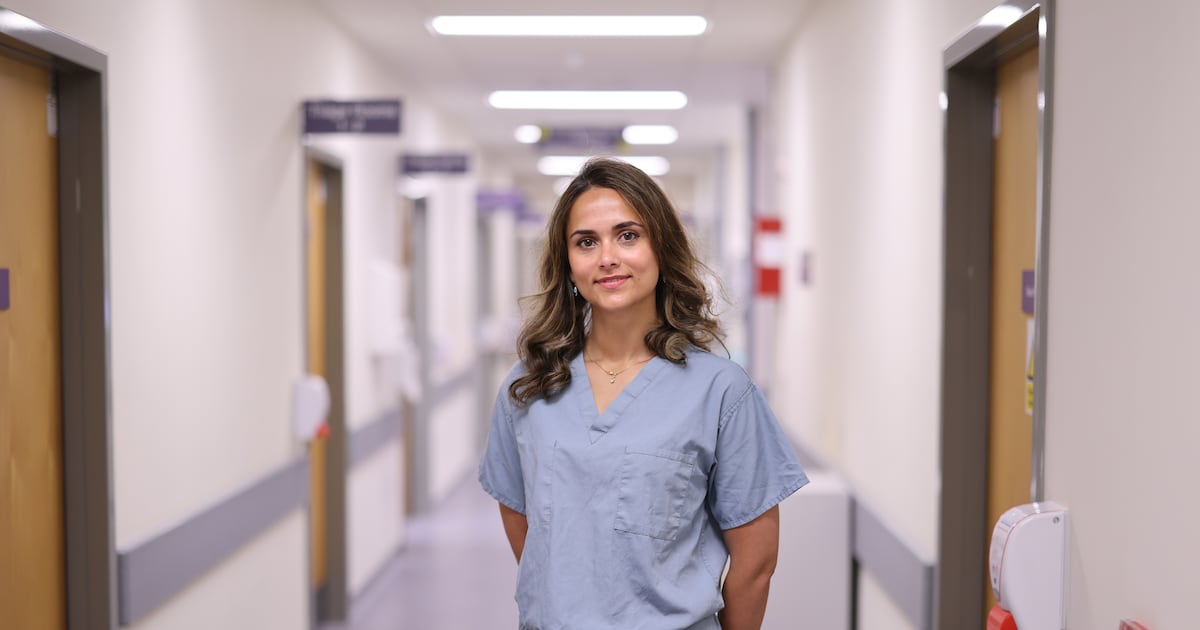
It was a decade ago when Pat Molloy was told something nobody ever wants to hear: he had cancer.“I wasn’t feeling fine, but I didn’t know what was making me feel a bit down. They figured out symptoms before I did,” he says of that time.When he underwent a blood test, the doctors noticed his haemoglobin levels were not as they should be. He was diagnosed with myelodysplastic syndrome, a group of bone marrow cancers.Now 75, Molloy says he’s been coming to St Vincent’s University Hospital (SVUH) in Dublin for “10 years now; they’re like family”.READ MOREThe Wicklow native gets a weekly blood transfusion and recently started a treatment called Azacitidine, a prescription chemotherapy medicine. He hopes it will reduce the number of transfusions needed.Despite the regular hospital visits, he is grateful for the additional years he’s been given. His focus is on living, not just surviving.“Six weeks ago I was out with Brad Pitt. I’ve been an extra in the Vikings. I have pigs that they use in the films sometimes. The work keeps me occupied so I don’t think about what’s wrong with me,” he says.“You like to get as much satisfaction out of life when you’re alive. You want to actually be alive. I used to always love the dancing and the jive. For years there wasn’t a band that played fast enough and now the slowest music is too much. But that’s the way life is, isn’t it?”Pat Molloy with nurse Ella Sweeney on one of his regular visits to St Vincent’s University Hospital, Dublin, where he receives ongoing care. Photograph: Dara Mac Dónaill/The Irish Times Molloy is one of thousands of people receiving treatment across the State’s cancer centres, which were established in a bid to centralise expertise, improve patient outcomes and to be on par with international standards.An estimated 44,000 people in Ireland get cancer each year, with the incidence rate increasing due to a number of factors, including Ireland’s ageing population. Over 220,000 people in Ireland are living with cancer or had it in the past – a 50 per cent increase compared to a decade ago. Consequently, the State recognised a need to move away from the fragmented delivery of cancer services, which resulted in inequity in the provision, availability and performance of services across various regions and social class.Now, eight hospitals have been designated as cancer centres. But some people working in the sector believe the State can take this a step further.Prof David Fennelly is clinical director of the UCD St Vincent’s Cancer Centre as well as clinical lead for cancer care in the HSE Dublin and South East region. He is seeking to set up a cancer network.Prof David Fennelly, clinical director of St Vincent’s UCD Cancer Centre at St Vincent’s University Hospital, Dublin. Photograph: Dara Mac Dónaill/The Irish Times A network would see hospitals, health groups and experts work together to share tools, skills and expertise to ensure the best outcomes for patients.“The advantage of a network structure is it won’t downgrade anywhere. It will support local hospitals. The benefit to the patient is huge, because there would be more clinical trials,” he said.“For a complex surgical procedure, outcomes are directly related to cancer volumes. The more times you do a procedure, the better you get at it.”But with these rising cases, problems are arising. “We don’t have enough beds,” he says, calling for “protected beds for cancer”.“We are the national centre for sarcoma, so if I have a 20-year-old down in Tullamore who I need to get into the national centre here, that patient in Tullamore is competing with the 75-year-old on a trolley in casualty.”Now that more people are surviving, and living with or after cancer, there is also a focus on life after the diagnosis.Michael Boland, an oncoplastic breast surgeon, said there have been advances in areas such as chemotherapy and other treatments for breast cancer, but there have also been surgical advances.Michael Boland, consultant oncoplastic breast surgeon at St Vincent’s University Hospital, Dublin. Photograph: Dara Mac Dónaill/The Irish Times “Historically, patients were offered a mastectomy, which is removal of the breast, or a lumpectomy, which is taking out the lump,” he says.“But we now try to offer patients an oncoplastic procedure which is the removal of the lump, and obviously that’s the primary focus, but doing that in a manner that allows us to put breast tissue back together in a cosmetic manner.”Boland says survival rates for breast cancer have improved. An increased focus has now shifted to the area of psychological recovery alongside physical recovery.“We want to make sure that the person has a really good outcome in terms of survival, but also in terms of quality of life. There’s loads of evidence to support that.”Continued progress towards these objectives requires additional time and staff, which he said will need to be resourced as demand continues to increase.“It’s just a matter of those procedures becoming standard for patients as opposed to offering them in a very limited basis,” says Boland.Surgical advances are not exclusive to breast cancer. Dr Nikita Bhatt, urological surgeon who specialises in robotic surgery, said the specialism has “pushed the boundaries in terms of what we can do”.Dr Nikita Bhatt (centre) with Dr Laurann Rabbitt and nurse Ping Zhang (right) at St Vincent’s University Hospital, Dublin. Photograph: Dara Mac Dónaill/The Irish Times “With the robot you have four arms so I do stuff now that I never imagined we could fix when I was doing my training,” she said.According to Bhatt, there are a number of benefits to robotic surgery, on an individual and system level.“The incisions are small so your recovery is much faster. You’re back up to your feet quicker. Your length of stay in hospital is shorter. The complication risk for after surgery is better,” she adds.“In terms of the surgeon, because you’re sitting down on the console, it’s ergonomically much better for your back and it’s a much more comfortable position to operate in. But also my hand can only rotate so much, whereas the robot can turn 360 degrees.”Bhatt says a large part of what she does is also reconstruction, which “100 per cent improves the quality of life of patients”.“Basically between Newcastle and us, we are the highest volume robotic reconstructive centres in UK and Ireland,” she says.“So if you have your bladder out, most people across Ireland are just offered a stoma. In some places, they do an open surgery called a neobladder which is essentially you use your bowel, you fold it and form a new bladder. We’re the first centre in Ireland to do that properly robotically.”A lot of the work is responding to these diagnoses, but the cancer centre is also working to see if preventive action can be taken, too.Dr Lynda McSorley, a consultant medical oncologist and lead for cancer genetics at SVUH, said around 10-12 per cent of all cancers are genetically-driven.Dr Lynda McSorley, of St Vincent’s University Hospital in Dublin, is helping to lead the fight against genetically-driven cancers. Photograph: Dara Mac Dónaill/The Irish Times “It’s the minority of cancer but there’s a real opportunity with cancer genetics to help the person who I’m seeing, who has the gene alteration, but also to help their family,” she said.“With screening, risk-reduction strategies, you could prevent a cancer developing. You can’t change your DNA but you might be able to mitigate the risk. A lot of these cancers develop under the national screening programme age, so genetic testing can be helpful to see.”McSorley acknowledges that the State is currently not doing enough genetic testing. However, the hospital has introduced mainstream genetic testing.“It’s done in the breast clinic, the surgical clinic, the prostate clinic, colorectal clinic, and in pancreas as well as ovarian cancer. So people can get genetic testing done there and they don’t have to go on my waiting list,” she adds.Cancer trials is another area she’s working in. McSorley is on the gynaecological cancer trial group as part of Cancer Trials Ireland.“It’s not the case at the moment but our plan is to have a clinical trial option for each cancer stage and each cancer type. That’s something we need to factor into our service planning,” she added.That service planning is something for which Molloy is very grateful. He sees their hard work and innovation each time he’s in the hospital.“If it wasn’t for the doctors and experts here, I would have been dead years ago. I got 10 years, but now I would love another 10.”
Robotic surgery one of several developments ‘pushing the boundaries’ of Irish cancer care
Full Article
Original Source
Read the full article at Irishtimes →KhanList aggregates and links to publicly available news content. We do not host full articles from third-party sources. Always verify important information with original sources.