
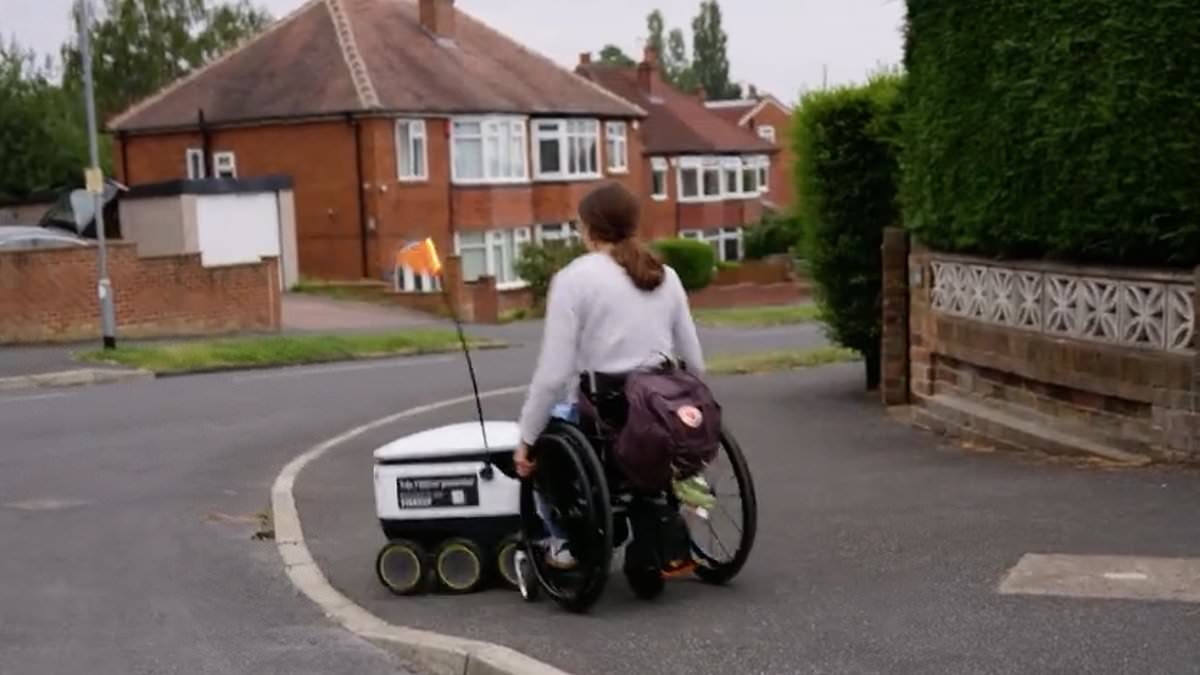
A robot delivery company has accused a British disability charity of 'selectively editing' videos showing its autonomous bots colliding with wheelchair users. In a video posted in September, Living Streets claimed to show Starship Technologies' robots on the streets of Leeds, blocking the pavement and tripping over blind pedestrians. The charity alleged that these delivery bots are 'putting pedestrians at risk' and accused the robotics firm of operating in 'a legal grey area'.However, Starship Technologies claims these clips have been manipulated and is now threatening to take Living Streets to the regulator if it fails to set the record straight. After seeing the campaign video, Starship Technologies compiled a dossier of camera and sensor data from the robots involved in the incidents.It claims that the data shows the robot tried to modify its route and avoid the crash, but collided after the wheelchair user deliberately accelerated.Likewise, Starship Technologies says its data showed a scene in which the wheelchair user appears to be blocked was caused by the person choosing to pass on the much narrower side, despite plenty of room being available. However, in yet another twist, Living Streets has now released the raw footage of the supposed collisions – and is sticking by its claim that the crash was not faked. A robot delivery company has accused a British disability charity of 'selectively editing' videos showing its autonomous bots colliding with wheelchair users In a video posted in September, Living Streets claimed to show Starship Technologies robots on the streets of Leeds blocking the pavement and tripping over blind pedestriansStarship Technologies alleges that it has written to Living Streets, offering to show them the data and correct the record.And, if Living Streets doesn't agree, the company says it is willing to take them to the Charity Commission to correct the record.Lisa Johnson, vice–president of Starship, told the Daily Mail: 'Their recent campaign video package is selectively edited and irresponsible, creating a misleading impression that robots are blocking or crowding wheelchair users.'That is simply not the reality. If Living Streets zoomed out on that footage, the public would see just how much pavement space was actually available to safely pass.'We've made 11 million deliveries over the last decade. They're a normal part of life for hundreds of thousands of people in multiple countries. This is scaremongering that could make people feel anxious about robot delivery when evidence shows there is genuine love for the robots where we actually operate.'However, the charity has now hit back against Starship Technologies, saying that the video had not been faked.In the raw footage, after the robot bumps into the wheelchair user, the camera operator can be heard saying: 'Did it hit your legs? I thought it would have stopped.' Emily Green, 18, the wheelchair user in the film, told the Daily Mail: 'Starship claim I moved into their robot's path but dropped kerbs are placed there for the benefit of wheelchair users and I don't have the luxury of not using them. Starship Technologies has hit back against the charity, claiming that the videos have been misleadingly edited to make their robots seem more of a nuisance than they really are In yet another twist, Living Streets has now released the original raw footage of the incident, claiming that they were not set up 'The independence of young wheelchair users like myself is important, and worth fighting for. Robots should not take priority over my safety and mobility.'Likewise, a Living Streets spokesperson told the Daily Mail: 'We have never claimed the interactions in our film were serendipitous but they do reflect how wheelchair users and blind pedestrians navigate our pavements. 'Delivery robots on pavements present a significant risk to pedestrians and we make no apologies for highlighting it.'These devices operate without any explicit laws governing their use – and in some cases, without consent from the local authority.'Starship Technologies, meanwhile, claims it has been actively making improvements to how its robots interact with disabled pedestrians.In an update posted in April this year, the company says that its robots can now recognise wheelchairs and mobility devices.When a robot sees a wheelchair, its driving becomes more cautious and an additional layer of human oversight is brought in.If the robot and wheelchair user meet on a narrow path, the robot will let them know that a human operator is taking over the controls, and the bot should be reversed out of the way. In the raw footage, the camera operator appears to be surprised that the collision has occurred. Telling the wheelchair user, 'I thought it would have stopped' Brian Dawson, 59, said a shopping bot rammed into his dog Pippa while they were walking on the pavement near a Co–op branch in Milton Keynes, Buckinghamshire Likewise, the company claims that it has been working to improve safety around blind pedestrians, but admits that programming the bots to spot canes has proved to be a challenge. However, this is not the first time that the safety of Starship Technologies delivery robots has been called into question.Concerns were raised over the robots after one rammed into a German Shepherd in 2023.Brian Dawson, 59, said a shopping bot rammed into his dog Pippa while they were walking on the pavement near a Co–op branch in Milton Keynes, Buckinghamshire.Mr Dawson, a Tesco delivery driver, said it went on to ram him in the leg, causing him to kick the droid to remove it 'out of harm's way'. This year, Starship's robots were removed from the streets in Sheffield after Uber Eats pulled the plug on a pilot scheme just five months in.During the short–lived trial, the robots were a constant target for vandalism and were frequently sprayed with graffiti.Locals also complained that the autonomous vehicles 'got in the way' of pedestrians and carried an alarming number of cameras. Starship said that the trial had been paused after coming to a natural end, and insisted that the graffiti was not a contributing factor. Starship Technologies has been approached for additional comment. WHAT ARE STARSHIP TECHNOLOGIES' DELIVERY ROBOTS? The San Francisco-based company was created by Skype's Ahti Heinla and Janus Friis in 2014.The slow-moving delivery bots have already been operating across the world.They have travelled more than 100,000 miles in testing mode in more than 100 cities in 20 different countries.Unlike robots designed to resemble humans, Starship's bot is purely functional with a large compartment to hold deliveries, the equivalent size of two grocery bags.Each six-wheeled 'ground drone' is completely self-driving.Workers can drop a pin on a map (like Uber) to show their location and then select what food they want to order. Each vehicle is 55cm (22 inches) high by 70cm (28 inches) long.It has a secured compartment where parcels with a maximum weight of 10kg (22 pounds) can be transported, accessible to consumers via a link generated by a smartphone app.They have six wheels and can travel at speeds up to 4mph (6.4kmh) per hour.They travel mainly on pavements, can go up curbs and operate in the rain and snow. The company has already been operating in a number of towns across England.
Robot wars in Leeds: Delivery company accuses British disability charity of 'selectively editing' videos showing its autonomous bots colliding with wheelchair users
Full Article
Original Source
Read the full article at Dailymail →KhanList aggregates and links to publicly available news content. We do not host full articles from third-party sources. Always verify important information with original sources.