
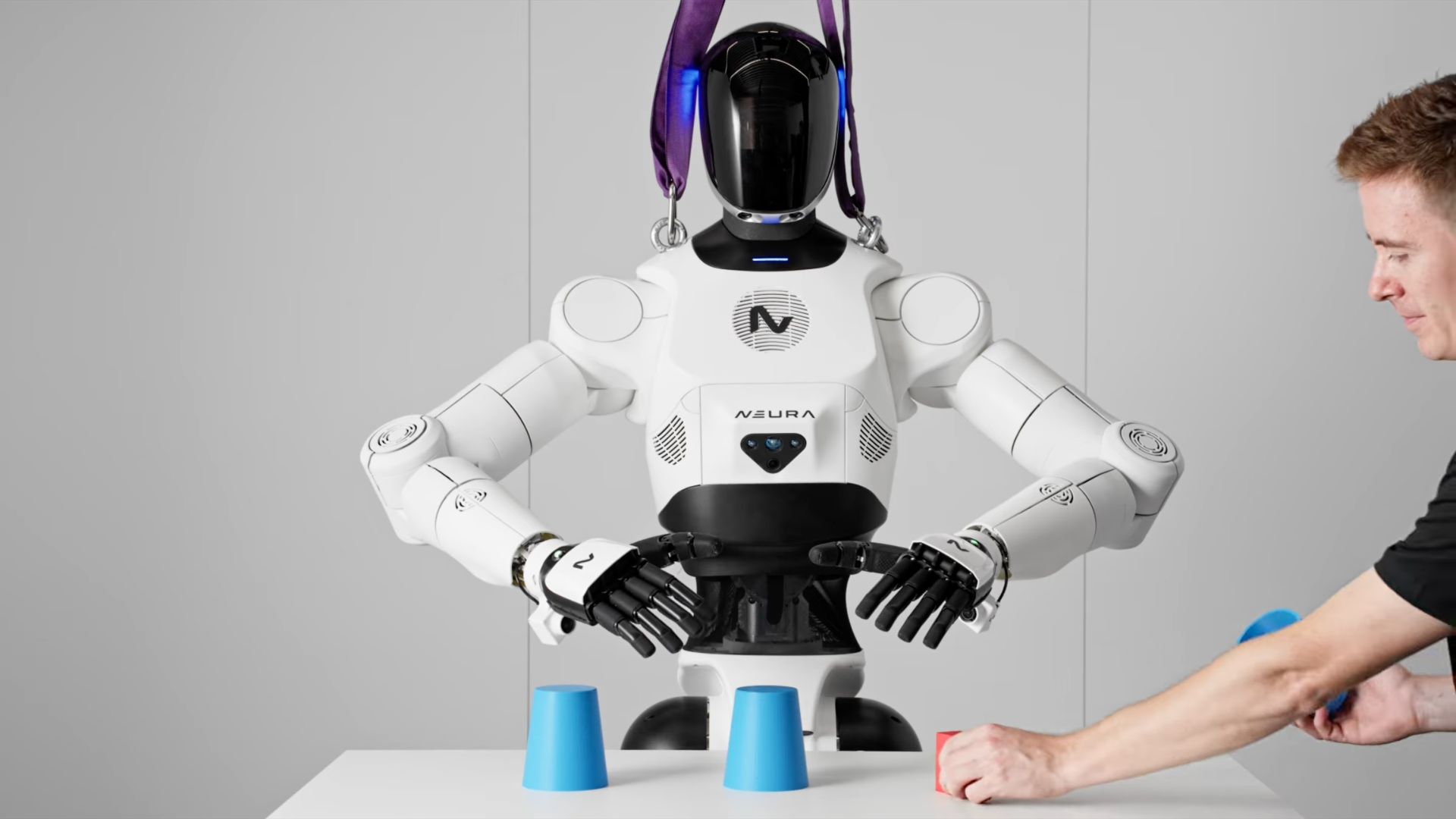
NEURA Robotics has introduced Neuron AI, a robot foundation model designed to help robots understand and interact with their surroundings using multiple sensory inputs. The system combines visual perception with touch, sound, language, robot-state information, and memory to support a range of tasks. The German company aims to deploy the model across different robot platforms, allowing customers to adapt its capabilities to specific applications. NEURA plans to demonstrate the technology through its humanoid robots, showcasing its approach to developing adaptable robotic systems for real-world environments. Advances robot Intelligence Neuron AI is a robot foundation model designed to combine visual perception, touch, sound, language, and memory to help robots perform complex tasks. The German robotics company described the system as a Perception-Language-Action (PLA) model that processes sensory information and translates it into physical actions. The architecture is designed to support multiple robot platforms, allowing skills to adapt to different applications rather than being developed separately for each machine. Neuron AI integrates several information sources, including 3D vision, tactile and force measurements, audio, robot-state data, and language. According to NEURA, the model aligns these inputs over time to help robots interpret their surroundings and maintain context as tasks progress. The inclusion of tactile and force data could help robots determine whether physical interactions have produced the intended results. For example, changes in contact forces could indicate whether a screw has engaged correctly, while audio cues could help identify when a mechanical latch has clicked into place. These examples illustrate the intended capabilities rather than independently verified performance results. Memory is another component of the architecture. NEURA noted that the system can retain information about earlier events and objects that have moved out of view, potentially helping robots coordinate actions across multiple stages of a task. The approach combines perception, contextual information, and action within a common model. However, the company has not published comparative benchmarks demonstrating how much memory or additional sensory inputs improve performance over vision-based systems. Furthering humanoid automation NEURA said Neuron AI supports five robot embodiments, including the 4NE1 Gen 3 and Gen 4 humanoids, a wheeled 4NE1 platform, and two additional bimanual robot platforms. This approach aims to transfer learned capabilities across different hardware configurations while allowing customers to adapt skills to their specific requirements. The company’s product information states that inference runs locally on the robot without requiring a cloud connection. On-device processing could allow robots to execute learned skills without continuous access to remote computing infrastructure. Neuron AI’s training process combines real-world robot experience, simulated variations, and human demonstrations recorded using sensor-equipped suits. NEURA’s training infrastructure, called NEURA Gyms, supports data collection, skill training, and benchmarking. The company also identifies industrial data partnerships with Schaeffler and Bosch. NEURA plans to use its Neuraverse platform to help customers fine-tune robot capabilities for particular workflows and distribute them across fleets. Customers can keep their trained skills private or choose to share capabilities and deployment data with the wider ecosystem. The company identifies Time-to-Skill—the time required to teach a robot a task and achieve reliable execution—as a key measure of progress. However, the announcement does not include measured results for this metric. NEURA plans to demonstrate Neuron AI using its 4NE1 humanoid at NVIDIA GTC Berlin from October 20–22. The planned 11-minute autonomous sequence involves sorting laundry, loading a washing machine, closing and reopening it, unloading the clothes, and transferring them to a dryer without human intervention. The demonstration is intended to show how the system coordinates multiple actions while maintaining context throughout a task. The announced sequence covers laundry handling rather than a complete washing and drying cycle.Get the latest in engineering, tech, space & science - delivered daily to your inbox.Jijo is an automotive and business journalist based in India. Armed with a BA in History (Honors) from St. Stephen's College, Delhi University, and a PG diploma in Journalism from the Indian Institute of Mass Communication, Delhi, he has worked for news agencies, national newspapers, and automotive magazines. In his spare time, he likes to go off-roading, engage in political discourse, travel, and teach languages.
Robot brain combines sight, tough and sound to help humanoids handle real chores
Full Article
Original Source
Read the full article at Interestingengineering →KhanList aggregates and links to publicly available news content. We do not host full articles from third-party sources. Always verify important information with original sources.