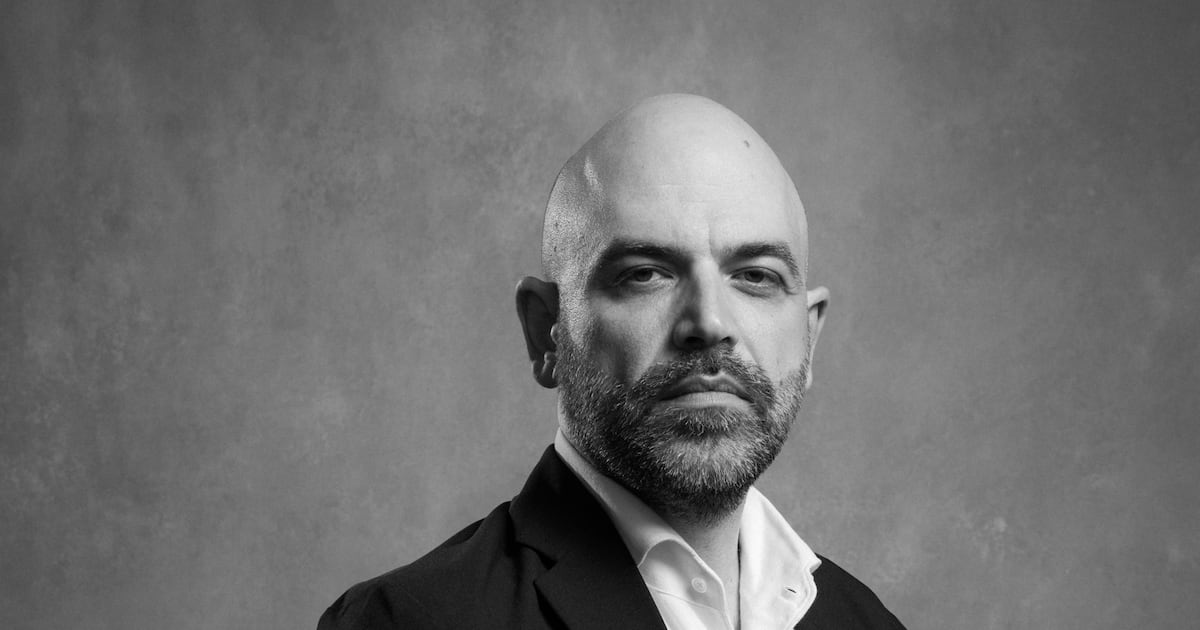
The moment Roberto Saviano’s life changed was when he decided to speak some names aloud.It was September 2006, he was a 26-year-old crime journalist, and he had just published Gomorrah, a book about the mafia’s stronghold in his home region of southern Italy which would become an international bestseller.Saviano was an invited speaker at a pro-rule of law demonstration marking the start of the school year in the central square of Casal Di Principe, deep in the heartland of the Casalesi mafia clan where he grew up. Looking out into the square, he noticed relatives of well-known mafia bosses among the young people who had gathered. He decided to break the omertà – the deeply rooted cultural code of silence that shields the mafia – and name the bosses aloud.READ MORE“I saw the students in the square, and I saw there were relatives of the clan leaders,” he recalled in an interview marking the publication of his new book, Shout It Out! 28 Portraits for a Committed World.[ Daniel Kinahan begins last appeal against extradition to IrelandOpens in new window ]“I was looking at these young people and thinking of the future they faced in a sick, polluted land, stripped of everything, with predators filling the gaps left by the state. I couldn’t hold back.”His speech described the mafia bosses as privileged overlords who exploited the south while making it big in wealthy northern Italy, according to a recording from that day. “Francesco Schiavone, Michele Zagaria, Antonio Iovine: get out. This isn’t your land,” he told the crowd. “We reject you.”Saviano has lived under armed guard since that moment. The police protection assigned to a senior politician who was also speaking at the event refused to let him leave alone. The government, considering his life to be under threat, assigned him his own protection a few days later.For more than 10 years, I have been a constant target of politicians, particularly on the right, who attack me despite knowing I’m the subject of mafia intimidation— Roberto SavianoFor the two decades since, he has moved constantly, sleeping in police barracks and windowless safe houses, planning the most trivial outing meticulously in advance and travelling by armoured car. The province of Caserta is “a place where everyone knows everything, but remains silent out of fear”, Saviano explains.“Those words condemned me to death... I was 26 years old, now I’m almost 47. Twenty years of police protection and 20 years of a half-life, neither dead nor alive.”All of those he named have since received life-sentences for mafia-related crimes. Iovine, known as the Camorra’s “minister of garbage” for his role in the racket of illegally burying toxic waste all over the surrounding countryside - hence the “polluted land” - was finally captured in 2010 after years on the run.He was hiding in a villa right there in Casal Di Principe. It’s a place known for both potent grassroots resistance to mafia infiltration, and for high-level complicity: its town council has been disbanded for mafia infiltration three times.Roberto Saviano: 'At 16 I had already seen a priest shot in the face.' Photograph: Serena Serrani The killing of a priest in the town, Don Giuseppe Diana, was particularly formative for Saviano growing up.Diana had set up a welcome centre for African migrants to try to prevent them being recruited as low-level workers for the mafia. Later, he distributed a letter calling on parishioners to reject the Camorra, a “deviant parallel state” he accused of extracting 20 per cent kickbacks from construction projects and using drug trafficking to create an underclass of marginalised youths to exploit.The priest was assassinated in his sacristy in Casal di Principe as he prepared for Mass on March 19th, 1994, one of 3,700 Camorra killings in Naples and its surrounds in the first 25 years of Saviano’s life - a similar death toll to that of Ireland’s Troubles.“It felt like a civil war,” he recalls.Saviano began reporting on the killings when he became a local journalist in his early 20s, turning up at the aftermath of shootings and gauging what had happened by the reaction of those who showed up.“I would observe the relatives of the victims, to figure out whether the person who was killed was an innocent bystander or a member of the Camorra,” he recalls.“When the relatives of the innocent dead arrive, they are overcome by confusion and disbelief. They are not prepared for that pain. You can see it immediately,” he says.“The relatives of victims who are mafia affiliates – they already have a ‘grammar of suffering’. They already know what to say, how to cry... they know how to express that pain. They’ve been expecting that moment.”All of this was being reported in the crime pages but was not, he felt, being addressed as a national crisis. He thought writing a work of literature – he refers to Gomorrah as a “non-fiction novel” – would give the issue its proper due.“At 16 I had already seen a priest shot in the face, at 20 a trade unionist killed, Federico del Prete; then a mayor who opposed them shot in the back and left paraplegic,” he remembers.[ Paul Williams: ‘Organised crime could not thrive without the connivance of so-called law-abiding society’Opens in new window ]“The constant attacks on anyone who opposed their power, the corruption, the feuds – all this led me to write Gomorrah. I didn’t expect it to be a hit at all. It was an act of insubordination, and one I’d pay for.”Does he regret writing it? “I regret it every day of my life. I’d like to say no, that I regret nothing, that I’d do it all again, but I would be lying to myself,” Saviano said. His family have almost all left southern Italy. His decision to write Gomorrah, to speak out and keep speaking out, “has ruined not only my own life but also the lives of the people who love me”.Schiavone, Zagaria, and Iovine were among the crime bosses convicted in Italy’s massive Spartacus Trial. It ran for 10 years, hearing the testimony of more than 500 witnesses, and in the end handing down a combined 700 years in prison sentences.Anti-mafia activists in Naples say the imprisonment of so many senior bosses has actually caused the situation on the ground to become more dangerous, as younger and more volatile criminals vie for control. “Mafia influencers” are accused of normalising criminal culture among a new generation by glamorising it on social media. The shooting of two innocent victims in separate incidents in April and June this year - 21-year-old Lorenzo Spasiano and 20-year-old Fabio Ascione - is seen as a warning sign.Roberto Saviano: 'Today, the financial sector operates by mafia rules.' Photograph: Mattia Venturi During the Spartacus Trial, senior clan member Francesco Bidognetti and his lawyer Michele Santonastaso filed a document to the court that attributed responsibility for the trial to Saviano and a former journalist colleague, Rosaria Capacchione, and told them to “do their jobs properly”.After a lengthy legal battle, a Rome court ruled last year that this was a threat, and convicted Santonastaso and Bidognetti of intimidation.They both received suspended sentences. For Saviano, the conviction matters above all politically. His reporting was not universally welcomed at home. He has long been accused of giving Italy a bad name, and has been a flashpoint for right-wing ridicule and anger for his progressive views and criticism of anti-immigration politics. Matteo Salvini of the hard-right Lega party, Italy’s deputy prime minister, repeatedly said he would strip Saviano of his police protection while he was in charge of justice and security as interior minister.“For more than 10 years, I have been a constant target of politicians, particularly on the right, who attack me despite knowing I’m the subject of mafia intimidation. That’s Italy for you,” Saviano says.“Anyone who says, as minister Matteo Salvini has done for years, that my police protection is unnecessary... knows that they are doing so despite a court having ruled in a now-definitive judgment that I am the victim of mafia threats.”Saviano sees the discovery of an alliance between the Naples Camorra and Ireland’s Kinahan cartel as “one of the most significant chapters in recent global drug trafficking”.It was revealed through an “old-school investigation”, when US law enforcement infiltrated the lavish wedding of crime boss Daniel Kinahan to Caoimhe Martina Robinson at the Burj Al Arab hotel in Dubai in 2017.A mole inside the event captured images, which investigators used to piece together a map of an international “super-cartel”.Capitalism has completely lost its democratic rules. It is no longer the best, most innovative or most efficient entrepreneur who wins— Roberto SavianoAmong the guests, investigators spotted Raffaele Imperiale – a high-ranking Camorra affiliate and major drug trafficker known for the discovery of two stolen paintings by Vincent van Gogh hidden in the wall of his house in southern Italy.“Imperiale was Kinahan’s guest of honour,” Saviano says.“There was Kinahan, there was Imperiale, there was Ridouan Taghi, the head of the Mocro Maffia; there was Edin Gačanin, the leader of the Balkan cartel,” Saviano says.Dubai had become an “El Dorado” for crime bosses because, as Imperiale would later tell Italian prosecutors after he turned “pentito” or state’s witness, it offered an easy route to launder criminal cash through purchases of its real estate.The Camorra-Kinahan alliance “wasn’t based on traditional mafia dynamics, but was actually a corporate joint venture,” Saviano explains.[ Who is not against the Mafia in Italy? Author Roberto Saviano raises controversial questionOpens in new window ]“They pooled their available cash to buy cocaine at a lower price from the leading South American producers. By purchasing larger quantities as a consortium, they were able to reduce their costs,” he said.“There were also agreements regarding shipping routes, with the ports – Amsterdam, Antwerp and Gioia Tauro – negotiating collectively to secure a better price.”Cultural commonalities have helped Irish and Italian criminal organisations to see eye-to-eye in the past.“The Irish and the Italians communicate well, form alliances and share a common sense of solidarity – a bond rooted in religion and, above all, in the concept of family,” Saviano says.“Family is everything. The Mafia would not exist without the concept of family, of unbreakable bonds, of blood ties, of kinship, and of monogamous control. Ireland and Italy are very similar in this respect and therefore recognise each other in criminal terms.”The word “mafia” can sometimes evoke colourful and almost romantic associations, but the reality in today’s world is more in the dry realm of international finance.“It actually has more to do with complex economic structures and the management of liquidity in a world where liquidity equates to enormous purchasing power, and significant discounts. It’s about opaque systems, and money laundering,” Saviano says.“Both Ireland and England are areas with a very high incidence of money laundering. The global financial system effectively provides the mafia with cover through offshore companies. If we don’t discuss this, we are not really discussing the mafia.”This is the aspect of international organised crime that Saviano believes has developed most strikingly since he wrote Gomorrah.“The economy itself has become mafioso. Capitalism has completely lost its democratic rules. It is no longer the best, most innovative or most efficient entrepreneur who wins, but the one who starts off with illicit assets and illicit capital, who is more dominating and aggressive,” he says.“Today, the financial sector operates by mafia rules; it is not that the mafia has become financialised, but that the financial sector has become mafia-like.”
Roberto Saviano on the Kinahans, living under threat from the Mafia and similarities between Ireland and Italy
Full Article
Original Source
Read the full article at Irishtimes →KhanList aggregates and links to publicly available news content. We do not host full articles from third-party sources. Always verify important information with original sources.