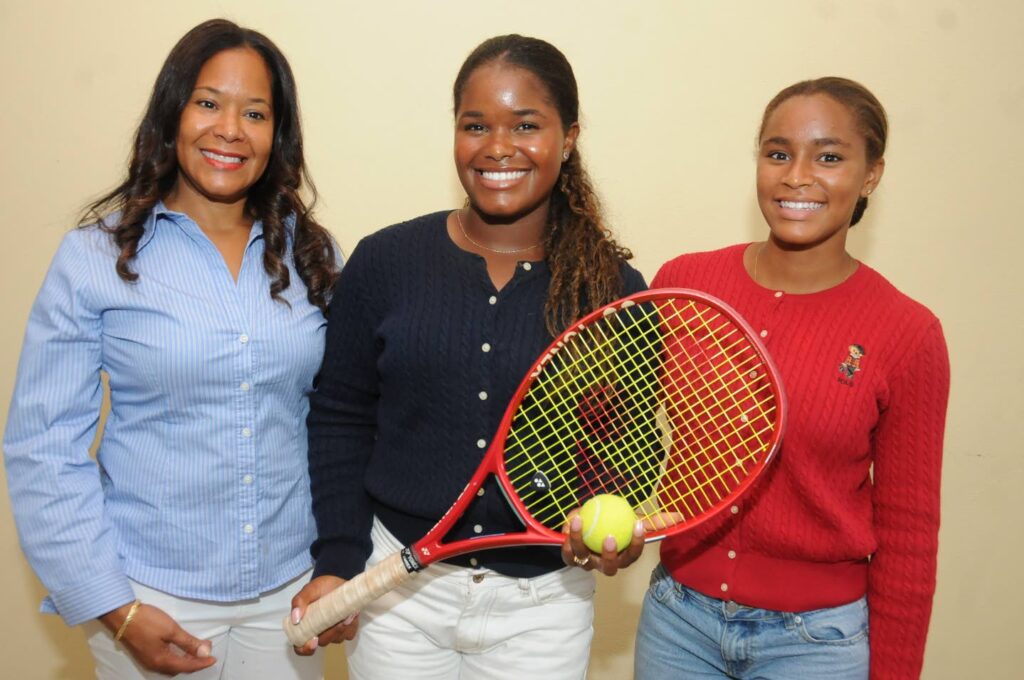
Jamaican tennis player Alyssa James (centre) flanked by her mother, Julie Thompson (left), and sister Arianne James. (Photo: Garfield Robinson) LONG before Alyssa James was walking into locker rooms at Wimbledon, navigating five-week international tours, or earning a scholarship to the University of Virginia, she was an eight-year-old taking aim at a chair. The chair had been placed on a court by the late Jamaican tennis icon Richard Russell. His method was simple: Set up a target, step back, and serve until you hit it. “He was such a beloved gentleman, a fine gentleman, and a good coach,” James’ mother, Juliet Thompson, recalls. “He said we should craft a road to Wimbledon. He provided us with a lot of resources and tips. Russell wasn’t only a coach, but also provided us with wisdom on the journey.” That “road to Wimbledon” was originally mapped out for Alyssa’s older brother, Matthew, now 20. But Alyssa — who first picked up a racket at three — was watching, learning, and competing. “I was definitely super-competitive with my older brother because he was better than I was when we were growing up,” James said. “I was trying to catch up to him and beat him… my brother and I practised together, so it was a good competitive environment. He was better than I was, and I was trying to raise my level.” That drive quickly produced results. At eight years old, while representing Hillel Academy, James won her division at the Little Mo International Tennis Tournament, her first international event. Around that same time, Tennis Jamaica brought her to a hitting session with visiting legends Venus and Serena Williams. Serena’s reaction was immediate and unforgettable. “Serena told me that I was better than her at my age,” James says. “That was a huge compliment coming from one of the greatest athletes of all time. It’s always been in the back of my mind motivating me. The older I get, the more I see it as a huge honour.” Yet talent alone doesn’t make elite tennis players; they need structure and discipline to stay balanced in life and sport. “When I was younger, I did ballet, swimming, and played the piano,” James said. “In everyday life, you have to be disciplined. Every day after school at 4:00 pm, there’s discipline with that. You have to have a level of focus. You have to be concentrated in your piano classes to make sure you’re taking in all the information, process it, and then execute. It’s the same on the tennis court.” Jamaican tennis wonderkid Alyssa James Ballet taught her body awareness and footwork while piano taught her focus and sibling practice built her competitive edge. Russell added the final polish, even running mock media interviews with young tournament winners so they would know how to handle the spotlight. “It was just bringing the tennis player to completeness,” Thompson says. “You play, compete, and then you’re able to interview on the outcome of your game.” By age 11, the family made the decision to switch James to online schooling to accommodate a demanding training schedule and constant international travel. Today, at 18, her schedule looks less like a typical teenager’s and more like a standard workday. “I train two hours for tennis in the morning and then two hours in the afternoon, plus one hour of fitness,” she says with a laugh. “That day starts at around 9:00 or 10:00 am and ends at around 4:00 or 5:00 pm — a nine to five.” That daily grind has paid off. Between November and April, James moved up the world junior rankings from 104 to 49, earning main-draw spots at the Junior Australian Open, French Open, and Wimbledon. In March, she made Jamaican tennis history by capturing the girls’ doubles title at the J500 Gaspar Banana Bowl in Brazil — becoming the first Jamaican ever to win a J500 event. Through all the travel and high-stakes matches, she remains grounded by her roots — and the Jamaican flags she spots in crowd stands in Melbourne, Paris, and London. Now preparing to transition to the professional tour after her collegiate stint at the University of Virginia, James is poised to carry the torch for Caribbean tennis on the global stage. Her advice for the next generation, including her 16-year-old sister Arianne, who is already following in her footsteps, is reflected in how she carries herself: Quiet focus, steady preparation, and respect for the blueprint that got her here. “It would be really nice to have someone from the Caribbean region representing us on the world stage,” James says. “It’s something that I would be really proud to do.”
Road to Wimbledon
Full Article
Original Source
Read the full article at Jamaicaobserver →KhanList aggregates and links to publicly available news content. We do not host full articles from third-party sources. Always verify important information with original sources.