
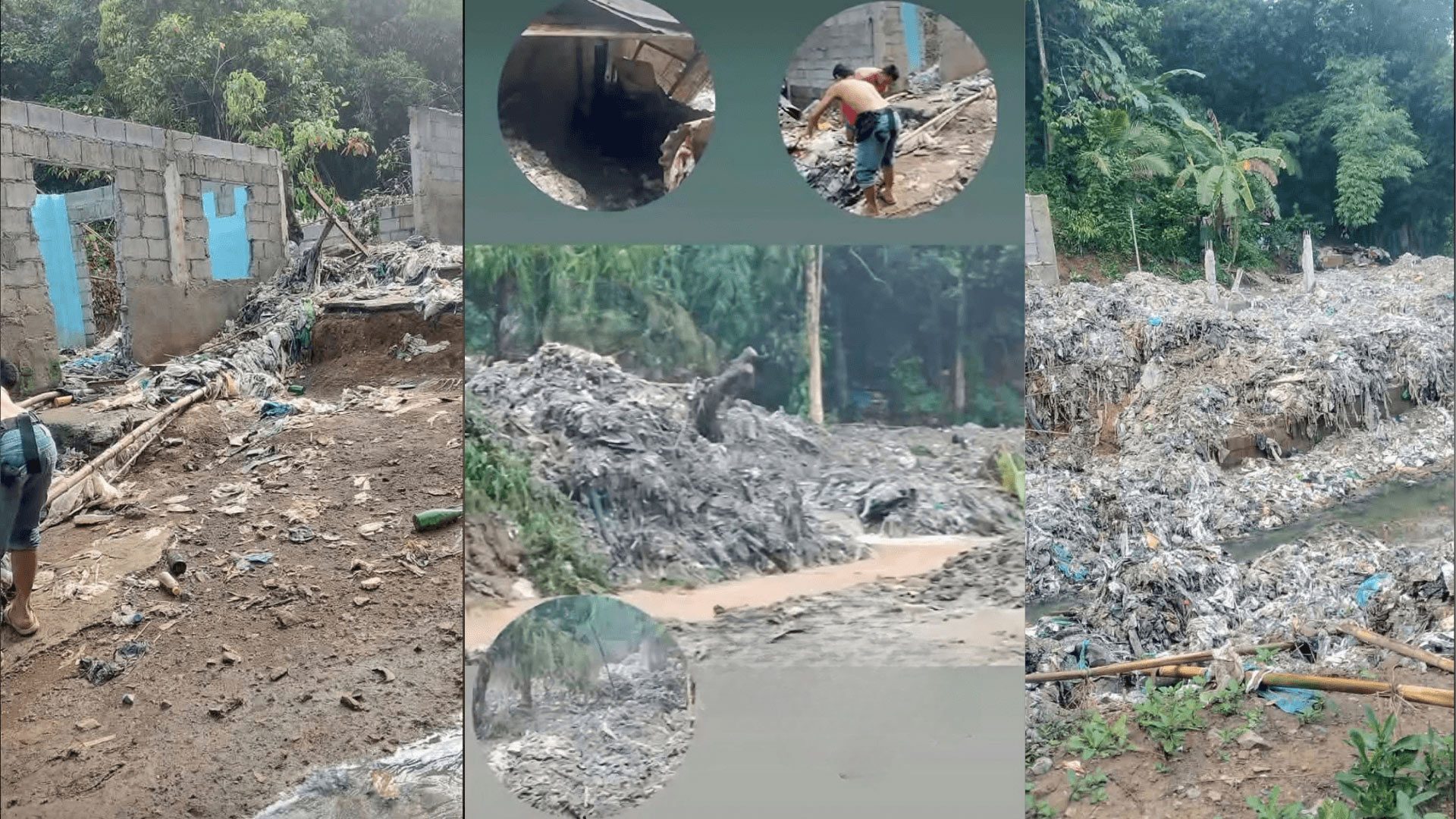
RIZAL, Philippines – At around 4 pm on August 31, 2024, “Ditoy” (her name changed to protect her privacy) was alone inside her home in Sitio Laan, Barangay Macabud, in Rodriguez, Rizal, when floodwater, mud, and rubbish buried the house. She tried to leave, but the door had jammed, possibly swollen by the rain. “Baha, putik, ‘tsaka basura ang magkasama noon,” she said. “Andiyan na ‘yung tubig na napakaitim, napakabaho ng amoy.” (It was a mix of floodwater, mud, and trash. The water was pitch-black and foul-smelling.) Ditoy’s family lost their home and the crops that helped feed them and bring in small amounts of money. More than two years later, she continues to seek answers about waste disposal and quarry activity near Sitio Laan. Ditoy attributed the rubbish to illegal dumping near Sitio Pintor in San Isidro, Rodriguez. She alleged that people dumped waste outside the sanitary landfill to avoid paying disposal fees. Waste management under scrutiny On November 2, 2024, the municipality declared businessman Wennie Destacamento, owner of Survivor Hauling Services and 5WRD Hauling Services, persona non grata through Resolution No. 95, series of 2024. Citing reports from the Municipal Environment and Natural Resources Office and a request from Mayor Ronnie Evangelista, the resolution addressed reports of illegal dumping along MWSS Road in Sitio Matang Tubig, Barangay San Jose, and parts of Sitio Pintor, Barangay San Isidro, as well as a garbage landslide in Sitio Laan, Barangay Macabud. The municipality’s allegations, however, do not yet establish a court finding of liability. Waste management in Rodriguez has faced scrutiny. In February 2026, a collapse at the Rodriguez sanitary landfill prompted an emergency response. The Department of Environment and Natural Resources ordered a halt to operations in part of the facility, citing operational and safety concerns, including erosion in the active waste-disposal area and a risk of further collapse. The incident also drew broader concerns about the effects of landfill and quarry operations on nearby communities. Commenters on a Facebook post by the Philippine Red Cross Rizal Chapter about its response to the incident raised issues affecting residents beyond the immediate emergency. The Rizal provincial government denied responsibility for the incident, saying the facility was privately operated. It is reported that International Solid Waste Integrated Management Specialist Inc. (ISWIMS) operated the Rodriguez facility through Green Leap Solid Waste Management Inc. The collapse occurred nearly 18 months after Ditoy’s home was buried. It does not establish where the waste that reached her property came from, but it shows the continuing questions surrounding waste disposal and the safety of communities near landfill operations. Her family had completed a P20,000 payment in February 2024 for what they understood to be rights to the land. They built a home there, hoping to give their children a place to grow up. The disaster destroyed the house and crops that helped feed the family and brought in small amounts of money. Ditoy sometimes asked her child to sell sweet potato leaves and taro shoots to a teacher to help pay for school expenses. Her husband also collects recyclable materials at a sanitary landfill to support the household. When the house was swept away, years of savings and hard work seemed to vanish. “Diyos ko po, nung natangay ‘yung bahay namin, parang lahat ng problema sumaklob! Back to zero!” she said. (When our house was swept away, my God, it felt like every problem descended upon us all at once. Back to zero!) Afterward, barangay officials helped the family find another place to stay and provided a written agreement, she said. The family has since begun planting again. Trucks, dust, and safety PROXIMITY. Markings by Gerbon on a Google Maps screenshot show that the residential area she calls Sitio Laan-Lower lies at the foot of the slopes. “That is exactly our location; our entire community is surrounded by the aforementioned quarry and sanitary landfill,” she said. Screenshot from Google Maps. Ditoy’s concerns extend beyond waste disposal. She said heavy trucks associated with quarry operations pass beside homes in Sitio Laan, keeping residents awake with their horns and rumbling engines. “Puro dump truck po doon, sobrang daming dump truck. Daan sa gilid ng mga bahay, ‘di na makatulog sa gabi,” she said. (There are so many dump trucks there. They pass alongside the houses, making it difficult [for residents] to sleep at night.) Ditoy identified “ATN” as one of the quarry operations in the area. Public records confirm that ATN Holdings Inc. operates the ATN Integrated Aggregates Project, a quarrying and rock-crushing facility in Barangay Macabud, Rodriguez. The firm was among 11 quarry and crushing-plant operators whose permits the DENR suspended in December 2020 following Typhoon Ulysses. Its mineral-processing permit was reinstated in January 2021. (READ: What went wrong during Typhoon Ulysses?) Ditoy recalled an incident in which a dump truck crushed a sidecar. The driver managed to jump clear, she said. “Eh, paano kung may angkas ‘yun? May sakay na pamilya?” she asked. (What if there had been a passenger? What if a family had been on board?) She also worries about dust from quarry operations and its possible effects on children. She said children in the community often become sick when it rains and described dust and dirt entering homes through gaps in their walls. She said nearby streams had also changed: one that was once narrow had widened, while another that used to be deep had become shallower as sand accumulated. She fears that water held near a quarry could rush toward homes below if the land retaining it gives way. Richard Ybañez, a licensed geologist and chief science research specialist at the University of the Philippines Resilience Institute, said quarrying can alter hills and waterways, affecting how runoff moves through a watershed. Excavations may also retain water, depending on the terrain and drainage. Establishing quarrying’s contribution to a particular flood, Ybañez said, requires comparable data from before and after landscape changes, including information on topography, vegetation, rainfall and urban development. “The data has to be there before and after,” he told Rappler. His comments do not settle the causes of the flooding or the changes Ditoy described. They point to the evidence needed to assess those concerns, which residents say affect their homes and daily lives. A bill still pending Government action on quarrying in Rizal dates back decades. In 1998, the DENR temporarily suspended quarrying and crushing operations in Rodriguez and San Mateo amid concerns about flooding, erosion and siltation. A 1999 DENR order permanently prohibited mining and quarrying within the Marikina Watershed Reservation, but did not ban all quarrying across Rizal. After Typhoon Ulysses in 2020, the government again suspended quarry and crushing-plant permits in the Marikina River Basin while investigating possible links to flooding. The Mines and Geosciences Bureau’s subsequent assessment found quarrying made a “minimal” contribution to flooding and siltation in the Marikina River during that event. It identified heavy rainfall, urbanization, erosion, deforestation and other land disturbances as contributing factors. The debate continues in the 20th Congress. House Bill No. 4313, filed in September 2025 by Rizal 1st District Representative Rebecca Maria “Mia” Ynares, seeks to declare Rizal a mining-free zone. As of October 2026, the bill remained pending with the committee on natural resources. The lawmaker has yet to respond to an interview request about the proposal’s implementation, enforcement and treatment of existing operations. Ditoy said she had not known about the bill before. Initially, she said change might still be possible. Then she reconsidered. “Pero parang hindi na,” she said. (But it seems that’s no longer the case.) She questioned whether improvements would last if residents continued receiving short-term assistance without long-term solutions. “Parang masusolusyunan nang panandalian, pero hindi pangmatagalan,” she said. “Puro na lang ayuda-ayuda, wala nang solusyon na pangmatagalan.” (It might be resolved temporarily, but not in the long term. It is always just aid, with no lasting solutions.) Ditoy helps lead the Sitio Laan Ladies Association, a group of women organizing to raise community concerns. For her, the issue goes beyond rebuilding a home. She wants officials to pay attention to the conditions residents face every day, particularly those affecting children. “Sana po bigyang-pansin din po ng gobyerno ‘yung lugar namin,” she said. (I hope the government will also pay attention to our area.) – Rappler.com Dominique Astucia is a Rappler intern studying BA Journalism at the University of Santo Tomas.
Rizal farmer loses home to floods, raises questions about quarrying, waste management
Full Article
Original Source
Read the full article at Rappler →KhanList aggregates and links to publicly available news content. We do not host full articles from third-party sources. Always verify important information with original sources.