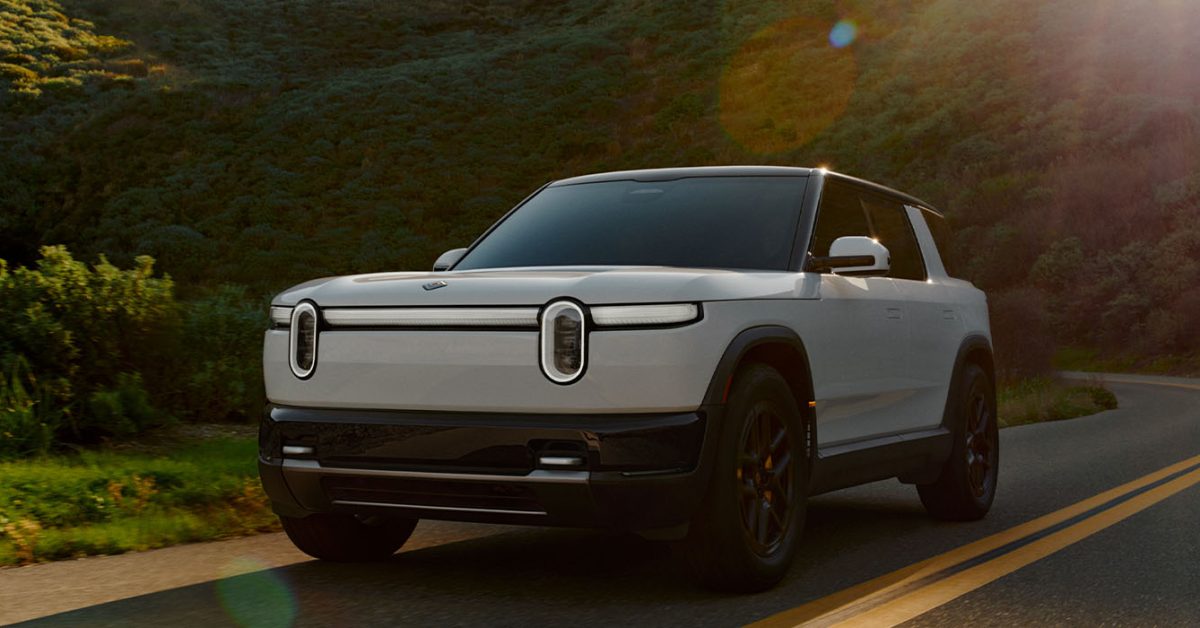
Rivian reported its second-quarter 2026 earnings today, and there are improvements across the board. It’s a car. The company started delivering the R2, its first vehicle priced under $50,000, to customers on June 9. The financials came in strong too. Revenue reached $1.658 billion, up 27% year-over-year, and Rivian posted a record $179 million gross profit while beating Wall Street on revenue, earnings, and adjusted EBITDA. R2 finally reaches customers The R2 is the whole reason Rivian exists as a mass-market company, so its arrival matters more than any single line on the income statement. Rivian began external deliveries of the mid-size SUV on June 9. Rivian hosted more than 57,000 demo drives during the quarter, a company record. We walked through the R2’s pricing and options when the configurator went live in May. The ramp costs money before it makes money. Rivian said it absorbed roughly $100 million in extra cost of revenue in the quarter from bringing the R2 line up to speed. That’s the price of scaling a new vehicle, and it’s why the automotive side stayed in the red even as the top line jumped. The numbers behind the beat Rivian produced 12,613 vehicles and delivered 12,194 in Q2, figures it pre-announced in early July alongside a raised delivery outlook. Automotive revenue was $1.143 billion, up 23%, though $108 million of the quarter’s revenue came from regulatory credits. Software and services brought in $515 million, up 37%, with $308 million of that, about 60%, flowing from Rivian’s joint venture with Volkswagen Group. Here’s the part worth reading closely. That $179 million consolidated gross profit, an 11% margin and Rivian’s best ever, was carried by software and services, which threw off $215 million at a 42% margin. That’s the Volkswagen deal paying off. Strip that out and the actual car business lost money: automotive gross profit was negative $36 million. That’s still much better than the $335 million automotive loss a year ago, and it’s still early in the R2 ramp-up. Below the line, Rivian reported an $837 million net loss, or $0.63 per share, narrowing from a $0.97 per-share loss a year ago and beating the roughly $0.65 loss analysts expected. Adjusted EBITDA came in at negative $379 million, well ahead of the ~$548 million loss the Street modeled. Free cash flow was negative $849 million as the company built R2 inventory. MetricQ2 2025Q3 2025Q4 2025Q1 2026Q2 2026Production (units)5,97910,72010,97410,23612,613Deliveries (units)10,66113,2019,74510,36512,194Automotive revenue$927$1,142$839$908$1,143Software & services revenue$376$416$447$473$515Total revenue$1,303$1,558$1,286$1,381$1,658Gross profit$(206)$24$120$119$179Gross margin(16)%2%9%9%11%Total operating expenses$908$1,007$953$1,000$1,015Adjusted EBITDA$(667)$(602)$(465)$(472)$(379)Cash, equivalents & ST investments$7,508$7,088$6,082$4,830$5,310Free cash flow$(398)$(421)$(1,144)$(1,075)$(849)Rivian quarterly financial performance, Q2 2025 to Q2 2026. Dollar figures in millions, except per-unit and margin. Source: Rivian Cash and the capital stack Rivian ended the quarter with $5.31 billion in cash, equivalents, and short-term investments. In July, it sold 86.25 million Class A shares in a follow-on offering to raise about $1.3 billion, tied to equity contributions and reserves for its Department of Energy loan funding the Georgia plant. There’s more capital lined up. Rivian said it expects $1 billion in non-recourse debt from Volkswagen and a $250 million equity investment from Uber later this year, both subject to conditions. Add in the DOE loan, and the company pegs its available and targeted future capital at over $14 billion. Guidance goes up Rivian improved its full-year 2026 outlook across the board. It now expects to deliver 65,000 to 70,000 vehicles, up 3,000 units from its prior range – though that was already announced after delivery results earlier this month. It narrowed its adjusted EBITDA loss guidance to a range of $1.8 billion to $2.0 billion, a $50 million improvement at the midpoint, and cut its capital expenditure guidance to $1.7 billion to $1.8 billion, down $250 million at the midpoint. The delivery number looks better once you do the second-half math on it, and it also looks harder. Rivian delivered 22,559 vehicles in the first half, 10,365 in Q1 and 12,194 in Q2. Hitting the full-year range means delivering roughly 42,000 to 47,000 in the back half of the year. That’s close to double the first-half pace, in two quarters. The R2 is the vehicle meant to get Rivian there, but doubling output is a serious task no matter how good the product is. However, Rivian giving this guidance now, in late July, amid the R2 ramp-up is a great sign of confidence, as the automaker likely has good visibility into demand and its production ramp. Electrek’s Take This is a good quarter, and it’s fair to say the progress is real across the board. Five straight quarters of climbing gross margin, from negative 16% a year ago to a positive 11% now, is the kind of progress most EV startups never get close to. While it’s important to note that the software division is behind the positive margin, only losing $36 million this early in the R2 ramp-up is incredible news in my opinion. Let’s add the regulatory credit in there too, and that would be a ~$140 million loss. The R2 ramp is dragging automotive margin down right now, which is expected, since R2’s materials cost roughly half of what an R1 costs. The whole thesis is that R2 volume flips automotive gross profit convincingly positive. And it sounds like those volumes are coming now if Rivian believes it can deliver more than 40,000 vehicles in the second half of the year – literally double what it delivered in the first half.We could see pure auto margins turn positive quickly, and Rivian’s financial story could change just as fast. If you’re buying an EV like the R2, powering it with home solar can cut your charging costs to nearly zero. With electricity rates up almost 10% last year and expected to keep climbing, going solar is one of the best ways to protect yourself against rising costs. And with lease and PPA options, you can do it with zero upfront cost and start saving immediately. If you want to find the best deal, check out EnergySage. It’s a free service with hundreds of pre-vetted installers competing for your business, so you save 20 to 30% compared to going it alone. No sales calls until you pick an installer. Get your free quotes here. FTC: We use income earning auto affiliate links. More.
Rivian (RIVN) Q2 2026 earnings: revenue up 27%, gross margins soaring
Full Article
Original Source
Read the full article at Electrek →KhanList aggregates and links to publicly available news content. We do not host full articles from third-party sources. Always verify important information with original sources.