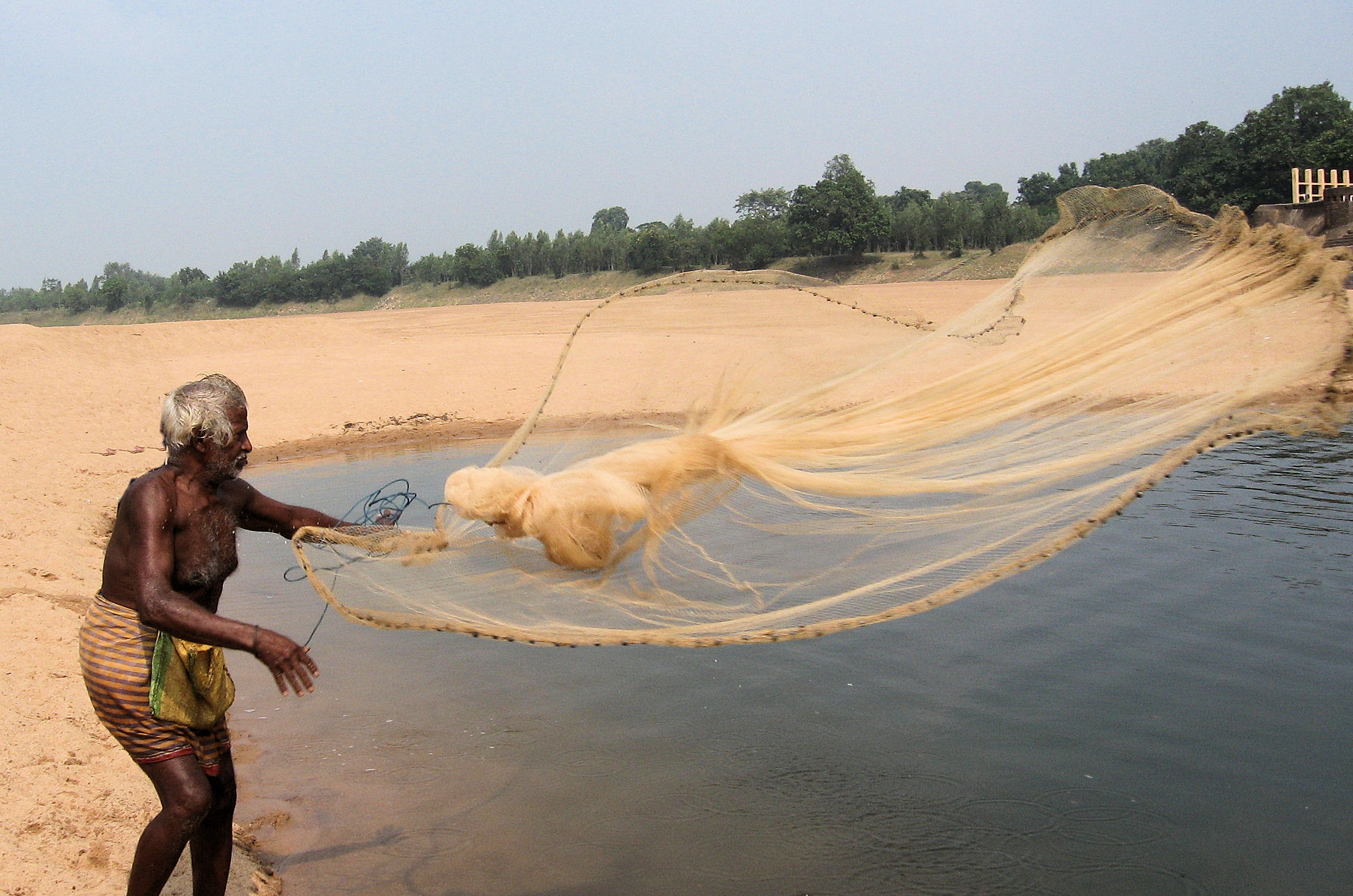
Ranjan Panda — social ecologist, journalist and researcher — is popularly known as the Waterman of Odisha.Panda highlights the invisible and noneconomic losses that communities living in coastal areas deal with due to climate change.In this interview, he highlights how rivers should be seen beyond their two boundaries of flow; how there is a stark difference in the ways rural and urban India see rivers. Rivers are not just seen as water bodies in India, they are considered religious. From taking holy dips (a sacred act of faith in Hinduism, also called snan) for spiritual purification to scattering ashes after one’s death, it all starts and ends with rivers. While some see them as religious spaces, others consider them recreational spaces. For some, there is no life without rivers. But others have forgotten to see how deeply connected rivers are to everyday lives. With rivers like the Ganga (considered the holiest river in the country) drying up and urban Indian cities like Bengaluru facing water crises, Ranjan Panda, popularly known as the Waterman of Odisha, has spent more than three decades working on water conservation and climate advocacy closely with communities in Odisha, eastern India. “I want to be a living Earth citizen and not a dead Earth citizen,” Panda says. Panda’s work is especially important at a time when rural India faces groundwater depletion. India’s share of the world’s population is roughly 18%, while its share of renewable freshwater resources is only about 4%, a gap that increases the consequences of river degradation. Panda, a trained sociologist, has written widely on water, disasters and climate change-related mental health challenges affecting coastal communities in Odisha. He shares his insights on issues like coastal cities, displacement and the effects of climate change on communities. He is not just a researcher but has also been a journalist for a decade of his early life. He has been actively engaged in the 2016 Odisha-Chhattisgarh Mahanadi river dispute and claims to have predicted the conflict a decade ago and forewarned the government. He is part of several global networks working on climate issues and is the founder and mentor of a budding organization called Youth4Water. Ranjan Panda, a trained sociologist, has written widely on water, disasters and climate change-related mental health challenges affecting coastal communities in Odisha. Image courtesy of Ranjan Panda. Mongabay spoke with Panda via video call. The following interview has been edited for clarity. Mongabay: How did you gain interest in working with communities around water? Ranjan Panda: During my college days while I was studying sociology, a transformation happened in me. I can say that two things have contributed a lot to whatever I am now. One is the department in college that gave me an opportunity to visit tribal villages — it was compulsory to do these field visits. While others did it for grades and degrees, I started enjoying knowing [the] communities closely. My professors introduced me to tribal and Indigenous communities. Visiting a tribal village was an eye-opener. I thought there are certain things I never imagined that would actually exist in this world. From the food they were eating, which mostly came from forests, and the water crisis they faced by walking kilometers to get water. [Secondly], during college, I was also introduced to a research paper written by one of my professors on drought and food security in the KBK region [Kalahandi-Balangir-Koraput] in Odisha. That’s where my quest started: Why did this region actually become a drought-prone one? Mongabay: Have you faced water crises personally? Ranjan Panda: I come from Sambalpur in western Odisha, a region whose parts are frequently affected by drought. I have experienced water scarcity personally very early in my life. I was 6 years old and we had a well at home, but after an irrigation canal was dug nearby, our well started drying up whenever water stopped flowing in the canal. We depended on tankers [water truck] and I remember walking long distances carrying a bucket to fill water, even at night. At the launching of the logo for Panda’s latest campaign, Youth4Water-India. This campaign is called “My 500-Meter City” and was launched June 5, on the banks of the Mahanadi River at Sambalpur, where more than a hundred youths and other stakeholders participated. Image courtesy of Ranjan Panda. Mongabay: What is the story behind the title ‘Waterman of Odisha’? Ranjan Panda: People started to know me because of my regular efforts to conserve and revive water bodies. I used to facilitate and bring people together. I developed a network called Water Initiatives where I started to interact with experts, NGOs and people from academic backgrounds on how water can be sort of an issue. At a point, I became the only voice who was actively speaking about water [scarcity]. People nowadays apply for awards, but at that time people came to see the work that you had done and that’s how I got the title. Mongabay: What does water justice mean to you? Ranjan Panda: The lower ladders of the society, or even economic strata, are losing their rights over water because water is getting scarce, and water is getting into the hands of the rich. It has been normalized in society that if you have money you can buy water, people buying tankers, people buying water bottles. So whoever has the money can actually get the water. Water justice, in that sense, is climate justice. There are two things one needs to focus on: One is local ecology that sustains water ecosystems, it has to be protected, and the second is you need to combat climate change because the first place where it will strike is the most vulnerable, poor people and other species. Mongabay: How did your journey from research to journalism happen? Ranjan Panda: Richard Mahapatra, managing editor of Down to Earth and a good friend, came to me regarding research I had done. He said: ‘You do research but who is reading them? Why don’t you start sharing these ideas even in short pieces to the world through media articles.’ It was very difficult for me at first to write a short-form piece as I was used to writing long research papers. I was also inspired by P. Sainath [author and columnist Palagummi Sainath], he also motivated me to write and report. I got influenced by these two people and that’s how I started writing for Down to Earth and then started writing for several publications. For a decade I wrote media pieces and also reported from ground whenever I thought an issue needed to be reported [on]. Lately, I have started writing opinion pieces. A tribal man from Sambalpur district’s Jujumura block discusses with Panda the importance of mahua flowers (Madhuca longifolia) in his life and the challenges associated with collection and selling of non-timber forest products. Image courtesy of Ranjan Panda. Mongabay: How are the Indian media reporting on climate issues? Ranjan Panda: I have a complaint [about] the media. Most of us are actually overwhelmed by the global studies, but climate reporting needs to be also looked at from the local lens. The media is struggling to keep pace with that. Mainstream media is not reporting much and doesn’t have the scope anyways, but I still feel a lot of people’s issues need to be covered. Except for trained journalists, many young journalists still feel climate change is [entirely] a science issue. Science is very important but many people struggle [with] attribution. For example, if the sea level is rising and while science is still settling on whether that sea level rise is due to climate change or over extraction of groundwater, the impact is visible [to] the person. I think journalists should look into the impact and they should talk about the connected resources. Solutions reporting is important. What we see in reporting is visible impacts but we don’t see the invisible impacts. That depth is missing. And for the media, there is a resource crunch, as I work closely with media organizations I know what’s happening. Local knowledge and local language is very important for reporting. Mongabay: What are invisible impacts in the effects of climate change on communities? Ranjan Panda: Mental health is an epidemic in many parts where climate change is impacting people in extreme ways. We have this limitation in our system that we respond to disasters, and to us, disaster is the rapid onset disaster, but mental health is an invisible slow onset disaster that is creeping into the society in a very rapid manner. We don’t have the system to address that as of now. Global networks are evolving to tackle mental health, but I still feel it has not come down to the local level as of now. Mongabay: What does mental health look like in a tribal village in Odisha where there is water scarcity? Ranjan Panda: They are stressed out when their local resources are taken away from them or are failing in fulfilling the requirements. Their life, culture, heritage and knowledge systems all are dependent on local natural resources, so when local natural resources are impacted, they will not define it or compartmentalize it as affecting their mental health, but any of the above increases their mental stress. For example, fisher folks in coastal villages who are completely dependent on the sea for their livelihood are stressed because climate change is taking that away from them. Ranjan Panda with Indigenous community members after a walk to understand the forest-water nexus in a forested village of Kandhamal district in Odisha. Image courtesy of Ranjan Panda. Mongabay: What is the major difference in how rural and urban India sees its rivers? Ranjan Panda: We remember the river only when it floods. More than urban and rural [considerations], the interactions that you have with the river shape your perception. For a fisher folk, the river is a family. For a farmer, they might not see it that closely. At the same time, for a youth, it’s a recreational space. For people like me who used to dive in rivers and play in rivers while growing up, we have a different relationship altogether. But someone of this generation who has not seen it that way might not understand. For policymakers, we are developing the cities as consumers. That belongingness is still there in rural communities, a sort of care for their river, for their ponds, but in urban areas that relationship is not there. It is more like we are paying the water tax and getting the water. Sand mining in a river in Odisha. Image by Sourabh Dubey/WorldFish via Flickr (CC BY-NC-ND 2.0). Mongabay: How are riverfront projects from Sabarmati (waterfront development in Ahmedabad, Gujarat) to Pune (metropolis in Maharashtra, western India) shaping how India sees its rivers? Ranjan Panda: Riverfronts should be under green infrastructure and not grey infrastructure. Because if you are going to make everything concrete around the river, you are destroying the soil and the river’s health. A modern outlook on the riverfront is needed. We are thinking of green infrastructure in cities due to heat waves, then why not think of rivers like that? Riverfront, as it stands, has nothing to do with the ecology of the river; it is only for entertainment. New ways of thinking are needed for city development. Mongabay: Climate pressures are increasing day by day; what should be the approach from civil society, communities and government? Ranjan Panda: Rivers should not be considered as pipelines that can be bent and turned whichever way we want. Communities have a better understanding of rivers than others. The river is useful to us but it is also useful to other species. It is interconnected to forest, soil, cities, species and everybody; it has to be understood like that. We should stop using rivers as a resource that we use and abuse as we want, it should be respected. Don’t look into rivers from two boundaries of the flow, look through the entire basin, the catchments, the mountains and the forest. Rivers are not just water resources, they are part of the entire ecosystem. Boys swim in the Mahanadi River. Image by Manas Nayak via Wikimedia Commons (CC BY-SA 4.0). Banner image: A fisher casts a net in the Mahanadi River in Odisha. Image by Sujit kumar via Wikimedia Commons (CC BY-SA 4.0). Turning a stream into a river: Inside India’s Yettinaholé diversion project River culture is the rhythmic pulse of the Bengal Delta (commentary) Credits Topics
Rivers are not just water bodies: Interview with the Waterman Of Odisha
Full Article
Original Source
Read the full article at News →KhanList aggregates and links to publicly available news content. We do not host full articles from third-party sources. Always verify important information with original sources.