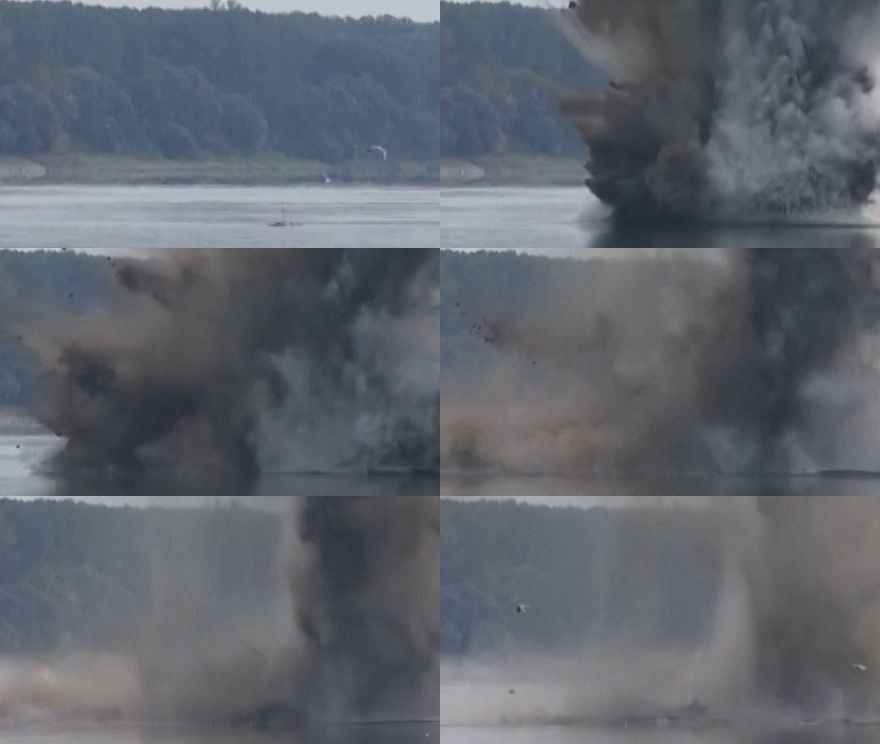
It was the dusty tail-end of summer when I stepped into a dystopian scene at a scruffy port on the Danube in Serbia in 2003. Usually one of Europe’s mightiest rivers, it was eerily shrunk: its level lowered so dramatically that the wrecks of old Nazi warships, unseen for decades, were poking above the sluggish waters. A line of tall marker poles, set up to measure the river’s depth, stood high and dry beside me, and the port itself, at Prahovo, was quiet; the normal convoys of barges that run from the Black Sea to the heart of Europe were paralysed because there wasn’t enough water to keep them afloat. At the time, the drought was considered so severe that it was described as “historic”. Shorts Two decades later, we’re in an even scarier and more uncertain territory, as the Danube has dropped to an even lower level, one of the most consequential symptoms of the latest punishing summer. At the root of it all are the repeated blasts of extreme heat, made far more likely by our overloading of the atmosphere with carbon. The heat has dried the soils and primed plants to burn, helping to make this year’s wildfires so extreme. It’s also left streams and rivers diminished or dead. The European Drought Observatory’s map marks the areas with the most serious shortages in red. There are a lot of them. It’s a view of a continent in trouble and shows the jaw-dropping scale of the current water crisis. The impacts of this are far-reaching and the responses are increasingly desperate. With the Danube and the Rhine now too shallow to handle the vessels that haul everything from chemicals to grain, the ripples are being felt by businesses across the continent. Europe’s largest port, Rotterdam, has reported a 10 per cent drop in traffic. Loads can be switched to trucks, if enough can be found, but they’re more expensive and more polluting. The wreckage of a Second World War warship emerges, due to the drought, in front of Djerdap II, a large dam on the Danube River between Romania and Serbia (Photo: Darko Vojinovic/AP) According to one estimate, every month of low water knocks around 1 per cent off Germany’s industrial production. Electricity supplies are threatened, too, and this is what most unnerves governments, because blackouts in a heatwave deprive people of the chance to stay cool with fans and aircon, and inevitably increase the death toll. But power stations – whether they’re run by coal, gas or nuclear fuel – depend on vast quantities of water for cooling, and have to reduce their output or even shut down if they can’t get enough of it. This is happening right now. Nearly half of Hungary’s electricity comes from its Paks nuclear power station, but it has had to close three of its four reactors because the Danube River is so reduced. The fourth may have to be switched off as well. Power can be bought from neighbouring countries, but prices are high. Hungarian citizens and businesses, urged to switch off where they can, have responded well despite the extreme heat: Budapest reached 39C this week. Nearly half of Hungary’s electricity comes from Paks nuclear power plant (Photo: Bernadett Szabo/Reuters) Romania, facing a similarly drastic scenario, has turned to one of the most outlandish measures of all: setting off a spectacular underwater explosion to clear the Danube of an outcrop of rocks. The aim was to improve the water flow to its beleaguered but vital nuclear power station, which has been forced to shut one of its two reactors – and may need to close the second if the water flow to its cooling systems can’t be maintained. Car factories in Romania are now pausing production for a fortnight, which should help cut demand for electricity. Further up the Danube, Serbia is being hit in notable ways. The reduced water flow caused by the drought means its biggest hydro-electric plant is generating far less power than usual. And one of its coal-burning power stations, Kostolac, has also had to scale back its output. I filmed at Kostolac a few years ago while it was being expanded as part of China’s controversial Belt and Road Initiative. The directors were proud of their project and never mentioned that it could be humbled by a shortage of water. There’s another desperately worrying angle to the current droughts: food supplies. In France, the maize harvest is set to be the lowest for 50 years. The soil there has never been so dry at this time of year. Yesterday, I walked past a field of withered sunflowers in the south-west of the country, their leaves dark and heads bowed. Dying sunflowers in rural France (Photo: David Shukman) A major study two years ago estimated that water shortages could damage EU and British agriculture to the tune of up to €65bn (£56bn) a year. Everyone will feel the effect of that. When harvests are bad, prices surge, hitting all consumers but the least privileged in society the hardest. Right now, across Europe water providers and governments are having to balance demands, either limiting the use of water, for example with hosepipe bans, or encouraging people to be sparing. The logic is clear: the more we save, the less likely it is that the worst will happen, with supplies rationed or even cut off. That would lead to further agonising choices between cities, industries and farmers. Just as the warnings about climate change have largely gone unheeded, so too with water. For decades, experts have called for a serious effort to fix leaks, to build more reservoirs and to publicly explain the costs of waste. Budapest has implemented energy-saving measures, including switching off lights to try and ease electricity usage (Photo: Zsolt Szigetvary/AP) For a glimpse of how bad it could get, in Cape Town in 2018 people were rationed to 50 litres a day. The Colombian capital, Bogota, was so short of water from 2024-25 that, for a year, it imposed a rotation in which each district had its supply cut off for 24 hours every nine days. This is how climate change could ultimately play out, in the UK and beyond: in the gritty reality of taps running dry and people waiting their turn for water and power. It’s a sobering glimpse into the future, and one that suddenly feels far less unreal. For now, it’s only early August and, for much of Europe, there’s little rain in sight. David Shukman is a former BBC News Science Editor and author of The Response: A Story of Fire and Flood in Britain’s New World of Extremes (Witness Books)
River explosions and power plant shutdowns herald extreme drought measures for UK
Full Article
Original Source
Read the full article at Inews →KhanList aggregates and links to publicly available news content. We do not host full articles from third-party sources. Always verify important information with original sources.