
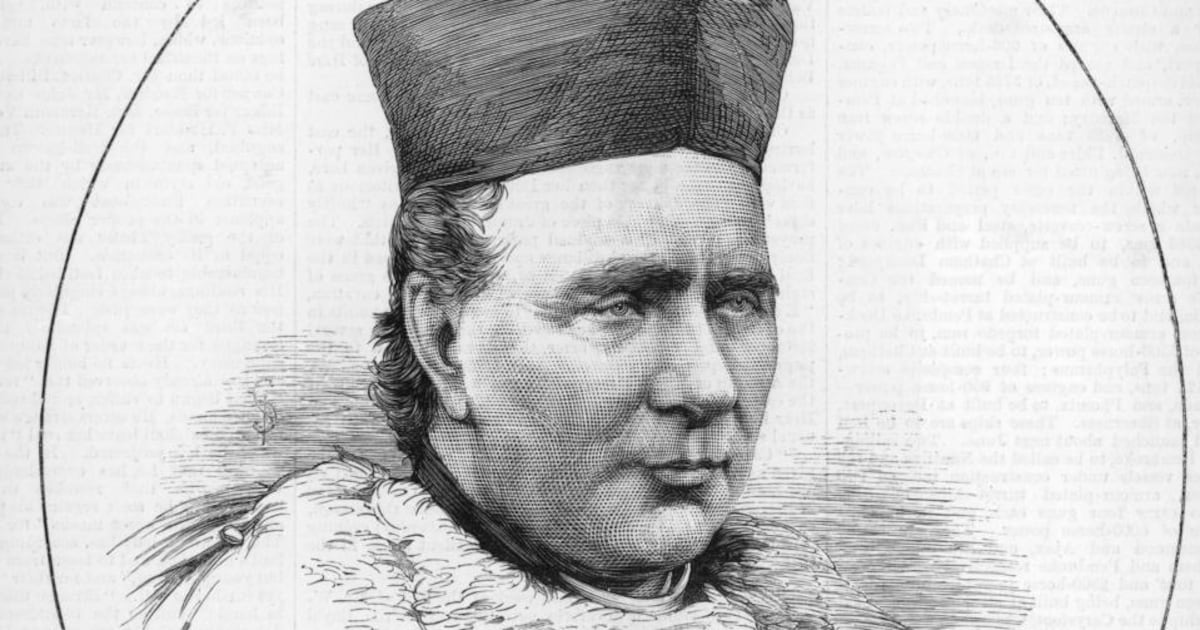
When Paul Cullen, Ireland’s first Roman Catholic Cardinal, died in October 1878, he was widely understood to have been both the dominant Irishman of his generation and a figure of global importance. The Times of London declared that for the previous 26 years: “No man in the kingdom has exercised a greater personal influence, or wielded more absolute power”; the New York Times called him “a power in the land” and the Sydney Freeman’s Journal published a six-page supplement commemorating his life. Requiem Masses were celebrated throughout the world, his coffin was drawn through the streets of Dublin in an open hearse, escorted by mounted police, and followed or observed by at least 100,000 people. Trains and trams were halted, flags were lowered, and the city ground to a halt. Many thousands more paid their respects at the Pro-Cathedral (now St Mary’s Cathedral) in Marlborough Street before the gates were finally closed. When he was buried the next day in a small vault beneath the chapel of Clonliffe College, there could be no doubt at all that his had been a consequential life. Some 143 years later, it was very different: Clonliffe had been sold, its contents auctioned, and the chapel closed. Cullen would have to be moved. This was done quickly and discreetly on the morning of June 25th 2021. READ MOREA brief service was held in the crypt, his remains were moved by van, and another brief service was held in the Pro-Cathedral. It was all over by 9.30am. The Irish Times noted the occasion in a short article. RTÉ’s news website allowed the event 210 words. Paul Cullen was no longer newsworthy. This did not happen overnight. For many years Cullen’s importance was unquestioned, even if his legacy was contested. James Joyce mocked him as an “apple of God’s eye”, for example, and he is reputedly the only person never to have set foot on the Continent to have received an entry in the Dictionary of Australian Biography. More than one old Fenian blamed him for Ireland’s continuing captivity. He was, as the Fenian novelist Charles J Kickham put it, “the deadly foe of Irish liberty.” Nor was it just nationalists who hated him. Cullen accumulated an impressive range of enemies: Irish Protestants blamed him for despoiling their church (and less plausibly for introducing sectarianism to the island); the Catholic seminary at Maynooth loathed him as a Romanising tyrant (and even now does not own a portrait of him); and the two-time British prime minister Lord John Russell, was convinced that Cullen looked “to force as the true mode of restoring the supremacy of the Roman Church”.Archbishop Dermot Farrell presides as the remains of Cardinal Paul Cullen are reinterred at the Pro-Cathedral crypt in Dublin As the idiosyncratic Sir Shane Leslie (who had himself briefly considered writing a biography of Cullen in the 1920s) put it: “At one time there was nothing too bad to be said of Cullen, even from his own countrymen.”If nothing else, it must surely be a singular achievement to have been disliked in equal measure by Irish patriots, Irish Protestants, the British establishment, and St Patrick’s College, Maynooth. Cullen clearly mattered.Yet, writing about Cullen is hard. There are masses of papers to work from – he is certainly the best documented Irishman of the 19th century – but they are in a formidably wide range of languages. (Cullen could read at least 10, including Arabic.) They are also widely distributed: for my book, The Irish Pope, I consulted more than 130 archives in 12 countries on five continents. He is also a difficult subject: he had no vices, no lovers and no sense of humour. Only a tiny handful of people called him Paul, only one person could unquestionably be called his friend, and his only discernible hobby was reading about Ireland’s past. His inner life is almost entirely unknown, even while we know what he did on an almost daily basis. Largely as a result there has never been a satisfactory biography.Yet coming to grips with Cullen is crucial. He was the most important Irishman in the generation between the death of Daniel O’Connell and the rise of Charles Stewart Parnell. Among other things, he bent the Irish church to his will, spread his own version of Irish Catholicism around the world, brought (now Saint) John Henry Newman to Dublin, crushed first the Independent Irish Party and then the Fenians, and proposed the formulation that defined the infallibility of the pope. It was also because of Cullen, the American historian Emmet Larkin argued in 1972, that the “great mass of the Irish people became practising Catholics”.Mid-Victorian Ireland can never be properly understood without sustained engagement with the man who stood at its political, social, and religious centre. As Leslie rightly noted of his own projected biography, “it would of course be writing the history of Ireland during the 50 years 1823-1878.”Colin Barr is Professor of Modern Irish History, Keough-Naughton Institute for Irish Studies, University of Notre Dame, USA. His book The Irish Pope: Paul Cullen, 1803-1878 will be published in Dublin next Thursday
Rite and reason: Cardinal Paul Cullen managed to be disliked by Irish patriots, Protestants and Britain
Full Article
Original Source
Read the full article at Irishtimes →KhanList aggregates and links to publicly available news content. We do not host full articles from third-party sources. Always verify important information with original sources.