
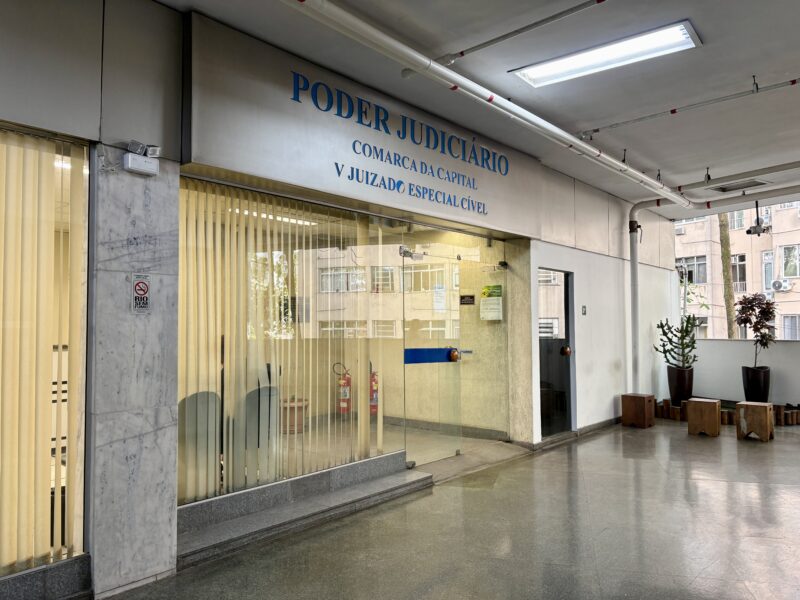
RIO DE JANEIRO (CN) — Erick Nunes, a supervising attorney with Estácio University’s legal clinic at Copacabana’s Fifth Special Civil Court which handles small claims, spent nearly half an hour helping a woman sort through three problems.She pulled a jar of coconut oil from a shopping bag and said it was expired when she bought it. Nunes told her to return to the store and, if necessary, contact health authorities.Then she said her pension payments had been cut off, prompting Nunes to refer her to Brazil’s National Social Security Institute. She later raised a third complaint involving a bank, pulling documents from a glittery pink folder.Scenes like this have played out for three decades at the small claims court in Copacabana. Court clerks said Monday marked its final day of hearings. The Rio de Janeiro state court, which oversees the unit, did not confirm the date of its closure.Inside Copacabana’s Fifth Special Civil Court, where residents could receive assistance and file small claims without a lawyer. (Marília Marasciulo/Courthouse News)The unit will give way to a court that handles claims against Rio’s state and city governments. Civil cases involving some 141,000 residents of Copacabana and Leme will be handled by seven small claims courts at the downtown courthouse, about 5 miles away.Brazil’s small claims courts gained constitutional status in 1988 and were regulated by federal law in 1995. Rio de Janeiro created the Fifth Special Civil Court the following May to serve residents of Copacabana and Leme. The court allowed residents to resolve less complex disputes worth up to 20 times the monthly minimum wage near their homes through simpler procedures and without a lawyer.Luciana Gross Cunha, a professor at Fundação Getulio Vargas Law School in São Paulo and author of a book on the creation and operation of small claims courts, said the model offered a simpler response to lower-value disputes that often went unresolved in the regular court system. Decentralizing the courts brought the judiciary closer to communities and reduced what Cunha called the “geographic barrier” to accessing justice.Three decades later, the Copacabana court received about 800 new cases a month, according to the Brazilian Bar Association’s Rio de Janeiro chapter.The hallway of the shopping center that houses Copacabana’s Fifth Special Civil Court. (Marília Marasciulo/Courthouse News)“The decision [to close it] affects access to justice, especially given the profile of the local population,” said Ana Tereza Basilio, president of the Rio bar association. “Copacabana has a significant population of older residents and people with mobility difficulties for whom traveling downtown poses a concrete barrier to accessing justice.”In 2010, the latest year with consolidated age data for individual neighborhoods, 43,431 Copacabana residents were 60 or older. They accounted for nearly 30% of the population, the largest number of older residents of any Brazilian neighborhood.Among them is retired engineer Jorge Carlos Alves Lima. He lives nearby, had already filed two cases without a lawyer and returned for guidance on a third.Lima was trying to cancel a 234 reais (about $46) service agreement with a medical laboratory. He said the company told him the contract required a minimum one-year enrollment, a condition he said had not been disclosed when he signed up. He filed a claim, but the court dismissed it after he missed a hearing scheduled while he was away.“It’s not about the money. It’s about feeling cheated,” he said.Lima also has a home downtown and said traveling there for future hearings would not stop him from returning to court. Yet the closure of the Copacabana unit is disappointing as getting assistance required only crossing the street.The Rio de Janeiro state court said in a statement that centralizing the cases would speed up proceedings. Residents of Copacabana and Leme will no longer be assigned to a single court and judge and will instead have their cases distributed among seven small claims courts downtown.Pending Copacabana cases will be divided among those courts, and parties and attorneys will be notified where their cases were transferred. Hearings will also take place downtown, though people with mobility difficulties may request to appear remotely.The state court will keep a walk-in intake desk in Copacabana for people filing small claims without a lawyer. Residents may also file online through the court’s Citizen Petition service.The resolution creating the new court cited an increase in cases involving public entities in 2025 as justification but did not include specific figures.The court also provided no data or projections supporting its claim that centralizing civil cases would speed up proceedings. It did not provide updated figures for the Copacabana court’s caseload, monthly filings or cases awaiting judgment, or confirm when the new court will open at the Copacabana location.The change also reflects a broader shift toward digital court services that accelerated during the pandemic, Cunha said. Remote access can help people who cannot travel and should remain an alternative to in-person service.“Brazil’s judiciary has been moving toward very little personal and physical contact with the state, but digital access has to be another option, not a replacement,” Cunha said.The National Council of Justice did not respond to questions about trends in the number of physical small claims courts, criteria for closing units and steps courts should take to preserve access to justice as services move online.Representatives of the local bar and neighborhood groups said the state court did not consult them before approving the Copacabana change. The Rio bar association said it learned of the decision only when the court published its resolution June 16.State court intern Diogo Carvalho, Estácio University legal clinic supervising attorney Erick Nunes and retired engineer Jorge Carlos Alves Lima at Copacabana’s Fifth Special Civil Court in Rio de Janeiro. (Marília Marasciulo/Courthouse News)Horácio Magalhães, president of the neighborhood association Amigos de Copa, said a court user alerted the group to the change. The association then reviewed the resolution and repeatedly requested a meeting with the president of the state court, and also joined a protest outside the court.“It’s already over,” Magalhães said. “What they’re doing now, they say, is a push to clear out the remaining cases. In practice, it’s like a locomotive. It doesn’t stop all at once.”Even staff members lacked some details about the transition Friday.Diogo Carvalho, a state court intern, said the team was telling users their cases and hearings would move downtown but did not yet know how the seven courts would handle them.“People are sad. They complain and ask questions, but there’s nothing we can do. We just have to follow orders,” he said.Nunes expects users to face difficulties when they need to appear downtown.“The courthouse is huge,” he said. “Even finding the right place is complicated.”Courthouse News reporter Marília Marasciulo is based in Brazil.Subscribe to our free newslettersOur weekly newsletter Closing Arguments offers the latest about ongoing trials, major litigation and rulings in courthouses around the U.S. and the world, while the monthly Under the Lights dishes the legal dirt from Hollywood, sports, Big Tech and the arts.Additional Reads
Rio closes Copacabana small claims court after 30 years
Full Article
Original Source
Read the full article at Courthousenews →KhanList aggregates and links to publicly available news content. We do not host full articles from third-party sources. Always verify important information with original sources.