
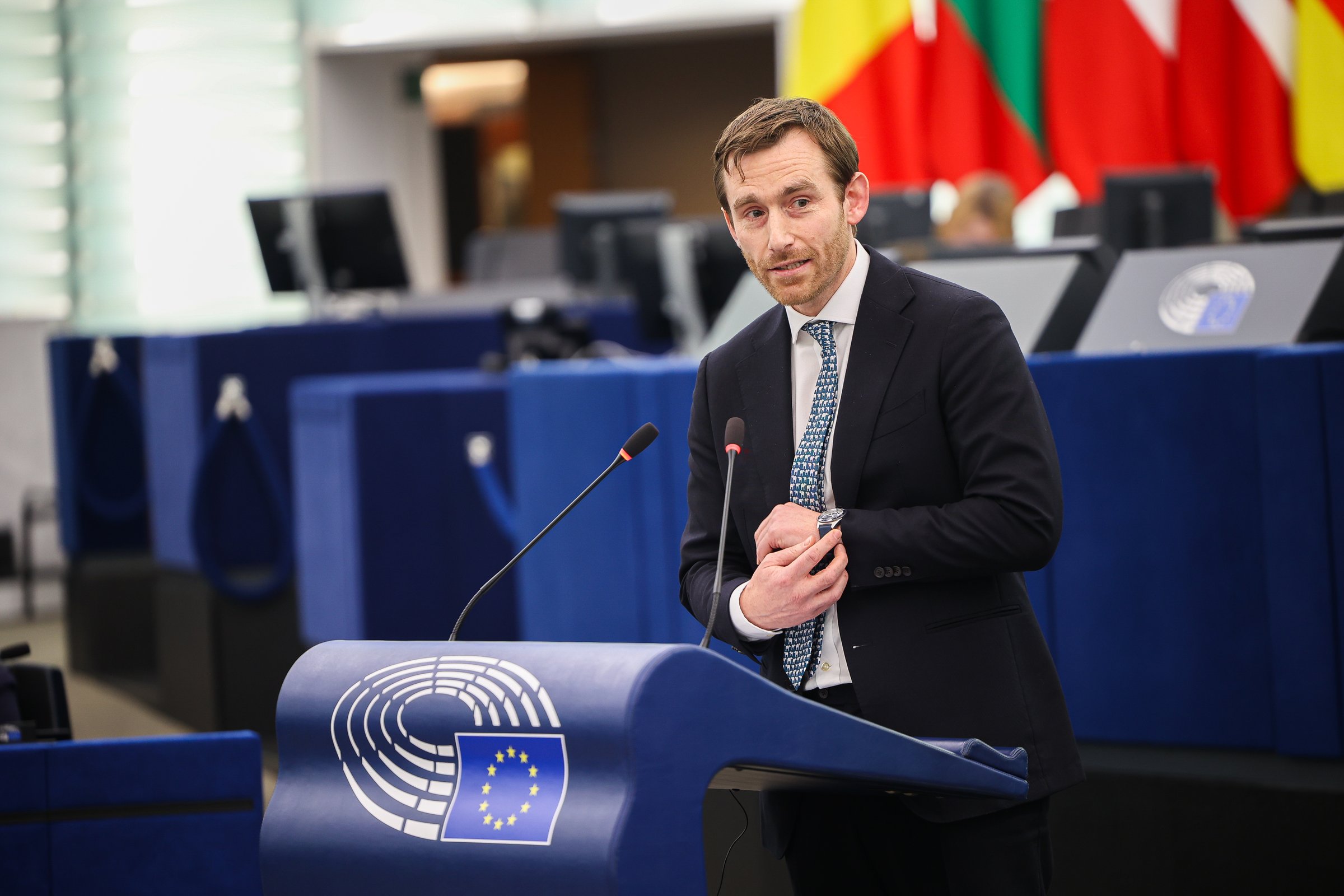
After a year of scrutinising NGO funding, rightwing MEPs have come up empty-handed — but full of new ammunition to dismantle civil society budgets: vague notions of “reputational risk” and “perceived” political alignment. A 71-page report, which was shared with EUobserver ahead of its presentation in the European Parliament on Wednesday (18 November), acknowledges that the evidence gathered by the Scrutiny Working Group (SWG) was insufficient to establish wrongdoing or financial misconduct by either NGOs or the European Commission. “On the regularity of expenditure, from the information provided to the SWG, clear and definitive conclusions could not be drawn out,” the report says. When it comes to lobbying EU institutions, the authors, Dutch centre-right MEP Dirk Gotink and Italian conservative Carlo Fidanza, also admitted that no proof was found when assessing whether advocacy was mandated or required by EU authorities. The report explicitly states that the evidence “does not allow to quantify the extent to which EU-funded advocacy altered specific legislative outcomes or distorted EU decision-making” and that available data “does not allow a reliable monetary quantification of amounts granted specifically for targeted activities towards EU institutions”. Put simply, after a year of scrutiny, the “group” could not establish a single breach of rules. And while one might assume that establishing any sort of wrongdoing was the inquiry’s main aim, Gotink made it clear in the past that this was not the point. “The problem that we’re pursuing here is not to establish whether things are illegal, it is to establish whether politically it is undesirable,” he said, during a hearing back in February. So with no findings of breaches of EU law or financial wrongdoing, the two MEPs turned instead to subjective criteria like "reputational risk”, "propriety", and "perceived conflict of interest”. In the report, they described a “persistent perception” of closeness between the commission and NGOs receiving EU funding, arguing that this raises questions about “the effective separation of powers” — their argument to justify defunding European civil society, seeking to achieve politically what they could not justified legally. So what does a year of inquiry actually produce? A list of suggestions to the EU commission, including five-year funding bans for those lobbying EU and national institutions, the phasing out of core operating support, and administrative ring-fencing requirements. In a statement, German Green MEP Daniel Freund described it as "a purely ideological project". "What we are seeing here is an attack on freedom of expression," he said. "Anyone who receives EU money is expected to shut up. Yet no wrongdoing has ever been proven against these organisations," he added. Whose perception? Nowhere in the report do the authors explain whose perception is actually being harmed. No survey is mentioned, and not a single NGO or beneficiary was interviewed for the report — yet this “persistent perception of a conflict of interest, or at least of insufficient institutional distance” seems to be presented as hard evidence.
Rightwing MEPs switch attack from facts to ‘perceptions’, after a failed witch-hunt against NGOs in Brussels
Full Article
Original Source
Read the full article at Euobserver →KhanList aggregates and links to publicly available news content. We do not host full articles from third-party sources. Always verify important information with original sources.