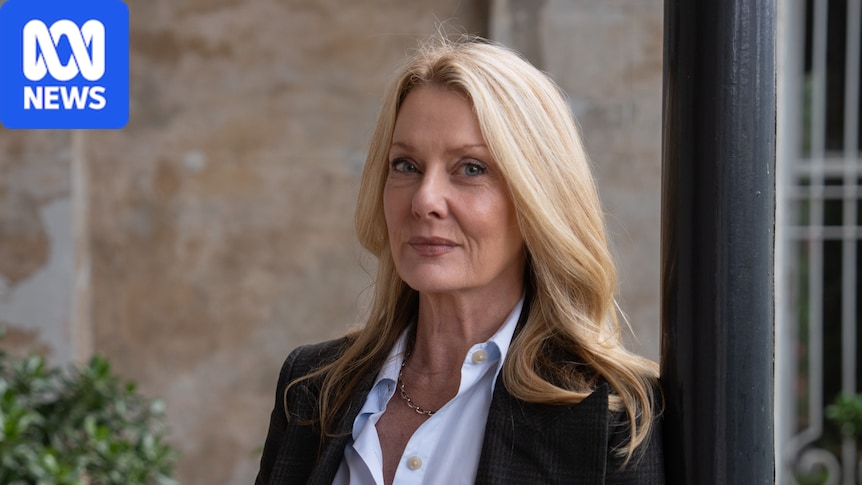
As a student living in West Berlin in the late 80s, Anna Funder would sit with her friends, a clique of East German creatives exiled from their country for criticising the regime, at a café near the Berlin Wall. For Funder, the walled city deep inside the Eastern Bloc represented the Cold War politics and the oppressive nuclear threat that defined the postwar period. But West Berlin at the time was an exciting place to be, full of artists, writers and conscientious objectors escaping compulsory military service. Funder, who was 20, was fascinated by the fact that 100 metres away, on the other side of the wall, were her friends' former lives — a whole network of friends, family and acquaintances — that were now unreachable. Funder returned to Australia where she worked as an international lawyer before publishing her first book, Stasiland, telling the stories of people who resisted the East German secret police known as the Stasi, in 2003. Stasiland made several shortlists and won the 2004 Samuel Johnson Prize, now known as the Baillie Gifford Prize for Non-Fiction. Anna Funder was born in Melbourne and, as a child, lived with her family in San Francisco and Paris. (ABC News: Jack Fisher)Two decades on, Funder is the author of All That I Am (2011), which won the 2012 Miles Franklin Literary Award, and Wifedom (2023), a hybrid work of biography, memoir and fiction exploring the life of George Orwell's wife, Eileen Blair, and her overlooked influence on his writing.Funder, who was recently appointed as a professor of practice in creative writing at Sydney University, is about to embark on a national speaking tour to discuss the provenance of her three acclaimed literary works. She sat down with ABC Arts to chat about AI, the state of democracy and her favourite Australian books. You trained as a lawyer, so how did you end up becoming a writer? I always wanted to be a writer [but] I'm very happy that I did law. I think it equipped me well for certain situations — facing down Stasi men who wanted to lecture me about human rights in their system. What drew you to write your first book about the East German Stasi? The [Berlin] wall fell in '89, so not long after I was there; I left in '88. No-one had any idea it would fall. Really, no-one. I went back on other little fellowships while I was working as a junior lawyer. I was fascinated by the fact that the wall was down now, so it was possible to go into this country which had been walled in, to go and speak to people who had lived there. It was like an investigation of my friends' past: what was this regime that kicked out its best and brightest, its artists? That was fascinating to me. Anna Funder studied under Hilary Charlesworth, who became the first Australian female judge to serve on the International Court of Justice. (ABC News: Jack Fisher)And then I came across the story of Miriam, which bookends Stasiland. I was told about someone whose husband had died in Stasi custody but, actually, Miriam's story went way back to when she was 16 years old, in 1968. She had protested about the destruction of a beautiful church in Leipzig and was arrested. It's a long and tricky and crazy story about Stasi methods, Stasi interrogation, Stasi paranoia, persecuting children and eventually of her trying to escape the country over the wall in Berlin, right near where I used to sit. It's a really extraordinary and wonderful story. It's one of the privileges of my life to have met her. I knew as soon as I had that story that that would be one of the best stories I would find, and it was. I felt like I was getting up close to human courage and conscience in its purest and most extreme form in her. How liberating, or not, was it to then fictionalise a true story as you did in All That I Am, after you had told the story of the Stasi in non-fiction? I had wanted to write a novel but the stories in Stasiland were not right to tell in fiction, it became clear to me, because the regime was too extreme to be believable. It was not believable that they collected people's dirty underwear, put it in jars to train dogs, to track dissidents. And it was barely believable that courage like Miriam's existed, the courage to refuse to inform or betray, no matter what the state would do to you. And the other thing was that the Stasi men were still walking around Berlin, largely unpunished — still the case. It seemed morally wrong to write a fiction out of stories that needed to be told in truth and needed to be put on the historical record. All That I Am is based on a true story, but it was a story of very, very early resistance to Hitler that had never been told. When I was telling it — I started writing it in 2006, it was published in 2011 — all the people in it were dead and I felt less beholden to real people. I wanted to write a book that made them live again. It was a great liberation. How did you settle on the three-pronged structure of Wifedom? The form of the book comes out of what truth is it that I'm trying to tell. I don't set out with a form in mind. Wifedom was terrifying to write because I'd never read anything that was formally like this. I had no models, but I was writing the story of Orwell and the story of how his biographers had eliminated his feminist suffragette, Fabian mother and aunt from his story, which is obviously where his underdog perspective comes from, which we all find so charming, and eliminated, most importantly, his brilliant wife. So that was an essayistic thing. But at some point, the fiction writer in me just couldn't bear it, and I had to bring Eileen back to life. I had her letters to her best friend from Oxford days, which are hilarious and very revealing of her and her marriage. I got permission to use them, so I could write scenes in which she's writing her real letters, but also other scenes in Spain and when she's dying. I wanted Eileen to live again. I didn't want her to be someone who was just written about by me. I wanted her to be somebody who, often in her own words, will live on in people's minds. Formally, it's risky to mix fiction and nonfiction and memoir and a feminist analysis of six major biographies of a major 20th-century writer. It's risky to put things very clearly on the public record that have been very deliberately hidden: his repressed homosexuality, his sadism, his paranoia, his infidelities, his complexity out of which the work comes. Was there any blowback from the Orwell fans? Yes. The Orwell fans have a fan club, which is a charity called The Orwell Society. It's not a learned society, as its name might imply. George Orwell and Eileen adopted a boy, a baby, in 1944. His name is Richard Blair, and he and his friend Quentin Kopp are behind this fan club. And while Richard Blair says that he thinks, for instance, that his mother had a much greater role in writing Animal Farm than she's usually given credit for, they know that everything in Wifedom is true, but they're not used to Orwell being looked at from Eileen's point of view, or my imagined Eileen's point of view, and a woman's point of view, and I think that that's difficult for them to integrate. Anna Funder says a novel would not show the sly ways in which history has hidden Eileen Blair. (ABC News: Jack Fisher)I think that they would rather think about Orwell as he wanted to think of himself: as a decent, upstanding, heterosexual man, whereas somebody who was so vanilla could never have had the vision, say, for Nineteen Eighty-Four, which is paranoid and sadistic and wonderful for us. Having studied totalitarianism, what do you make of Western democracy at this moment? I think it's under threat from within and without. The number of democracies in the world is diminishing. The democracy in the US is white-anted or moth-eaten or whichever insect metaphor you like. I lived there with my husband and children for three-and-a-half years during the Obama period, which now looks like halcyon days, but it felt to us like we were inside a dying beast. It is touted as a democracy, but democracies vary. And in a democracy where you have no right to healthcare that isn't connected to your employer, people are very vulnerable and the level of freedom and dignity that they have is much diminished. If you get cancer, you will go bankrupt and have to sell your house because very likely, even if you are employed, your insurance will not cover treatment. Also, 60 per cent vote. It is a less robust democracy in terms of its structures than Australia, where we have compulsory voting, preferential voting. These things are rare. We have an electoral commission that deals with gerrymandering. We have limits on political donations, so companies cannot, as they can in the States, effectively buy a politician to represent them. And we are not such a religious country, so we don't have faith in prayer. We want practical, real solutions. Worldwide, the rise of largely right-wing populism is something to be taken very seriously. It's a threat to democracy because it's essentially an anti-democratic, quasi-fascist movement that is extremely anti-women — we have Pauline [Hanson] coming out against childcare, against abortion, against parental leave. It's tricky times for democracy. We need to really protect it and cherish it. What is your view on AI and the arts? In order to make AI have content, it's not enough to scrape the internet and everyone's emails. If you want high-quality content, it comes from books, so what the tech companies have done is steal all books in violation of copyright. These businesses are worth vast amounts of money. Of course, your business will be worth more money if you do not pay for the raw materials you are using and then offering up for a fee eventually. And the raw materials are the thinking and research and writing and creative thinking in all of our books. A massive crime has occurred, and the tech companies have been lobbying the government to retrospectively make that copyright crime and theft legal, which the government is holding firm on. We should not be giving all of our best thinking, music, art and films away for free to be broken up for parts and offered up as answers to AI questions. People will not continue to make work if we're not paid for it. There's no point in me writing a book if it's immediately stolen and distributed globally for free. It's not difficult to establish a consent and licensing scheme for money, and that's what needs to happen now. We've done it for every other technology that's existed. We do it for universities, we do it for photocopying, we do it for electronic lending, we do it for libraries. If you can be made to pay $5.99 on your television at home for a movie that Netflix is offering you, the tech companies can easily be made to pay for our books. What do you make of the prime minister's recent comments on the issue of AI and copyright?Big Tech has been walking the corridors of Parliament House for months, lobbying politicians hard to gut copyright instead of talking to us, the creators whose works they need, have stolen, and wanted for free in future.It was a magnificent speech by the prime minister, putting the regulations and guardrails to come on AI into the context of other Australian innovations and protections such as Medicare, universal voting, universal superannuation and the under-16s social media ban.Big Tech won't want to behave legally in Australia because it would be the first jurisdiction to make them do so — but Australia is good at firsts. We now need the government to require them to negotiate consent and licenses with us, or not be given permission to set up here with our stolen goods.What do you think AI's impact will be on human creativity? Because I wonder what is the future of the novel when we can't necessarily trust that a human has written what we're reading? Art is about human connection. A novel is a way in which you can see inside other people's minds: the writer's, for one thing, and the characters that they're presenting to you. And that's extremely fundamental to our self-knowledge, to pleasure, to connection, to community, to solace, to consolation. I have no interest in reading a book written by AI. A novel written by AI is a category error. Watching a short grab of a cat playing basketball is one thing, but a novel is totally another. I think that we are going to value the products of genuine human creativity more in an age of dross and slop and stolen material. I think AI will find its place. I think it's going to be an incredibly useful tool for number-crunching statistically, in medicine, in all kinds of things. In the arts, no. And they need to pay. They need to get consent for our work and pay us. This year, Radio National is asking people to vote for their top 100 Australian books. What are some of your favourites? I've just been looking at an essay I wrote about Jessica Anderson's Tirra Lirra by the River, a beautiful novel, and also about Christina Stead's The Man Who Loved Children. I think it's her best book; it's a liberation coming-of-age story. They are absolutely extraordinary Australian novels, and they were very formative for me. More recently, I loved Fiona McFarlane's Highway 13, which I thought was incredible. I would also recommend all the books, particularly The Watchtower, of Elizabeth Harrower, a writer who was forgotten for many years. Our literature is so wonderful, thriving, and it's the only way that we know what we're thinking and what we're feeling and who we are. An Evening with Anna Funder is at Perth on July 31; Adelaide on August 2; Sydney on August 4; Brisbane on August 6 and Melbourne on August 10.Quotes have been edited for clarity and brevity.
Right-wing populist politics is 'extremely anti-women', warns Anna Funder
Full Article
Original Source
Read the full article at Abc →KhanList aggregates and links to publicly available news content. We do not host full articles from third-party sources. Always verify important information with original sources.