
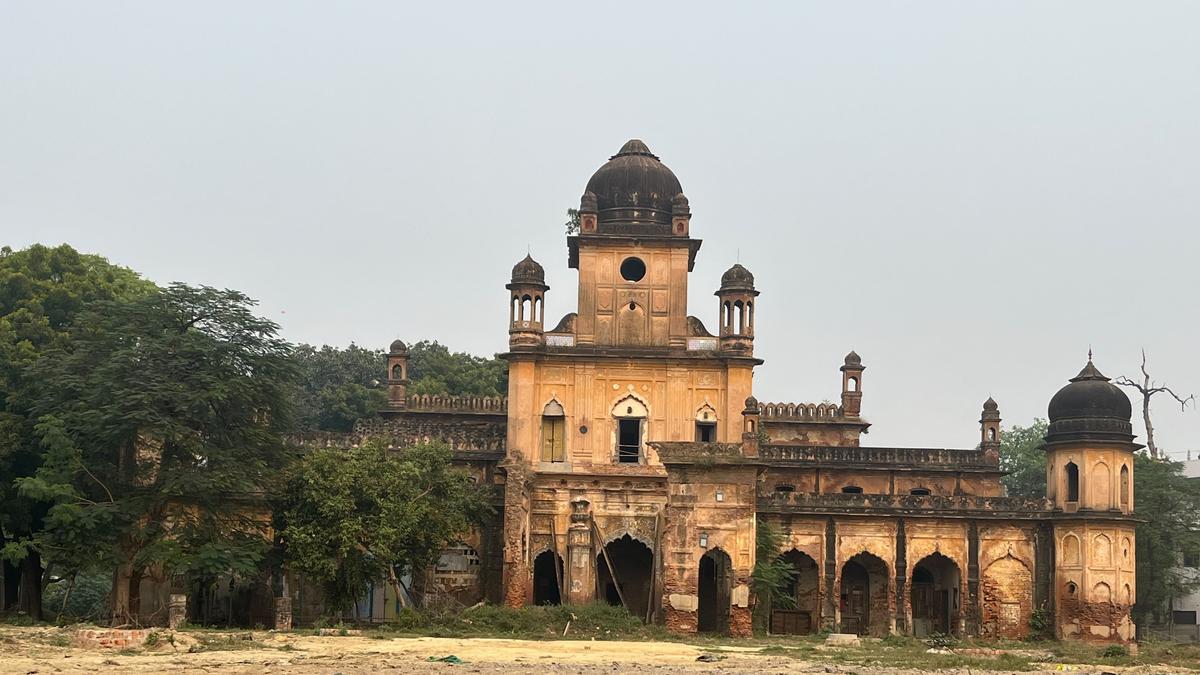
At Lucknow’s Rifa-e-Aam Club, there is little sign of activity on the day of my visit. Bricks, cement and other construction material lie scattered across the premises, while the building’s peeling paint, damaged walls and broken sections bear the marks of years of neglect. This was once one of the city’s most important meeting grounds for political leaders, writers and intellectuals.Rainwater has left parts of the site waterlogged and muddy. Workers had not come in. One security guard sits at the entrance and another in the building’s verandah. The guards say restoration that had begun earlier this year has been stalled for the last four months, for reasons unknown.Against this backdrop of decay came a new promise of revival. In July 2026, the Lucknow Development Authority (LDA), which has administrative oversight of the building, and the Indian National Trust for Art and Cultural Heritage (INTACH) announced a ₹10-crore restoration projectthat envisages transforming the historic building into a heritage conservation and research hub, with laboratories and training facilities for students of history and architecture.The ambitious plan raises a question: can restoring Rifa-e-Aam also revive the political and literary legacy that made it significant? Politics and literature met at Rifa-e-Aam. | Photo Credit: Laraib Fatima Warsi Relic in the localityFor Shifa, a student who lives nearby, the building is familiar, but its history is not. She knows its literary significance, but not its place in India’s freedom movement. “I haven’t really thought much about it… you go to college, study and come back,” she says. “But if it is important, people should know about it. It should definitely be restored.” In 1920, Mahatma Gandhi addressed a gathering at Rifa-e-Aam Club on Hindu-Muslim unity. | Photo Credit: Laraib Fatima Warsi Rakshanda Jalil, literary historian. “Rifa-e-Aam was not a benign gathering of poets and writers talking about romantic, sentimental things. It was, in every sense, a coming together of literature and politics. The progressives believed that what came from a writer’s pen had to connect with the world. They did not believe in art for art’s sake, but in art for life’s sake.”Rakshanda Jalil Literary historian Literary historian Rakshanda Jalil points to the 1936 Progressive Writers’ Conference at Rifa-e-Aam as a particularly significant moment, when writers were encouraged to break free from established literary conventions and forge new forms of writing. Aarav, 29, who recently completed his MBA, had read about Rifa-e-Aam. “We don’t pay much attention to our heritage. If we did, it wouldn’t be in this condition. Life is very fast, I agree, but this is our legacy and history…we need to pay attention to it.” Built in 1860, Rifa-e-Aam had become part of Lucknow’s public life. | Photo Credit: Laraib Fatima Warsi Restoring India’s historic buildingsHere are three other Indian historical buildings currently undergoing conservation/restorationGanga Mahal, VaranasiBuilt in 1865 by Maharaj Jiyajirao Scindia. Ganga Mahal suffered damage after parts of the building collapsed following heavy rains in 2011. INTACH undertook emergency stabilisation and structural strengthening from 2012, with Phase I completed in 2014. Phase II, begun in 2019, is ongoingGovernment Public Library, PrayagrajEstablished in 1864, the British-era library is being restored under an agreement with Prayagraj Smart City Limited (PSCL), with INTACH as the conservation consultant. The project is being carried out in phases because the library remains in use, causing delays since 2023.Vadia Palace, RajpiplaBuilt in 1939, the palace building, which is also known as Indrajit-Padmini Mahal, now houses the Gujarat Forest Ranger’s College. INTACH’s Phase I structural restoration and waterproofing was completed in 2021. Phase II is ongoing, with the Oriental Room restoration completed. On April 10, 1936, Rifa-e-Aam hosted the first All-India Progressive Writers’ Conference, with Munshi Premchand as its president. | Photo Credit: Laraib Fatima Warsi A meeting ground for ideasLong before the Progressive Writers’ Conference of 1936, it was a venue for political meetings, public speeches and literary gatherings. Built in 1860, Rifa-e-Aam had become part of Lucknow’s public life as nationalist politics and debate gained momentum in the city.“Lucknow had a special importance during the freedom struggle. Its composite culture and history of Hindu-Muslim unity made it a natural meeting ground when the Congress and Muslim League sought to come together,” says local historian Roshan Taqui. Lucknow historian Roshan Taqui. | Photo Credit: Laraib Fatima Warsi In 1916, Lucknow hosted the historic joint sessions of the Indian National Congress (INC) and the All-India Muslim League (AIML), which culminated in the Lucknow Pact, an agreement on constitutional reforms and Muslim representation. In 1920, Mahatma Gandhi addressed a gathering at Rifa-e-Aam Club on Hindu-Muslim unity, adding to its history as a site of public political debate.But politics was only part of its story. The building would acquire an equally important place in the history of modern Indian literature. Long before the Progressive Writers’ Conference of 1936, it was a venue for political meetings, public speeches and literary gatherings. | Photo Credit: Laraib Fatima Warsi On April 10, 1936, Rifa-e-Aam hosted the first All-India Progressive Writers’ Conference, with Munshi Premchand as its president. The gathering brought writers from across India together around the idea that literature should engage with the realities of everyday life. In his address, Premchand called for a new understanding of literary beauty, urging writers to find subjects in the lives and struggles of ordinary people.“This was not a benign gathering of poets and writers talking about romantic, sentimental things. It was, in every sense, a coming together of literature and politics. The progressives believed that what came from a writer’s pen had to connect with the world. They did not believe in art for art’s sake, but in art for life’s sake,” says Jalil. Anis Ashfaq, former head of the Urdu department at Lucknow University. | Photo Credit: Laraib Fatima Warsi For Anis Ashfaq, former head of the Urdu department at Lucknow University, its importance lies in the lasting impact the 1936 conference had on Urdu literature. “Rifa-e-Aam is a turning point in Urdu literature. If that conference had not taken place there, our Urdu literature would not be what it is today because of Premchand’s keynote address,” he says. Beyond restoring the wallsWhile the ideas associated with Rifa-e-Aam have endured, the building has struggled to survive. “Buildings have their own journeys, much like people. After Independence, the systems of maintenance and patronage that once sustained them may have disintegrated, while administrative and funding problems can also lead to deterioration,” says Vandana Sehgal, architect and dean at Dr. APJ Abdul Kalam Technical University. Vandana Sehgal, architect and dean at Dr. APJ Abdul Kalam Technical University. | Photo Credit: Laraib Fatima Warsi For Sehgal, preservation is also about how such spaces are presented to the public. Unlike monuments associated with royalty or religion, ordinary public spaces where political and literary ideas were debated may not automatically command the same attention. “It is not about the monument but about the idea, how we project it,” she says.Roshan Jacob, who worked on Rifa-e-Aam’s conservation during her tenure as Lucknow divisional commissioner, during 2018-23, recalls the extent of its neglect. “My memory of Rifa-e-Aam is connected to encroachment, sadly. The complete disregard for history is what struck me the most, and that stays with me,” she says. For Jacob, conservation cannot end with repairing a structure. It must also find a contemporary purpose for it. “We cannot just conserve the bare building; we have to preserve what it originally signifies. No conservation will last unless you link it to the modern day. Otherwise, a monument can simply return to ruins and dead silence,” she says. The LDA restoration proposal includes a heritage centre with a conservation laboratory, reference library and digital archive. | Photo Credit: Laraib Fatima Warsi Awaiting a new lifeIn a written response, former LDA vice-chairperson Prathamesh Kumar says, “The proposed intervention is not just about restoring the Rifa-e-Aam Club as a historic building but about giving it a meaningful and sustainable new life.” The proposal includes a heritage centre with a conservation laboratory, reference library and digital archive, alongside exhibitions, workshops, lectures and guided tours. Questions about the proposed cost, funding, timeline and extent of the restoration were sent to the LDA but the authority had not responded at the time of publication. For Ravidas Mehrotra, Samajwadi Party MLA from Lucknow Central, the building’s value lies in more than its physical structure. “It is not appropriate to call Rifa-e-Aam merely a building. It is not just a building, it is history,” he says. Ravidas Mehrotra, Samajwadi Party MLA from Lucknow Central. | Photo Credit: Laraib Fatima Warsi Yet, bringing that history back into public view may be as challenging as restoring the structure. With younger people, just like Shifa and Aarav, being less familiar with Lucknow’s forgotten historic buildings, Ashfaq sees a growing generation gap. “They are not told these things in the way they were told before,” he says. Historian Jalil describes places such as Rifa-e-Aam as “repositories of the past”.For Rifa-e-Aam, the challenge now is to ensure that its revival, once it resumes, goes beyond repairing its physical structure. It must also reclaim a place in the city’s public life, where the political debates and literary ideas it once hosted can be remembered, explored and passed on to another generation. Whether the proposed heritage centre can make that possible remains to be seen. The writer is an independent journalist based in Lucknow.
Rifa-e-Aam Club: Can Lucknow revive its forgotten literary and political legacy?
Full Article
Original Source
Read the full article at Thehindu →KhanList aggregates and links to publicly available news content. We do not host full articles from third-party sources. Always verify important information with original sources.