
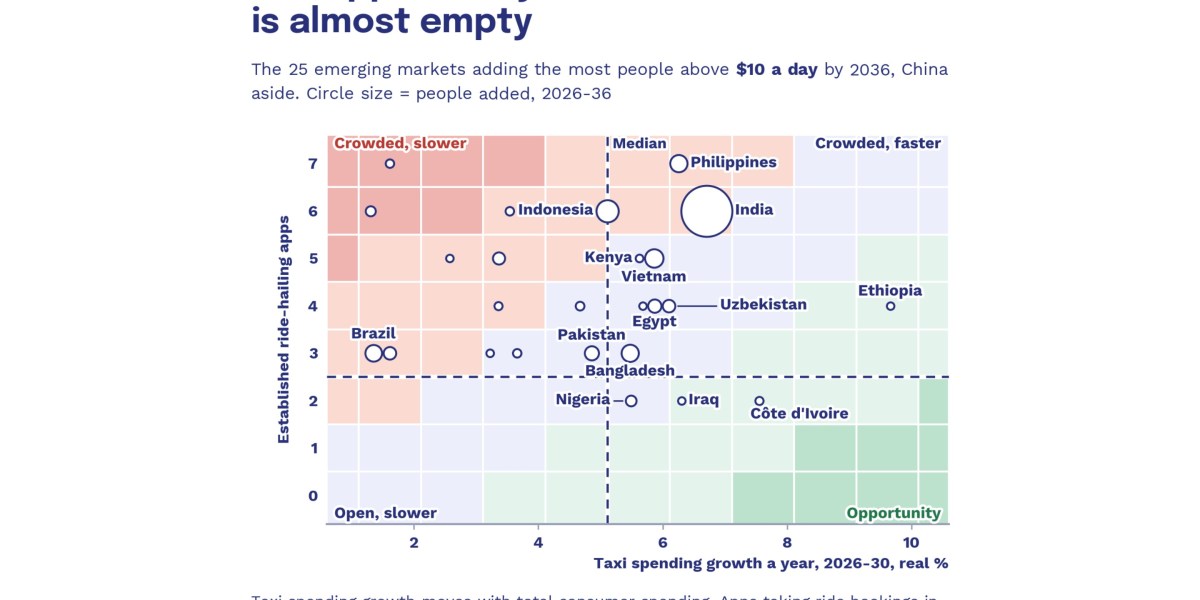
Whether or not to go somewhere else is predicated on addressable market size. Household surveys in India and Mexico show families moving from motorbike rides to car rides once their household spends about $1,200 a month, or $300 a person, at today’s market prices. By 2036, some 850 million more people in emerging markets will spend more than $300 a month and become the likeliest new customers for car rides. About half of them will live in India and China, with Indonesia, Vietnam, the Philippines and Bangladesh adding another 125 million. They will include about 200 million members of Gen Z and about 420 million women. However, nearly 9 in 10 will live in markets where at least three established apps already compete. The problem with betting on expansion is that the largest growth markets are already the ones the apps fight over. An app can be considered established if it has more than a million downloads, 5% of local rides or 10,000 drivers. Of the 25 emerging markets adding the most new customers, only Iraq, Nigeria and Côte d’Ivoire have fewer than three established apps in their largest city. Even the markets growing fastest have filled up before a newcomer could arrive. Kenya’s taxi spending should still grow by almost 6% a year, yet five apps already take bookings in Nairobi, while Ethiopia, the fastest grower of the 25, already has four. Courtesy of World Data Lab The markets still open are too small to deliver material growth. Three markets now drawing new entrants, Namibia, Botswana and Mozambique, will add about 2 million people spending more than $300 a month by 2036, compared to 35 million in Nigeria, Egypt, South Africa and Kenya. Entering uncontested markets buys a firm little addressable demand. One sizable opportunity is that, within these countries, new customers will be widely distributed beyond the capitals. Outside China, the biggest cities will add the most, about 118 million people by 2036. Smaller towns will grow fastest, and secondary cities such as Patna in India or Can Tho in Vietnam will more than quadruple their customer numbers from a small base. The few fast-growing cities with only one or two are small African markets such as Maputo and Lomé, although together they hold only about 1% of new customers. A crowded market is also worth more to a ride-hailing app than its rides alone. In emerging markets, spending on restaurant meals will double to about $3 trillion a year by 2036, growing faster than grocery spending. Gen Z already puts 6.1% of its budget into eating out and 3.3% into ride-hailing, against 5.5% and 2.6% for people aged 45 to 64. As Gen Z gets richer, they will drive spending growth towards meals and rides. By 2036, nearly two in three Southeast Asians spending at least $300 a month will buy goods online, up from about half, and more than three in four of those in their late teens and twenties. Like today, many of them will order dinner through the same app they use to get home. So little open ground would be bad news, if crowded markets had nothing left to give. Yet they still hold most of the growth, especially given riders spend more on more expensive rides as they get richer, not just because there are more of them. In India, the Philippines and Brazil, the share of households paying for a car ride rises from about 4% in the lower middle class to around 20% among the rich. Seen this way, the cheap rides in this quarter’s results look less like the race to the bottom and more like an entry fee. The riders who take cheap motorbike trips now will become the likeliest car-ride customers once their spending passes $300 a month. If incomes rise as forecast, most future car rides will be booked by people who are budget riders today. Most of them live in countries the apps already serve. New countries make for good earnings calls but will add few customers. For ride hailing companies, what matters is how many budget riders can start to afford more expensive rides, when they pass that threshold, and in which countries and cities they live. There is almost no white space left in ride hailing: growth now follows the competition.The opinions expressed in Fortune.com commentary pieces are solely the views of their authors and do not necessarily reflect the opinions and beliefs of Fortune.
Ride hailing’s next 850 million riders mostly live where three apps already compete. Growth means trading them up
Full Article
Original Source
Read the full article at Fortune →KhanList aggregates and links to publicly available news content. We do not host full articles from third-party sources. Always verify important information with original sources.