
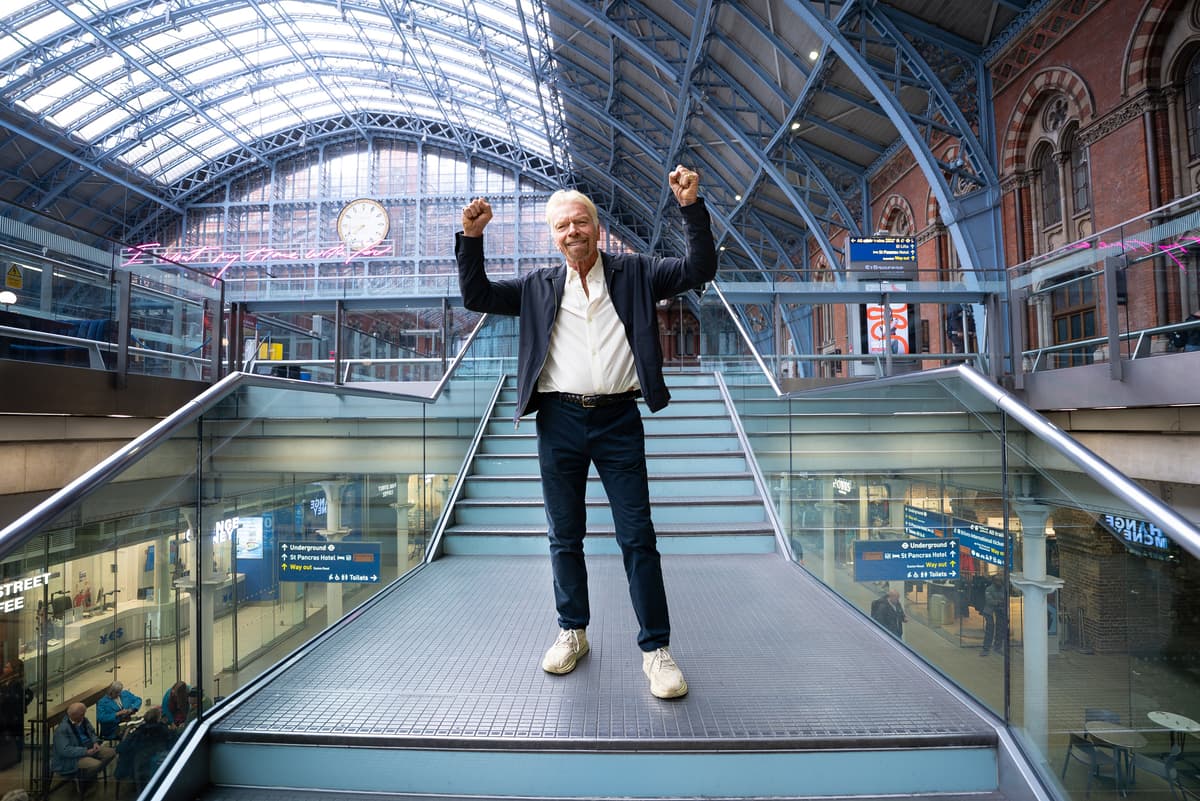
At a private meeting of senior business folks this week, the chat turned to who is best able to convey a brand’s core values, who does the smartest job of selling themselves and their company. A single name elicited approving nods around the table. Richard Branson. One of those present told how he was due to board a Virgin flight from the US back to London, when the news came through it was cancelled due to a technical problem with the aircraft. Automatically and smoothly, he said, the passengers were gathered together, told exactly what was occurring and taken to a luxury airport hotel. There they stayed until the following day when they flew to the UK. He compared it with his experience of other airlines and how they behaved in such circumstances and could not fail to be impressed.What struck him was how personal and attentive the service was, how the staff knew what they were doing and how, as he put it, they behaved “as if they were Richard Branson”. Don’t worry, this is not an advert for Virgin. Even Branson’s carrier is not without its faults. But it says a lot that there we were, with Branson, now Sir Richard of course, in his 76th year and he was the only person to feature. It’s as if British business has stood still all these decades, only able to produce a single leader who, where reputation is concerned, stands head and shoulders above the rest.Remarkable really and a huge tribute to the entrepreneur — who founded Virgin Atlantic 42 years ago and went on, along with his existing music label and retail chain, to spawn the Virgin empire — that he remains out on his own. He was knighted in 2000, was included in Time magazine’s “100 Most Influential People in the World” in 2007, has long lived on his Necker Island in the Caribbean, recently lost his beloved wife, Joan, but remains commercially active and committed.Sir Richard BransonPA WireAn abiding characteristic of the Virgin magnate is that underneath Branson’s casual demeanour he is a born fighter, far more disciplined than his image suggests and fiercely determined. Which is why he has just landed a deal that means so much to him — to run train passenger services across the Channel.In all likelihood, Virgin will secure the necessary licences. It’s previously secured the shared access of the Eurostar depot at Temple Mills in east London, to store and maintain the trains it needs. Branson is moving ever closer to what, for him, is a classic play.He’s still smarting from having lost the UK West Coast, Cross-Country and East Coast rail franchises. That hurts and with the Channel he is out to prove a point. It’s also seeing him challenging an established monopolistic player — remember how he went head-to-head against British Airways in true David v Goliath fashion and won. Again, it’s transport and ferrying and serving people, which has always excited him and which he adores. It’s time for a change, for a shake-up and who better to achieve that than Branson Once owned by the UK taxpayer, Eurostar now belongs to the French giant SNCF, having held the sole right to use the Channel line ever since the company’s creation in 1994. It’s time for a change, for a shake-up and who better to achieve that than Branson. That, at least, is how he and his team see it. As he says, he wishes to end “this 30-year monopoly and bring some Virgin magic to the cross-Channel route”.Eurostar, which has faced criticism over its perceived high prices and the reduction in its network, scrapping international services from Ashford and Ebbsfleet, now has a fight on its hands. Branson is planning to invest £700m in new rolling stock and aims to create 400 jobs in the UK. He’s also intent on expanding the market, offering more destinations and drawing in passengers to rail from air. There is talk his trains could stop at Ashford and Ebbsfleet, if those stations reopen. In this, he is replicating what Eurostar did back when it launched. Then, 4m people a year flew between London and Paris. Last year, nearly 10m travelled between the two cities by plane or train — 2.3m by air and 7.6m via Eurostar. So, Eurostar grew the market, while also reducing the threat from air. It’s similar to what Branson did versus BA across the Atlantic. More people flew who would not otherwise have flown — they weren’t simply switching from BA; they were persuaded by Branson and Virgin to fly.Read MoreHe’s introducing competition and choice, which can only be good for the consumer, London’s transport links, the capital’s hotels and businesses and rest of the UK. It will be interesting to see, for instance, if the Branson stardust can encourage more travellers from the other side, from France, to visit London — at present the cross-Channel numbers remain skewed in favour of Brits going to and from there. Where Branson may score and what could prove to be the difference on quality of service, customer care and pricing is the type of train he deploys. Writing on the academic news platform The Conversation, Marcus Mayers, visiting research fellow in intelligent mobility at Manchester Metropolitan University, credits Virgin for having chosen Alstom Avelia Stream trains. Computer generated photo by Virgin Trains of one of their trains at St Pancras International stationPAThey are shorter than the trains used by Eurostar. “This allows Virgin to match the size of the train more closely to passenger demand. Virgin could use one train when demand is weaker and couple two together when it needs the capacity of a full-length international train.That choice may matter most on the Brussels and Amsterdam routes, where demand is lower than for Paris,” writes Mayers.“Eurostar’s 900-seat trains often leave with significant unused capacity… whereas Virgin’s roughly 500-seat trains will be much closer to the size those markets need.”Virgin, he adds, “gets to start with 12 identical new trains and build the organisation around them. That gives the company the opportunity to concentrate more of its people and money on the parts passengers notice.”It should mean as well, Virgin can achieve lower turnaround times. Eurostar’s current agreement gives it a 52-minute turnround, versus a limit at Euston of 30 minutes. On a straight London-Paris round trip, reducing turnrounds from 52 to 30 minutes at each end would remove 44 minutes from the operating cycle. Mayers says: “The proportion of the cycle during which an expensive train is moving passengers rises from roughly 72 per centto 82 per cent. The capital saving could plausibly be worth around £2 to £5 per passenger journeyMarcus Mayers“At sufficient scale, that means providing the same number of services with fewer trains. The capital saving could plausibly be worth around £2 to £5 per passenger journey.”Possibly lower fares in other words. A smaller train, says Mayers, makes the market “more interesting, and so does competition. An incumbent naturally concentrates on the markets that best fit its existing railway. A challenger has an incentive to find passengers the incumbent has overlooked.”For its part, Eurostar is not standing still. It’s spending £2bn on new trains, including “double deckers”, and wants to push ahead with new services to Frankfurt and Geneva. While Eurostar’s objections were discounted by the Office of Rail and Road watchdog in granting access to Virgin, the firm maintains it welcomes the move, which “confirms the huge potential for growth in international rail and the ambition across the industry to bring more passengers to Europe by train”. Eurostar is continuing to invest, aiming to carry 30m passengers a year, an enormous advance.A battle royal is set to commence. International rail travel to and from London is set to leap to another level, which can only be welcome, bringing more trains, carrying more people, injecting more money into the London and UK economies. Hopefully, Richard Branson may do for cross-Channel trains what he did for transatlantic air travel.
Richard Branson’s next stop: Paris and beyond as he takes on Eurostar
Full Article
Original Source
Read the full article at Standard →KhanList aggregates and links to publicly available news content. We do not host full articles from third-party sources. Always verify important information with original sources.