
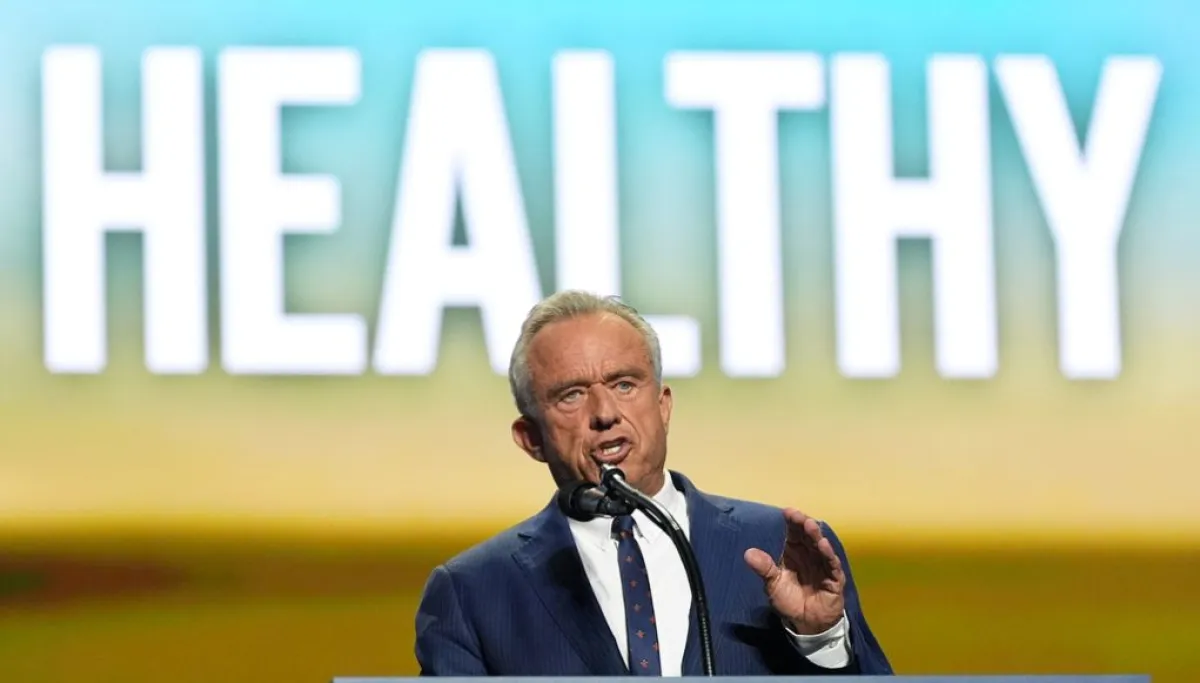
In Focus delivers deeper coverage of the political, cultural, and ideological issues shaping America. Published daily by senior writers and experts, these in-depth pieces go beyond the headlines to give readers the full picture. You can find our full list of In Focus pieces here.Health and Human Services Secretary Robert F. Kennedy Jr. claimed the nationwide drop in obesity rates as a victory for his Make America Healthy Again movement, but credit likely should go to the pharmaceutical companies he derides, for producing GLP-1 weight loss drugs.During his 25-minute speech at the Republican midterm convention in Dallas, Texas, on Thursday night, Kennedy strongly implied the rapid drop in obesity rates since their peak in 2022 is attributable to a widespread adoption of improved eating habits and increased physical activity spurred by the MAHA movement. “Since President [Donald] Trump took office, obesity is down by 7% after 40 years of increasing,” Kennedy said after citing improvements in American eating habits, without citing GLP-1 uptake.The data are correct. Based on Gallup’s National Health and Well-Being Index from July, the prevalence of obesity has declined from about 40% in 2022 to about 37% thus far in 2026, a roughly 3-percentage-point drop, or a 7.8% relative decline. That means nearly 1 out of every 12 people who were obese in 2022 are no longer obese in 2026, based on the best available numbers. Multiple times during the speech, Kennedy, a fierce critic of the pharmaceutical industry, railed against “Big Pharma,” citing the industry’s power over regulatory agencies like the Food and Drug Administration and its connections to the Democratic Party. Although he did outline how the Trump administration has worked to bring down prescription drug prices, Kennedy did not credit GLP-1 products for the nation’s collective weight loss.Health and Human Services Secretary Robert F. Kennedy Jr., speaks at the Republican convention Thursday, Sept. 10, 2026, in Dallas. (AP Photo/Alex Brandon) Medical experts, though, say GLP-1s from Novo Nordisk and Eli Lilly are the primary reason why Americans have shed pounds at a greater clip, rather than MAHA-influenced lifestyle changes.Roughly 11% of Americans are currently on a GLP-1 medication, according to Gallup, up from just 3% in 2024. About 15% of Americans say they have taken a GLP-1 in their lifetime.Dr. Angela Fitch, president of the Obesity Medicine Association, told the Washington Examiner that only with “the addition of pharmacotherapy” have patients, particularly with severe obesity, been able to reverse disease progression.“I think it is access to GLP-1,” Fitch said. “We know that lifestyle changes alone have not produced sustained weight reduction long term that reverses the disease of obesity.”Health and Human Services Secretary Robert F. Kennedy Jr. speaks at the Republican convention Thursday, Sept. 10, 2026, in Dallas. (AP Photo/Julio Cortez) MAHA lifestyle factors likely not driving the trend MAHA messaging has perhaps influenced positive lifestyle trends, but these changes are likely not the reason for declines in obesity.A July survey from the global market research firm Nielsen found purchases of ultra-processed foods in the United States over the past year have declined by about 7% compared to minimally processed foods. Recent fitness industry studies have also suggested that Americans are exercising more than in years past, particularly younger and better-educated adults.But because of the speed of the decline in obesity since its peak in 2022, medical experts credit GLP-1s rather than lifestyle changes like diet and exercise.Dr. Hemalkumar Mehta, associate professor of epidemiology at Johns Hopkins Bloomberg School of Public Health, told the Washington Examiner that it is “highly unlikely that lifestyle changes alone produced a decline of this size this quickly.”Mehta, who specializes in how comorbidities like obesity affect disease outcomes, said there was little to no change in obesity rates from 2013 to 2023, before GLP-1s were widely used. Evidence from before the widespread adoption of GLP-1s also indicates that lifestyle changes alone are not usually enough to reverse obesity long term. The Look AHEAD clinical trial, for example, compared intensive lifestyle interventions for diabetes and obesity management. Trial patients who lost between 8% and 10% of their body weight initially regained weight after eight years, such that they were only 4% to 5% less overweight than at the start of the trial. “Physical activity alone is unlikely to have produced a major decline over the past 3-4 years,” Mehta said via email. “Pharmacotherapy is the more plausible explanation, especially GLP-1s.”Centers for Medicare & Medicaid Services administrator Dr. Mehmet Oz speaks at the Republican convention Wednesday, Sept. 9, 2026, in Dallas. (AP Photo/Julio Cortez) Others in Trump administration pushing GLP-1s Other Trump administration officials have stressed the importance of GLP-1 medications in reducing the chronic disease burden in the U.S.Dr. Mehmet Oz, Centers for Medicare and Medicaid Services administrator who serves under Kennedy, is one of the chief proponents of GLP-1 access in the Trump administration, and his agency has made inroads to expand access to the medication treatment. Oz’s agency has been at the helm of negotiating most-favored-nation prescription drug pricing deals to lower prescription costs in the U.S. to levels comparable with other developed countries. As a result of deals with both Novo Nordisk and Eli Lilly, their GLP-1 products are now available at discounted prices on the federal drug deal aggregation site, TrumpRx.gov. CMS also earlier this year launched the GLP-1 Bridge program to provide eligible Medicare beneficiaries access to GLP-1s with a $50 co-pay. The pilot program ends in December 2027 pending congressional action to make permanent new rules that cover weight management drugs as a Medicare benefit.Oz praised GLP-1s during his convention address on Wednesday night, quoting President Donald Trump, who calls the medications the “fat shot,” and crediting the drug class for the drop in obesity rates.“It’s contributing to a historic American weight loss. So many of you look like gazelles tonight, probably for that reason,” Oz said addressing the crowd.HEAD START PROGRAM GETS $225 MILLION MAHA BOOST FROM TRUMP ADMINISTRATIONFor Mehta, GLP-1 weight loss coverage for Medicaid beneficiaries ought to be the next step. Roughly 25% of children on Medicaid and 40% of adult Medicaid beneficiaries are obese.“Medicaid coverage remains thin, with only 13 states programs covering GLP-1s for obesity under fee-for-service as of January 2026,” Mehta said. “Given the high prevalence of obesity in the Medicaid population, expanding access there matters.”Trump for his part has repeatedly touted the so-called “fat drug,” often using an anecdote of an unnamed “extremely obese” friend who highlighted the price disparity of the drugs when comparing the U.S. to Europe, although he admits the drug isn’t working for his friend.“I said, ‘are you taking this stuff?'” Trump said he told his friend. “I said: it’s not working — you look like s—, but he got me going.”
RFK Jr. claims credit for Big Pharma’s success in obesity decline
Full Article
Original Source
Read the full article at Washingtonexaminer →KhanList aggregates and links to publicly available news content. We do not host full articles from third-party sources. Always verify important information with original sources.