
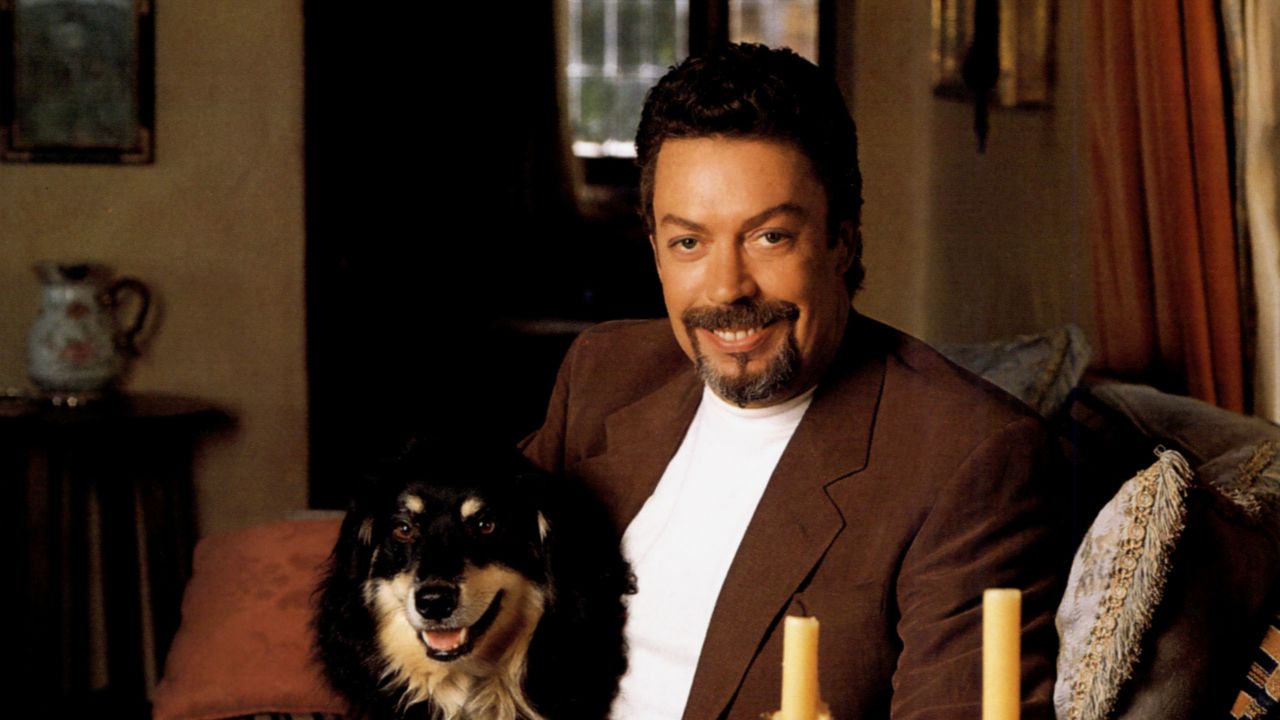
Tim Curry, the British actor famous for his work on stage and screen, died today at the age of 80 in his Los Angeles home. He was perhaps best known for his role as Dr. Frank-N-Furter (both in the musical The Rocky Horror Show as well as its cult-classic 1975 film adaptation, The Rocky Horror Picture Show), though a number of appearances as fan-favorite villains, from con man Rooster Hannigan in Annie to the evil clown Pennywise in the 1990 It miniseries, made him a household name across generations of viewers.Born in Cheshire, England, on April 19, 1946, the young Curry honed his vocal talents before deciding to focus on acting. His big break would come in 1968 with a role in Hair’s original London cast, where he met the screenwriter who would later pen him the iconic part of Dr. Frank-N-Furter.Off set, Curry was an avid horticulturalist and worked on gardens across his own residences as well as in the homes of friends—among them, Freddie Mercury. He saw the hobby as a natural condition of his nationality: “I think if you’re English, a trowel appears in your hand when you’re 30 like a prosthetic device.”In honor of the late legend, AD looks back at a November 1998 tour of Curry’s Los Angeles home.Once when he was in Ireland to meet with playwright J. P. Donleavy, Tim Curry was entertained at the great Guinness family home near the River Liffey in Dublin. “It was the most beautiful and comfortable house I’d ever been to,” the actor recalls. “The dining room’s red Chinese silk walls had been blasted by the sun and were covered with faded Hokusai and Hiroshige prints bound, the way they used to be in the nineteenth century, in black passe-partout. We sat at the end of an enormous Regency table and ate potato pie.”“The house is actually quite simple,” says Curry. “The staircase and archways are very plain.” A portrait of 18th-century actress Sarah Siddons, a blue Catalina pottery vase, and an Italian runner are all part of a tabletop arrangement in the entrance hall. Curry admired the Guinness drawing rooms with their endless pockets of seating and tables spilling over with flowers from the gardens. “There was an extraordinary range of paintings and just the sort of patina—and obsessions—of several centuries of people who’d lived there, with everything having a layer of dog over it. A great jumble it was, all arranged by an eye.”Curry’s own eye developed early. Since his father was a British navy chaplain, his family moved regularly, and with that came an acute sense of place. Richard Cork, now the art critic for the London Times, was one of several friends who influenced his taste. “Richard would walk down the halls of the Pitti Palace saying, ‘Rubbish, rubbish, rubbish, rubbish—oh, now look at this!’ and, very simply, make me understand why I was looking at a great painting.”“I do still have a Methodist sensibility, which leans toward simple earthenware and solid oak,” says Curry, who furnished the dining room with circa 1700 Italian oak chairs. The sconces, stenciled ceiling and rope molding are all original to the house. Some years later, as Curry was being recognized for such stage roles as Tristan Tzara in Tom Stoppard’s Travesties and Mozart in Peter Shaffer’s Amadeus, he was refining his appreciation for architecture. A wainscoted garret at the top of a Glasgow house fitted with William Morris pheasant wallpaper and a Charles Rennie Mackintosh front door and a Thames-side flat filled with copper Art Nouveau fireplaces were two of his many dwellings. Just as he was about to restore a Dutch bakery built in 1715 near Kew Gardens, he elected to move to Hollywood.“After twenty years of working in theater, I fell in love with the camera. It’s a kind of collective psyche looking at you and, at its best, an engine of myth,” Curry reflects.A portrait of Sir Henry Irving—“the first actor ever knighted,” says Curry—hangs between French Art Nouveau enamel-and-copper sconces in a guest bedroom. “I prefer paintings that have some sort of moral attitude that will be sustaining in some way.” Amused by Los Angeles’s architectural dreamscape and passionate about gardening, Curry went with his friend and fellow actor Annie Potts to have a look at a property that had just come on the market. It was her favorite house in the city.Originally scheduled for demolition by a developer, the once-terra-cotta-toned quarters had been painted a Campbell’s Tomato Soup orange. When the living room’s French doors were flung open, Curry looked at the terraced, grottoed, wild canyon shooting up behind the patio. “Oh my God,” he gasped, “we’re in Ecuador.” He made an offer “that minute” and immediately went into “the world’s longest anxiety attack.” He adds, “I soon learned that the previous bidder had been told by her psychic that the house was haunted and had just withdrawn from escrow.”The rooms were painted “realtor white,” says Curry, before he enlisted the late designer Jim Lassiter to help with the palette. They chose an auburn hue to contrast with the loggia’s blue ceiling. Atop the bookcase is Curry’s Emmy Award for Peter Pan and the Pirates. The house turned out to be haunted only by history. Designed by architect Stiles Clements, who is known for some of the more romantic public buildings in Los Angeles, the 1922 residence exhibits key characteristics of the Spanish Colonial Revival movement of the twenties and thirties—thick stucco walls, arched doorways, deep recesses, red-tile roofs—and does so with utter restraint. “It has none of those elements one sees so often: festivals of wrought iron, little Juliet balconies, guitars strumming in every corner,” says Curry.When he designed the house, the Beaux Arts-educated Clements had not yet engineered the Babylonian-walled, Assyrian-influenced Samson Tire Company or the equally farouche Mayan Theatre. He would also go on to design the green Zigzag Moderne office tower known today as the Wiltern Theatre. While the exotic grounds allude to Alcázar, Chichén Itzá and the Hanging Gardens of Babylon, the elegantly proportioned house is more sotto voce.With French doors on two sides, the arched primary bedroom “catches the breeze that comes up from the canyon,” Curry says. He made the headboard with “just a chunk of Guatemalan carved wood that I nailed to the wall.” the bedside tables are 19th century. Curry resists the baronial impulse. He may clearly relish such period details as the vaulted ceilings with their original Moroccan Art Déco and Art Nouveau-style stencils and plan to restore the fleurs-de-lis to the eaves, but he has no intention of installing the few grand pieces one might have found there three-quarters of a century ago. Rather, he has surrounded himself with the more-is-more aesthetic diary he’s been composing for decades.Curry has amassed Stickley furniture, found streetside in the seventies before it was fashionable, and lots of eighteenth-century English antiques. “That’s what I like, really—making contradiction work,” he once said, explaining his fascination for playing complex characters.The drawings and oils, nearly all of them portraits, are hung in the spirit of an earlier transatlantic traveler. “I’ve always loved photographs of Gertrude Stein’s apartment on the rue de Fleurus. It was crammed with extraordinary pictures that nobody else wanted to buy. Who hung them? I imagine that Gertrude sat there and said, ‘Now left a bit, Alice.’”For the rear courtyard, where he lives “nine months out of the year,” Curry chose circa 1900 Arts and Crafts wicker-and-hickory pieces. “I eat out here and entertain out here. It’s a great party space.” The tiles below the fireplace tell the story of Don Quixote. In Curry’s case, assistance was provided by the late designer Jim Lassiter, who advised him on textiles and color. Lassiter even fabricated a long-held Curry vision: an ottoman large enough for man, tray and dog. The palette, determined by Curry, Lassiter and decorative painter Richard Martin, grew from the few paint fragments that survived on a relief of the Madonna and child outdoors. The dark persimmon dining room is, in part, an homage to the Guinness house. “I do think,” Curry notes, “that red encourages the appetite.” And soft green? ”A great color to think in, which is why it’s in the guest bedrooms.”“It’s rather like designing a set for the life you wish to pursue. When I truly had a place that I wished to call home, I wanted it to be equally marvelous for my great friends, the other ‘cast members.’” Tim Curry breaks into his Mephistophelian laugh. “Once I stopped rushing about the world, trying to colonize London and New York and Los Angeles, I realized there were more important things in life than a marquee.”
Revisiting Tim Curry’s Mediterranean-Style LA Home
Full Article
Original Source
Read the full article at Architecturaldigest →KhanList aggregates and links to publicly available news content. We do not host full articles from third-party sources. Always verify important information with original sources.