
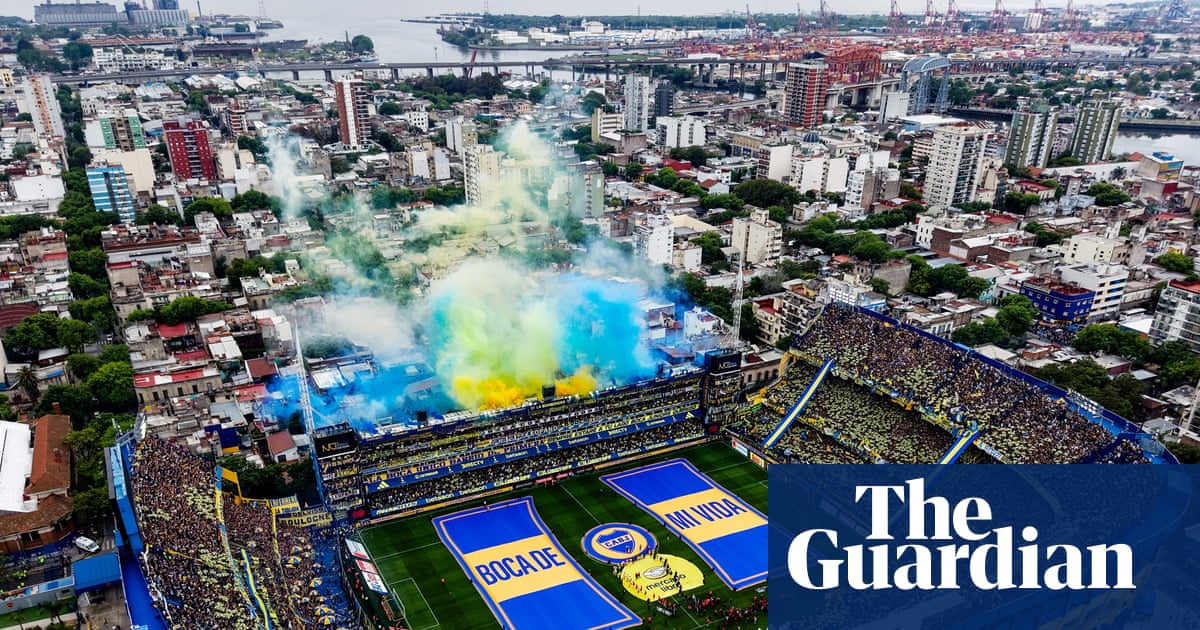
Ever since the Observer Sport Monthly published a list of 50 sporting things you must do before you die with Watch Boca Juniors Play River Plate in Buenos Aires at No 1 in 2004, the biggest super derby in Argentina has been firmly positioned in the global imagination; its reputation for colour, passion and uncontainable emotion acquiring an almost glamorous sheen. The thump and thud of the coordinated chants, the shiny ticker-tape amid flare smoke matching the teams’ strips, the bounce of the concrete as tens of thousands jump in unison, mounted police surrounding the stadium, avalanche stoppers set alight, rockets aimed at players; blood and fire.Exciting, right?Things have changed, though, and Sunday at La Bombonera (Boca’s stadium known as the Chocolate Box) was quite a different spectacle. Since 2013 football matches in Argentina have been played without visiting fans, so for starters the colour palette has been greatly reduced. The absence of the opposing tribe has been welcomed by many, making the experience of going to a football match more family-friendly and increasing ticket availability for club members.As we shared a choripán in a corner grill before the game, the Argentinian journalist Ezequiel Fernández Moores recalls the first Superclásico without away fans, at the Monumental in 2013. As Boca’s Emmanuel Gigliotti scored to give the away team the lead, in the press area Moores heard the beginning “G” of someone ready to shout the goal with glee, suddenly realising “non-home joy had to be repressed”.Fans of Boca cheer from beneath their umbrellas. Photograph: Marcelo Endelli/Getty ImagesOver the years the absence of away fans has been mirrored in an absence of away press. Now the journalists sit at their desks along the same height as the middle tier of the traditional home end, where the heart of the hardcore organised gang known as La Doce leads the rhythm section, creating a sense of continuum, with hacks clad in Boca strips cursing and cheering along with the crowd.Rain had been forecast for Sunday so Boca distributed blue and yellow umbrellas which opened in sync and matched the colour of the smoke from the fireworks organised by the club.The pyrotechnics used to be smuggled in by La Doce, who would also orchestrate the release of blue and golden balloons at the exact time the players emerged from the tunnel. When I went to pick up my accreditation, the head press officer announced to no one in particular that this “Señora” (meaning me) had once interviewed José Barritta. A young man holding a newborn baby and a couple of kids who looked barely out of school just stared. “The day of the Ambush,” I stated by way of explanation.Barritta was the infamous leader of La Doce decades ago and in 1994 I did indeed spend the afternoon with him to write a colour piece about the Superclásico from the “middle tray” (the terraces are tiered in three balconies and the middle one is the centre of operations). It was an afternoon that would end in tragedy with two River Plate fans shot dead after the game. Disgustingly, graffiti emerged nearby soon afterwards reading “River 2 Boca 2”, equating two young lives to the two goals River had scored against Boca securing their victory.My feature was shelved and instead I became a witness to the fact that Barritta had not been involved, my work published in a human rights journal, and my interest in football-related violence swiftly losing the wide-eyed fascination.River Plate fans clash with riot police outside the Monumental prior the final of the Copa Libertadores against Boca Juniors in 2018. The match was rescheduled after the bus carrying Boca players was attacked, injuring several players. Photograph: Sebastian Pani/APDeath at the Superclásico was not something new, even then. In 1968, 71 fans – mostly Boca – were crushed when one of the exit gates for away supporters didn’t fully open. Known as the incident of Puerta 12, much of what actually happened remains unknown, but El Gráfico reported the following year’s game saw members of both Boca and River fans chant together against the police. In those days both gangs were friendly, with then-Boca gang leader Quique, who ran a grill opposite the stadium, buying meat from River gang leader “El Tano Mingo”, who was a butcher. They would often join forces and combat against other club gangs well into the mid-1970s when the leaderships changed. Barritta took the helm of La Doce in 1981, by which time the rupture was total.In 2018 Boca and River met in the Libertadores final, South America’s version of the Champions League, and the Argentina president, Mauricio Macri, thought it might be fun to show the world what a colourful spectacle the Superclásico might be, so away fans were allowed back to the stadium in a one-off experiment. After the Boca bus was attacked with stones and crowd control fell apart around the inner ring surrounding the River stadium, fans were kept under strict orders to remain in place for close to five hours while the powers that be discussed options. The match was cancelled and outrageously moved to Madrid, where one could argue the soul of the Superclásico has remained, if it hadn’t been sucked out already.Sunday’s game was not a fixture of the calibre of a Libertadores final. In fact, the strangeness of the current system in Argentina means it was almost inconsequential for either cup or league, although a total points system known as the Argentina Table has implied that Boca’s underwhelming 1-0 victory against a River side down to nine men by the end means Boca have a place in next year’s Libertadores.“I’ve seen better Superclásicos,” said the radio commentator Victor Hugo Morales in his tiny cabin at the stadium. He was commemorating 60 years to the day of his very first radio commentary, back in Uruguay in 1966. I went along to exchange greetings, as I was commemorating 60 years to the day of being alive. “But I’ve also seen worse,” he added.Leonel Flores of Boca celebrates with teammates following the team’s victory in the Superclásico. Photograph: Marcelo Endelli/Getty ImagesThat must be debatable, though I’ve probably not seen as many as him. The derby doesn’t always offer the best football, often too embroiled in the hype and the media frenzy surrounding it, and the massive banners and flags obscuring the view for most of the pitch. I started going to the Bombonera with my cousins as a teenager, and the most poignant memory of the fixture was taking my 10-year-old brother along without telling my dad. In those days, women and children got in for free. On Sunday, tickets were going for half a million pesos (£240).I remember grabbing the little boy by the waist of his trousers as I saw him flying above a sea of sweaty men, as I heard someone shout: “Careful you lot, there’s a ‘Señora’ here!” I was 20. I felt perfectly safe, but I couldn’t convey that to my furious father, who I don’t think I’d ever seen so angry, before or since.Years later, when TV rights took possession of the industry and football became pay-per-view, my dad was one of the early adopters of a codified system which enabled live watching. I suggested our dear family friend Klaus, a River fan, desperate to watch the Superclásico, join my brothers and cousins atDad’s. Klaus didn’t reveal his allegiance and sat quietly in grief while the assorted Boca fiends jumped about in joy when they won. The anecdote is remembered fondly to this day in my family but for him it was a particularly unpleasant experience.River Plate’s Gonzalo Montiel leaves the pitch under police protection after being sent off Photograph: Luis Robayo/AFP/Getty ImagesMaybe new generations will be better at bridging the cultural crack. Streamer Davo, the face of new sports media, was nonchalant before the game. “Don’t give me all this Superclásico nonsense. For me, nothing changes if River beats us this game. I’m focused on the Argentina Cup, on the South American final … this is just another match.”Also seemingly oblivious to the hyped-up frenzied vitriol, my own son had suggested we go to the game together. He, a River fan, however, could not in any realistic sense attend. I’d love to go to a Superclásico with my son, neither one of us banned by the other’s tribe. Maybe one day.
Revisiting the Superclásico: a story of death, violence, colour and family
Full Article
Original Source
Read the full article at Theguardian →KhanList aggregates and links to publicly available news content. We do not host full articles from third-party sources. Always verify important information with original sources.