
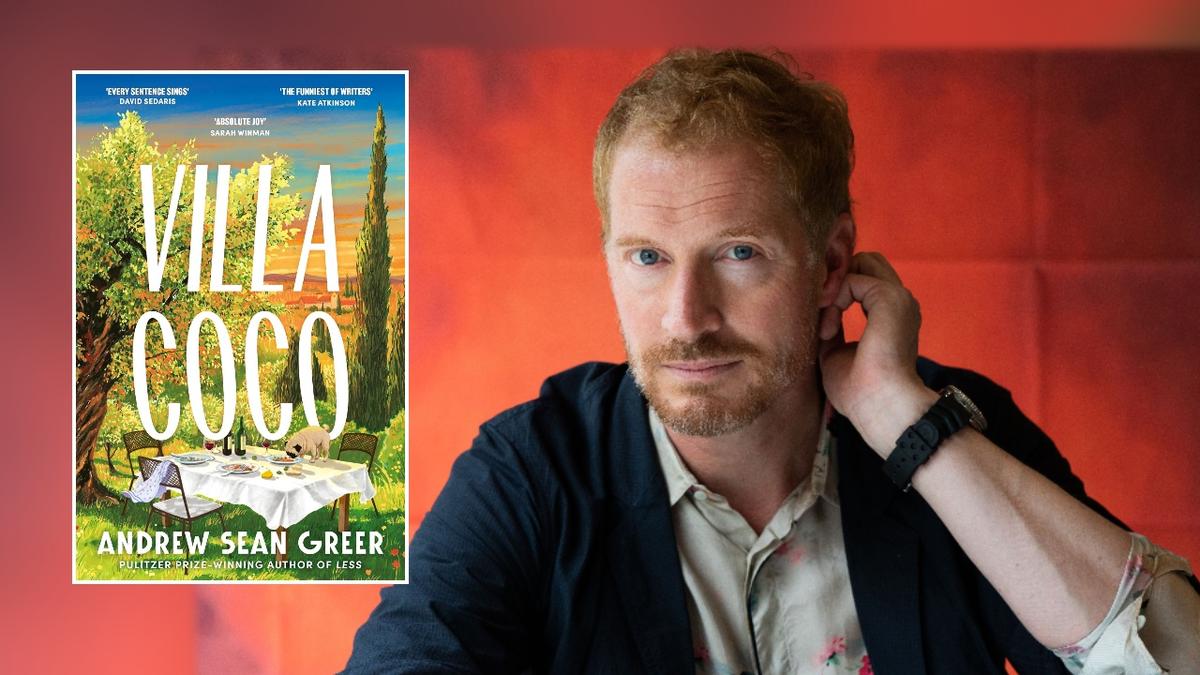
What happens when a 21-year-old, white, gay American man “near the end of the millennium” has a college major in archives and record management, but no plans for the future? Call it karmic lottery, socio-economic privilege, or plain good ol’ luck, but things begin to fall into place for him.In the fictional universe created by Pulitzer Prize winner Andrew Sean Greer in his new novel Villa Coco, the protagonist Geoffrey’s college adviser feels sorry for him, and finds him a seemingly fancy overseas job. It involves relocating to the Italian countryside to assist a baroness who has amassed a fortune: paintings, books, jewellery, artefacts, and a never-ending supply of stories that hold him under her spell. Most Indian readers, accustomed to bureaucratic hurdles, may need some mental gymnastics to process how moving between countries requires hardly any paperwork for Geoffrey. This passport privilege is perhaps taken for granted, given that Greer himself lives between San Francisco and Venice. Desperate for Geoffrey to take his life seriously, his parents, who are “both trained in classical physics”, tell themselves, “What could be more serious than Europe?” A gift of a round-trip ticket materialises as their enthusiastic show of support. And off he goes on a surreal adventure where lines between the personal and professional get blurred with alarming frequency. Geoffrey arrives in Tuscany telling himself, 'No more men for a while. No more chaos,’ only to fall for Giacomo, a passionate older married gay man. | Photo Credit: Getty Images Between promise and expectationThis funny and soulful coming-of-age story ambles along in the first half, matching the pace of life in Geoffrey’s new environment. The languorous prose will delight readers who like to read a few pages at a time, then put the book away to dream about the world the author has created. But it may test the patience of someone who gobbles up words as if time were running out. Neither Geoffrey nor his parents have the faintest idea that his duties will go far beyond cataloguing his employer Baronessa Lisabetta’s possessions. He will be asked to prune roses, harvest olives, take dictation, go on shopping expeditions, and provide entertainment on demand. With a hat tip to novelist Daniel Defoe, Lisabetta — Coco to her friends — says, “Crusoe had his Friday. You are my man Thursday.” Geoffrey is also expected to learn Italian during his brief stint. But this is not really a book about workplace burnout. It is more about what lies between promise and expectation. And the wonders that await when you make choices throwing caution to the wind. With a colourful romantic life in her distant youth, Coco cannot help but play cupid to her young employee. Geoffrey arrives in Tuscany telling himself, “No more men for a while. No more chaos,” only to fall for Giacomo, a passionate older gay man in a lavender marriage — to a lesbian woman who has a female lover of her own. This neat arrangement allows private pleasures to continue behind the polished facade of social decorum. It is hardly possible to tell an engaging story without setting up a conflict and orchestrating a resolution. That is why you should read Villa Coco. Though Greer appears to be stingy when it comes to writing physical intimacy, he is marvellous at conveying emotions. In the novel, the self-deprecating Geoffrey says, “For all my training, I struggled to organize the muddle in my heart.” Being American in ItalyA more compelling reason, however, to pick up this book is Coco, who is stubborn and vivacious, manipulative and loving. She has been on a date with artist Salvador Dali, gone shoe-shopping with poet Allen Ginsberg, and welcomed musician Mick Jagger into her home. As Geoffrey rightly says, her genius lies “in making life do her bidding”. While she is rich in the conventional sense, her true wealth is “the fierce gaiety of a woman who would not let tragedy bend her”. Villa Coco might remind you of the Netflix series Emily in Paris when Geoffrey says, “Being American seemed to me, before my later travels, the natural state of being in the world.” Coco sounds like Sylvie Grateau in the series when she gently mocks Geoffrey about the American tendency to think “that literature began with Hemingway and art with Warhol”. The dialogue is well-crafted, alternating easily between the sublime and the silly. But one aspect leaves you uneasy. While Coco’s friends Oscar, Estelle and Pippa emerge as well-constructed personalities, her Sri Lankan employees, Nimali and her husband Vinsanda, never quite become fully-formed characters. They remain largely in the background, existing merely to serve. Even the baroness’s dogs have striking names like Pushkin, Gorky and Cesare, but we do not get to know them at all. It is hard to fathom why Greer leaves so much of this world unexplored. Villa Coco Andrew Sean GreerHachette India₹699The literary critic’s poems have appeared in ‘Fearless Love’ and ‘Bent Book’.
Review | ‘Villa Coco’ by Andrew Sean Greer: love, chaos and a jolly Tuscan romp
Full Article
Original Source
Read the full article at Thehindu →KhanList aggregates and links to publicly available news content. We do not host full articles from third-party sources. Always verify important information with original sources.