
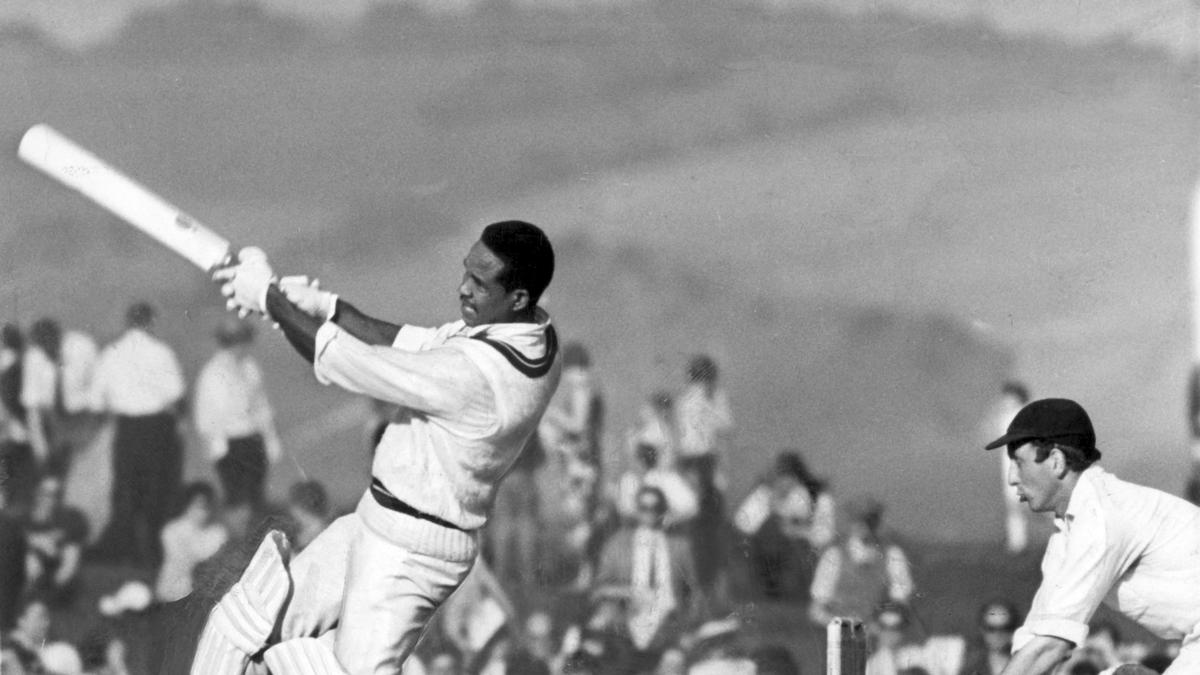
Few obsessions are as fruitful as the one that sinks its roots in a child’s porous mind once a hero is sighted. And few heroes were as rewarding to obsess over as Garfield Sobers was.On a cricket field, nothing seemed beyond his powers. His was not the frail, flighty genius that draws its allure from how reluctantly it gives of itself. Worshipping Sobers did not involve the seductive ferment of pining and heartbreak, aching for that elusive moment of triumphant release.No, his was a genius in spate, swollen to bursting. Cricket poured itself into the world through Sobers. He could do everything. His strokes were made in curving-whipped lashes of a debonair blade. He swung the new ball at sharp pace and spun the old, both in left-arm orthodox fashion and wrung from the wrist. His fielding was kinetic, soft-handed, predatory.Sobers, moreover, did it all with dazzling warmth. A young Duncan Hamilton, who first saw the West Indies cricketer on “a black-and-white set … no bigger than a square dinner plate” in the 1960s, fell instantly in love. More than six decades of this obsessive love have culminated in The Man Who Walked Out of the Sun, which poignantly hit bookstores just before Sobers died in July.Spectator of a dreamThe biography offers a sense of what the stellar all-rounder, the “first jet-age cricketer”, meant to generations of fans. “Even I, a know-nothing novice, recognised at first sight that Sobers was cut from the rarest of cloth,” writes Hamilton. “There was art in his hands. There was grace in his body.”The cricket he saw emanating from the young man with “the closely cropped hair, the pencil-thin moustache and the diastema between his front teeth” transfixed Hamilton. But it was the “elan, the joie de vivre manifest in him” that engaged the boy’s undying loyalty.In the writing of biographies, the choice of narrative aperture is defining: it determines which light, reflected off the subject, enters. The poet and novelist Philip Lindsay, in his 1951 memoir, Don Bradman, contends that geniuses are best viewed from a distance. “Unless one is able to know such a man intimately, it is best not to know him at all,” writes Lindsay. Far better, he insists, to be “the spectator of a dream”.The Man Who Walked Out of the Sun contains sections in which Hamilton is just that, the wide-eyed spectator of a dream that unfolds in “drably provincial” Nottingham.“Blessed to grow up so close to Trent Bridge during the age of Garry Sobers”, Hamilton visits with his father the sports shop which has on display the bat with which Sobers smote six sixes in an over. He watches from the George Parr Stand, sitting with the city’s small West Indian community, sharing their lunch “wrapped in wax paper and stored in flat tins”, Sobers’ elastic majesty for Nottinghamshire.Hamilton even considers joining a queue of “big lads with broad backs, muscled arms and strong, thick fingers” raring to knock back Sobers’ stumps at a gala, with the great man in a silver suit, cream shirt, dark tie and black shoes — wearing no protective equipment — despatching all-comers to all corners and yet ensuring none of the patrons scattered across the ground is felled.Personal and the publicThe author parses his memories as a prospector might a pan sieve, carefully sifting the sluice so the nuggets of gold may settle and be seen.But it’s not all boyhood wonder. Hamilton interlays his personal Sobers with the public Sobers, swapping the devotee’s lens for the chronicler’s. What emerges is an account, dense with detail, sprawling across eras, continents, cultures.The harrowing death of his best friend Collie Smith, killed in an accident with Sobers at the wheel; the relationships with his mother, his Australian wife Prudence, Frank Worrell, Don Bradman, fame, gambling, and alcohol; the decision to play a double-wicket competition in Rhodesia, after which he was “portrayed as being soft on apartheid, a useful idiot for those who supported it”: Hamilton resurrects the body of the Sobers lore, unafraid to press, with a sympathetic finger, on its tender spots.He also restages, in discursive prose, the many miracles of Sobers — the then record Test score, the six sixes, the 254 in his twilight against a stormy Dennis Lillee, ‘the shot’ at the Adelaide Oval.But the thing with athletic genius is that its expression is fleeting, flash-fast. Attempting to capture it in writing is like trying to stick a pin in a bead of quicksilver. The author works around this by retrieving backstories time may have concealed and airing them in all their magnificence until the awe you feel is his own.With this book, Hamilton does the kindest thing you can with an obsession: he bequeaths its seeds to others. The Man Who Walked Out of the Sun: A Lifetime of Summers with Garry Sober Duncan HamiltonAbacus₹1,491rammahesh.s@thehindu.co.in
Review | The Man Who Walked Out of the Sun: a sprawling portrait of Garry Sobers
Full Article
Original Source
Read the full article at Thehindu →KhanList aggregates and links to publicly available news content. We do not host full articles from third-party sources. Always verify important information with original sources.