
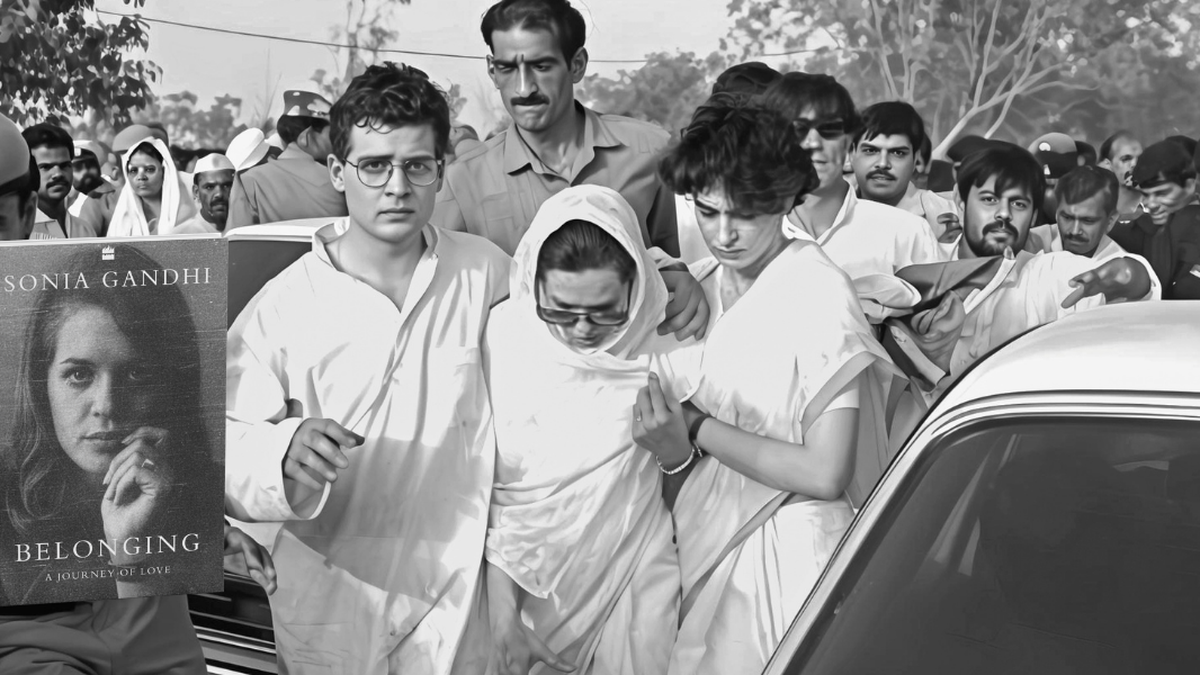
Sonia Gandhi has been an intensely private person and, arguably, one of the most consequential politicians of contemporary India. When she decides to share her personal account in Belonging: A Journey of Love, with politics largely in the background, or as she describes it, a “kind of framework”, it is bound to generate curiosity among readers.The book offers not only a window into the world of the Nehru-Gandhi family, which shaped many decades of independent India, but also an understanding of the landmark events that helped define the nation’s contemporary history.Her interpretation of events such as the Emergency in 1975, the 1984 anti-Sikh riots following Indira Gandhi’s assassination, or the Bofors scandal of the late 1980s may be contested by her political rivals, but it provides a ringside view of how they unfolded for the principal players.The book is neither a dispassionate analysis of the Gandhi-Nehru family’s politics nor a comprehensive political autobiography. Instead, Sonia Gandhi chooses to tell her story through the people she loved, the losses she endured and the country she eventually made her own.That choice gives the 544-page memoir its emotional anchor, but it also defines its limits.Recalling the pastSonia writes about her childhood in Italy, her meeting and marriage with Rajiv Gandhi, and the effort to make India her home. Her recollections of domestic life, her children’s growing-up years and her relationship with Indira Gandhi bring a sense of intimacy and warmth to the book.Indira emerges as a complex figure: a formidable political leader, but also a protective mother-in-law and grandmother who could be affectionate, demanding and occasionally volatile. Her account of the Emergency is revealing as it sheds light on the family’s private conversations during a challenging political crisis, differences between Rajiv and his younger brother, Sanjay, especially over reports of excesses during the Emergency, and Indira’s state of mind.She recalls Rajiv advising his mother to hold elections after the Allahabad High Court verdict and later encouraging her to end the Emergency. Rajiv comforting Rahul at the funeral of Indira Gandhi in 1984. | Photo Credit: SONDEEP SHANKAR, GETTY IMAGES Though she touches upon the arrest of Opposition leaders, curbs on the press, coercive measures under Sanjay’s sterilisation programme and “a fear psychosis spreading like wildfire in the northern States”, the memoir doesn’t get into the aspect of accountability of the political leadership.The same interplay of personal memory and public history marks her account of the 1984 anti-Sikh violence. She writes of her shock after Indira’s assassination and her fear for Rajiv and the children. She recalls Sikh families fleeing the violence to find shelter and even acknowledges that sections of the administration may have looked away or some officials may even have fuelled the violence. Rajiv Gandhi with his wife, Sonia, and children, Rahul and Priyanka. | Photo Credit: The Hindu Archives She describes the attacks as “barbaric”, but asserts that Rajiv could not have authorised attacks on innocent people.Her treatment of the Bofors controversy is understandably influenced by the personal toll the allegations took on Rajiv and the family. She recounts his decision to seek an investigation by Swedish authorities, the setting up of a Joint Parliamentary Committee, and the campaign that, in her view, sought to portray him as the beneficiary of bribes. She also refers to the Delhi High Court’s 2004 decision quashing the charges against him.The account conveys the family’s sense of being besieged but stops short of scrutinising in detail the political damage it brought to the party.Reluctant political lifeRajiv’s assassination in 1991 is recounted with an emotional directness that is among the book’s sharpest portions. She describes the moment when Priyanka told her that her father was dead, and the shock of a loss that changed the course of her life. The account of Rajiv’s assassination also raises questions about security failures. She refers to intelligence intercepts warning of an LTTE threat, the failure to act on them and the findings of the Verma and Jain commissions, noting that the larger conspiracy remains unresolved.She recounts her own reluctant entry into politics after his death and her eventual decision to lead a Congress weakened by electoral defeats. The 2004 victory brought another turning point: she declined the Prime Minister’s post and nominated Manmohan Singh. She says that she had discussed the possibility of becoming Prime Minister with her children before the election, and that both Rahul and Priyanka were opposed to it, having lived through the assassinations of their grandmother and father and fearing the danger the office could bring.Her subsequent roles as Congress president and UPA chairperson raised questions about the distribution of political authority. Recalling a conversation in 2010, she says Pranab Mukherjee shocked her by suggesting that it might be time for a change at the top, which she understood as a hint of his own ambition to become Prime Minister. Sonia Gandhi interacting with children during a public interaction in Rae Bareli, Uttar Pradesh, on September 14, 2004. | Photo Credit: Subir Roy The closing chapters cover the Congress’s decline, the Modi government, Rahul Gandhi’s Bharat Jodo Yatra and the INDIA bloc. On her own equation with Modi, she says that she has had practically no real contact with him during his years as Prime Minister, beyond formal greetings and brief exchanges.Shaped by memoryWritten in an engaging style, the tone of the memoir is direct, personal and nostalgic. The book stands out for its striking candour, especially in its treatment of the turbulent phase the Gandhi family faced during the Emergency, electoral loss in the 1977 Lok Sabha polls, the sense of vulnerability after Indira’s assassination and the strained relationship between Indira and her younger daughter-in-law, Maneka Gandhi, over the latter’s political ambitions. Sonia and Rahul Gandhi. | Photo Credit: Rajiv Gandhi/author’s private collection. A sense of awe, admiration, loyalty and even devotion runs through the pages when Sonia describes her relationship with her mother-in-law.Another political theme that is unmissable in the book is Sonia’s opposition to the RSS and its hold over the present government.Adding to its personal appeal is a collection of rare photographs from Sonia’s personal archives, including several taken by Rajiv, an avid photographer. Sonia also gives a vivid account of her growing-up years in the Piemontese village of Sangano and the nearby town of Orbassano, in Turin. Growing up in post-World War II Italy, she reveals that her family was shaped by discipline, austerity and a strong sense of duty.The memoir’s value lies in the insider’s perspective on a life often overtaken by public events. Shaped by memory, it is strongest when personal experience is used to contextualise political history, even as some questions remain beyond its account. Belonging: A Journey of Love Sonia GandhiHarperCollins₹1,299sandeep.phukan@thehindu.co.in
Review | Sonia Gandhi’s Belonging: A memoir of revelation and reticence
Full Article
Original Source
Read the full article at Thehindu →KhanList aggregates and links to publicly available news content. We do not host full articles from third-party sources. Always verify important information with original sources.