
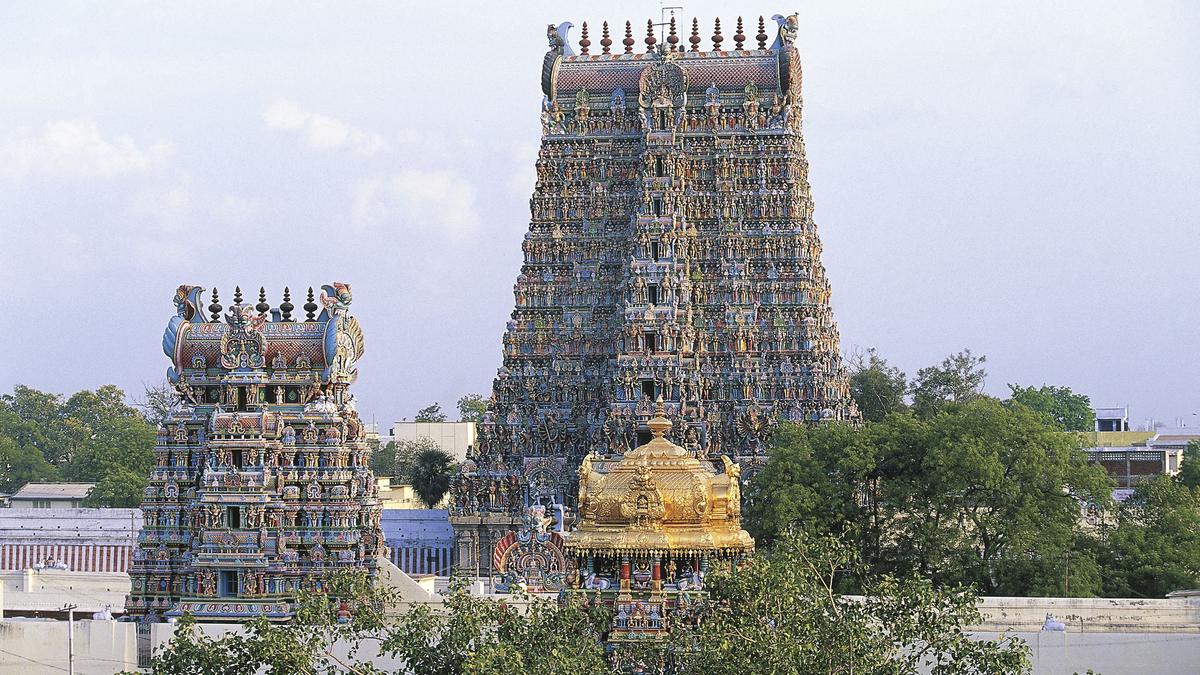
A view of the Meenakshi Amman temple in Madurai. | Photo Credit: Getty Images When we carefully create a narrative, weaving a warp of memory and mourning with a weft of remembrance and rejoicing, the fabric called history begins to make sense, clearing the layers of fog that cloud our present. This twinning is central, as most egalitarian dreams do not follow a linear path but take a sinusoidal route, where a step forward is generally followed by a couple of steps backward. The struggle for course correction brings the dream back to life.Manuraj Shunmugasundaram’s book, The People’s Sanctum, documents a century-long sociopolitical movement to democratise temples in India in general and in the South in particular. It was not just the sanctum; even the temple precincts were not accessible to all. This Indian journey is different from the principles that guided the West when it marched towards democracy. There, the State and Church are formally separated. Here, the decision was not to replicate that model lock, stock, and barrel. Instead, it was to examine the power dynamics that emanated from places of worship and the social inequality that flowed from them — the concentration of wealth, social clout, and the power to keep a vast section of society outside the social structure.Legal strugglesShunmugasundaram traces the challenges faced by lawmakers and social reformers to make our society more equal. Temples cannot simultaneously be places where the privileged seek divine redemption and where the less privileged are forbidden entry. While the southern story starts with the Vaikom Satyagraha of the 1920s, the book documents the legal struggle that dates back to the Religious Endowments Act of 1863, which dealt with the difficulty of defining who is a Hindu. Citing J.C. Ghose’s Tagore Law Lecture on Endowments in 1904, he explains the complexities of the term ‘Hindu’, which remains “difficult of definition”. The colonial administration created a negative definition. With the exception of Christians, Muslims, Parsis, or Jews, all others were to be considered Hindus. While this was a convenient tool for colonial administration, it ruptured the plural structure of the subcontinent.When an author has more than enough historical material gleaned from archives, private papers, and political records, a dilemma arises: should they produce an encyclopaedic tome or an accessible book? Shunmugasundaram has enough historical facts that could have led to a multipart book series, but he chooses to present a birds-eye view of India’s secular character, one that imagined places of worship free from discrimination and humiliation. With the religious right gaining political space not only in India but across major democracies, understanding the history of rights around religion and faith is of paramount importance. Shunmugasundaram tells this story with a flair of a journalist or an essayist while retaining the rigour of an academic scholar.Forms of resistanceThe striking aspect of this book is that instead of creating a cleavage between Periyar’s thought and Ambedkar’s scholarship, Shunmugasundaram draws our attention to the many points of convergence between the two profound thinkers. He shows how both sought to create an inclusive public sphere in which temples had a place. The enactment of The Madras Hindu Religious Endowment Act, 1925, though not radical enough for some, opened a legal avenue to address the access to and administration of temples for those who had been excluded by the caste system. The ground that was prepared carefully for inclusion paved the way for O.P. Ramaswamy Reddy to introduce the Temple Entry Authorisation Act in 1947. It was a commitment of the State government to “remove the disabilities imposed by customs and usage on certain classes of Hindus against entry into Hindu temples in the state”.Enacted about five months before Independence, the Act faced two forms of resistance as the State sought to preserve the gains of hard-won social change: socio-political agitations and legal challenges. In the Madras High Court, the 1947 Act was challenged in 1956. The High Court held that nothing in the Act was “repugnant to the Constitution”. This paved the way for the State to use the two laws — the 1947 State law and the Protection of Civil Rights Act, 1955, by the Union of India — to govern temple entry in the State.The chapter ‘Courts, Customs and Constitutional Morality’ draws our attention to wilful distortions, the power of entrenched privileges, the deep-seated notion of hierarchy, and our difficulty in moving from a feudal society to a democratic one. The trajectory of Seshammal and Others v. State of Tamil Nadu (1972), in which the Supreme Court held that hereditary succession to the office of a temple priest is a secular practice and not an essential religious practice, tells us in an unambiguous manner that whatever progress we have made so far remains fragile and is under the constant attack. Shunmugasundaram’s book gives us a way to defend our rights.The writer is the Director General of the Chennai Institute of Journalism. The People’s Sanctum: The 100-Year Struggle to Democratize Temples in India Manuraj ShunmugasundaramPenguin₹699 Published - September 04, 2026 05:45 am IST
Review of The People’s Sanctum by Manuraj Shunmugasundaram
Full Article
Original Source
Read the full article at Thehindu →KhanList aggregates and links to publicly available news content. We do not host full articles from third-party sources. Always verify important information with original sources.