
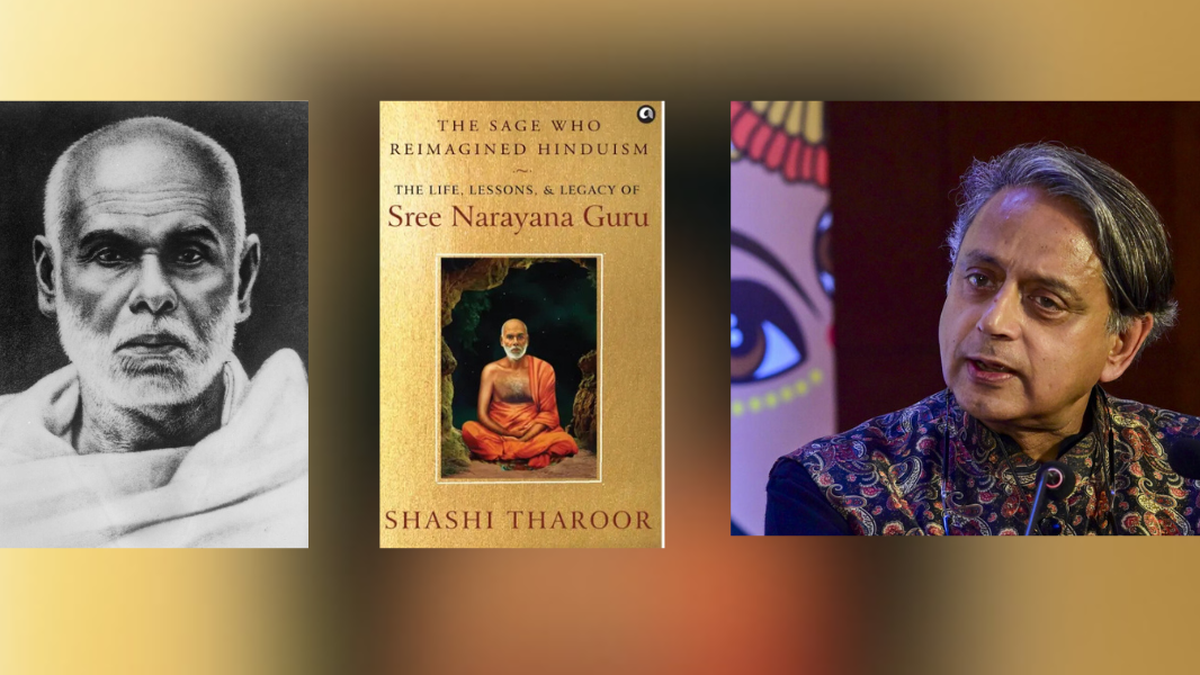
Among the many anti-caste reformers who shaped modern India, Sree Narayana Guru occupies a distinctive place. Revered in Kerala but relatively little known elsewhere, he led a movement that transformed the social and cultural life of a large section of the oppressed population while articulating a universal vision of human equality. In The Sage Who Reimagined Hinduism, Shashi Tharoor performs a valuable service by introducing Narayana Guru and his legacy to a wider audience. Written with empathy and clarity, the book succeeds as an accessible, intellectual biography of one of India’s most remarkable social reformers.A practical reformerThe importance of Narayana Guru lies not merely in the reforms he initiated among the Ezhavas of Kerala, but in the challenge he posed to the religious foundations of caste hierarchy. His famous declaration — ‘One Caste, One Religion, One God for Man’ — represented a direct repudiation of the Brahmanical worldview that sustained social exclusion. Tharoor effectively narrates the key moments of the Guru’s life, especially the consecration of a Shiva idol at Aruvippuram in 1888, an act that challenged the monopoly of Brahmins over the sacred and asserted the right of the oppressed to religious self-determination. Birth place of Sree Narayana Guru in Chempazhanthy village, Kerala. | Photo Credit: S. GOPAKUMAR The book also highlights Narayana Guru’s role in inspiring social transformation through the Sree Narayana Dharma Paripalana Yogam and related institutions. Tharoor is particularly effective in portraying the Guru not merely as a saint or mystic, but as a practical reformer who understood the importance of education, organisation, and social uplift. In this respect, the book helps correct the tendency to reduce him to a spiritual figure detached from the realities of caste oppression.A broader frameYet the significance of Narayana Guru can be fully appreciated only when situated within the broader trajectory of anti-caste movements in India. From Harichand Thakur’s Matua movement in Bengal and Jotirao Phule’s Sarvajanik Satya Dharma to the various Adi movements of the early 20th century and Ambedkar’s eventual conversion to Buddhism, anti-caste struggles repeatedly engaged religion as a terrain of contestation. Since caste derived its legitimacy from religious doctrine and ritual, the oppressed could not simply ignore religion; they had to reinterpret it, challenge it, or abandon it. Narayana Guru belonged to this tradition. Like other anti-caste thinkers, he recognised that social emancipation required intervention at the level of religious consciousness. Unlike Ambedkar, however, he sought to democratise Hinduism from within rather than break from it altogether.This raises one of the central questions surrounding his legacy. Was the reform of Hinduism sufficient to annihilate caste? Tharoor presents the Guru’s universalist spiritual philosophy with considerable admiration, but is less inclined to probe the limits of a strategy that remained broadly within a Hindu framework. The contradiction is visible in the historical trajectory of the movement itself. Despite the Guru’s universal message, the social base of the movement remained largely confined to the Ezhava community. Like many anti-caste movements, it combined universal ideals with the practical imperatives of caste-based mobilisation.The book might also have engaged more deeply with Narayana Guru’s relationship to other strands of Kerala’s anti-caste awakening, particularly the movement led by Ayyankali among the Pulayars. While the Guru challenged the ideological foundations of caste and promoted spiritual equality, Ayyankali battled against the orthodox for civil rights of access to roads, schools, public spaces, and economic rights. The two leaders shared a commitment to social justice, but represented different responses to caste oppression. Together they constituted complementary currents of Kerala’s social transformation, one directed at religious reform and the other at civic and material emancipation.Similarly, the Vaikom Satyagraha offers an illuminating perspective on Narayana Guru’s social philosophy. While Gandhi viewed the agitation primarily as a campaign against untouchability and accepted a compromise limited to access to temple roads, Narayana Guru appears to have regarded such concessions as inadequate. The logic of equality, in his view, could not stop at the roads leading to the temple; it had to extend to the temple itself. The subsequent Temple Entry Proclamation of 1936 arguably vindicated this broader vision.Recovering a legacyThese observations do not diminish the book’s achievement. Tharoor has written a lucid, engaging, and timely introduction to a thinker whose relevance extends far beyond Kerala. At a time when religious identity is increasingly mobilised for exclusionary purposes, Narayana Guru’s attempt to ground spirituality in equality and human dignity deserves renewed attention. The book succeeds in recovering that legacy for contemporary readers and invites a wider national audience to engage with one of the most original social philosophers of modern India.If there is a limitation, it is that the book occasionally leans towards celebration where a more critical engagement with the historical contradictions of the movement would have been welcome. Nevertheless, it remains an important contribution and perhaps the most accessible account of Narayana Guru available to English-language readers today. The Sage Who Reimagined Hinduism Shashi TharoorAleph Book Company₹799The reviewer is a scholar, writer and activist. Published - August 28, 2026 03:08 pm IST
Review of Shashi Tharoor’s The Sage Who Reimagined Hinduism
Full Article
Original Source
Read the full article at Thehindu →KhanList aggregates and links to publicly available news content. We do not host full articles from third-party sources. Always verify important information with original sources.