
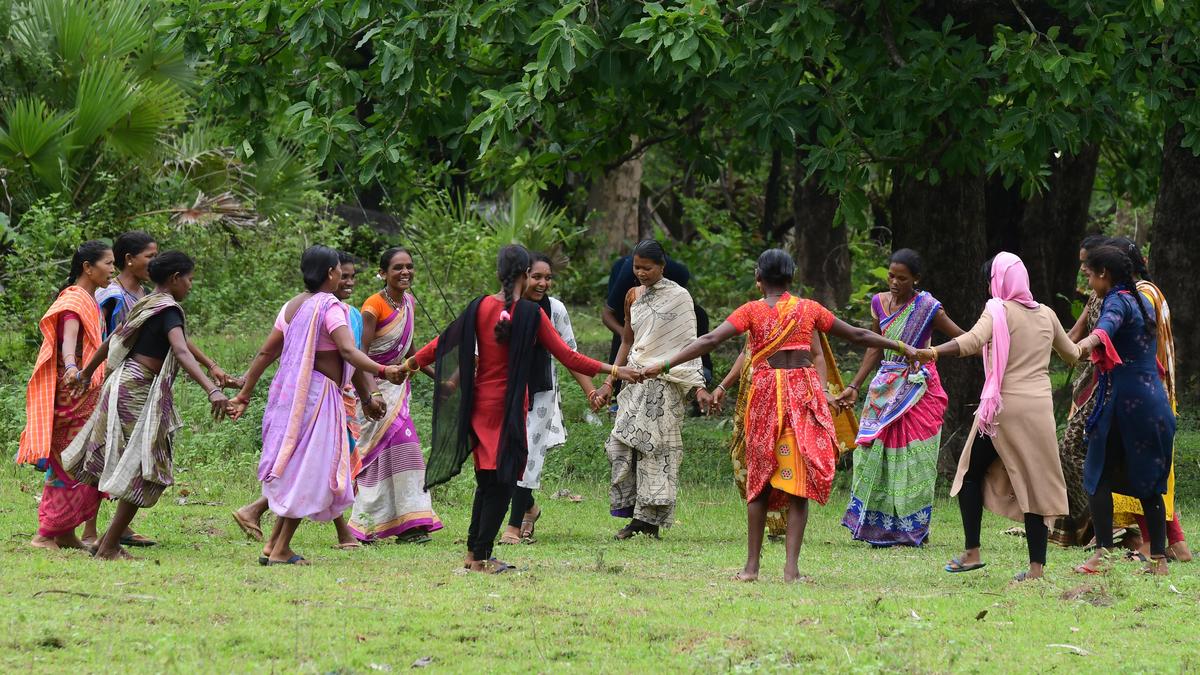
Prem* is a young mathematics graduate from a village in Jharkhand. He was known as an energetic and supportive young person. Children from the village often approached him when they had difficulties with mathematics. When he was selected for a job with the Indian Railways, it was expected to be a moment of happiness. But the thought of leaving his parents, friends, village and the life he shared with them was difficult for him. In the weeks following the job offer, Prem began having sleepless nights, worrying about how he would cope with a new life and new responsibilities. Gradually, he stopped talking to his family. He began to feel helpless and worthless, lost interest in everyday life and reached a point where he attempted to end his life.What helped was having people around him who could understand not only what he was going through, but also the world he was coming from. A neighbourhood facilitator working in a community-based organisation was able to sit with him, listen to his worries and share his dukh-sukh. They understood why leaving his parents, friends and village felt so difficult and gave him space to talk about the fears he was carrying.The support was not about asking him simply to adjust or move on. It helped him think about what mattered to him, what he wanted for his future and how he could remain connected to the people and place that were important to him while taking up the new opportunity. He eventually wrote to the department asking for another opportunity to join. He was invited again and went to work, while continuing to receive support.Prem’s experience highlights that what looks like a positive life event from the outside can sometimes become overwhelming. A suicidal act can often happen suddenly, during a moment of intense crisis. But the distress behind that moment may have been building for much longer. For Adivasi communities, distress can be shaped by circumstances that may never appear in a psychiatric consultation.When distress is accumulatesA recent study in Jharkhand examined psychosocial distress and help-seeking among Adivasi Ho adolescents. It found that distress was often linked to family conflict, pressure around education and work, financial hardship, violence, separation and loss, and difficulties in relationships. Some adolescents withdrew and stopped sharing what they were going through; for some, this included thoughts of self-harm or suicideThese accounts do not offer a single explanation for suicide among Adivasi communities. They show how distress can accumulate across everyday life — in family conflict, having to leave school temporarily or reduce schooling to help with agricultural or household work, substance use, untreated illness, violence, displacement, loss of livelihood, lack of mentorship, identity-related stigma and self-doubt, or the erosion of community and belonging.When communities are disruptedBelonging is an important part of suicide prevention. Stereotypes, exclusion, humiliation, discrimination and pressure to hide one’s identity can affect how people see themselves and how connected they feel to society. Historically, Adivasi communities stayed together. But modern development, alongside education and employment opportunities, have in some cases, uprooted Adivasi people from their culture. Mainstream schools do not teach Adivasi children in their own mother tongue; their history is woefully under-represented in the school curricula. Sandip Sing, a radiologist from the Munda community practising in rural West Bengal and a first-generation learner, says, “There is a rapid transition in accessing and navigating educational and professional spaces, often amid gaps in resources, networks, and institutional familiarity. Bridging these gaps can be challenging, particularly with unfamiliar systems.”Many educated Adivasis may also have had fewer opportunities to engage with their community’s history, culture, language and traditions, and may have complex or evolving relationships with their Adivasi identities. This matters for mental health because belonging itself is a source of strength. When people are uprooted without finding a new sense of belonging, distress can deepen.This does not mean that development itself causes mental illness or suicide. The concern is what happens when rapid social change is accompanied by displacement, loss of livelihood, cultural disconnection and weakening social support.Collective strength, mentoringThe strength of Adivasi life also lies in ways of expressing emotions and sharing knowledge. Songs and dances are not simply cultural performances; they are ways of expressing emotions, maintaining connection and making sense of life. The Adivasi dance itself is a powerful metaphor. People dance in a chain, holding one another. The village headman, Majhi Baba, dances alongside everyone else. An 80-year-old and an eight-year-old can dance together. There is no hierarchy; the strength is in the circle. For suicide prevention, this collective strength matters.Young people also need places where they can be themselves without constantly having to explain or defend who they are. Lilibiti Saren, a medical officer from the Santhal community working in tribal areas of Bankura, West Bengal, notes that she often finds young people in these communities lacking direction. “There is a need for proper mentorship,” she says. Locally organised Adivasi youth spaces can help. Such spaces can offer young people opportunities to speak in their own language, share experiences, learn from peers and elders and explore what Adivasiyat — identity, history, relationships and belonging — means to them.Access and pathways in careClinical care remains essential. A person experiencing suicidal thoughts may need assessment for depression, substance use, trauma, psychosis, previous attempts, suicidal intent, access to means and immediate safety. Treatment and follow-up can save lives.But access to mental health care is itself a major challenge in many Adivasi areas. Services are often limited, distant and unevenly available. And even when services are available, the pathways into care may not be optimal. An Adivasi person with lived experience of mental healthcare says: “I felt like the psychiatrists and the psychologists were not speaking to me. They were judging me for what I had done and they were trying to find symptoms instead of trying to understand me, my pain and my situation.”This raises an important question: are our mental health systems listening as carefully as they are diagnosing?When formal services are scarce, difficult to reach, or experienced as unfamiliar or judgmental, people may seek support elsewhere—including from family, community networks, faith healers or indigenous systems. These spaces may offer something that the formal system does not: familiar language, relationships, cultural understanding and a sense of belonging.Adivasi mental health therefore cannot be treated simply as another category within rural health. Representation matters — from schools to healthcare institutions and policy making. Models that could workIn Adivasi communities of Jharkhand, particularly among the Ho, Munda and Santhal communities, Madait refers to a tradition of voluntary help and collective support for someone who needs it or is in distress. It reflects an understanding that some difficulties are too large for one household to manage alone.This may be a useful way to think about mental healthcare too. The question is not simply how services can be delivered to Adivasi communities, but how communities themselves can shape, participate in and lead the care they need.The same principle can be seen in Dukhu-Sukhu Baithaki — community support group meetings where people experiencing mental health difficulties and their families can meet, share experiences and support one another. This model works in West Singhbhum, Jharkhand, where people living with mental health conditions come together each month. These spaces do not replace professional care. They bring community knowledge, relationships and mutual support into the process of recovery.Education without a knowledge of one’s roots; development that comes with displacement and mental healthcare that does not see or hear the people who need help is no longer enough. For suicide prevention, we must ask not only, “What is wrong with the individual?”, but also, “ Where is the community support? Where is the system that understands them?”Perhaps suicide prevention in Adivasi communities must begin there — not by doing things for Adivasis, but by doing them with Adivasis.*Name changed to protect privacy(People in distress can reach out to Tele-MANAS (14416 or 1-800-891-4416) or the helplines listed here)(Dr. Sachin Barbde is a public health physician working with Adivasi communities in Jharkhand barbdesachin@gmail.com; Dr. Christianez Ratna Kiruba is an internal medicine physician and a freelance health journalist from Guwahati christianezdennis@gmail.com; Dr. Debasmita Saren, is a Santhal Adivasi psychiatrist debasmitasaren5@gmail.com)
Rethinking suicide prevention in Adivasi communities
Full Article
Original Source
Read the full article at Thehindu →KhanList aggregates and links to publicly available news content. We do not host full articles from third-party sources. Always verify important information with original sources.