
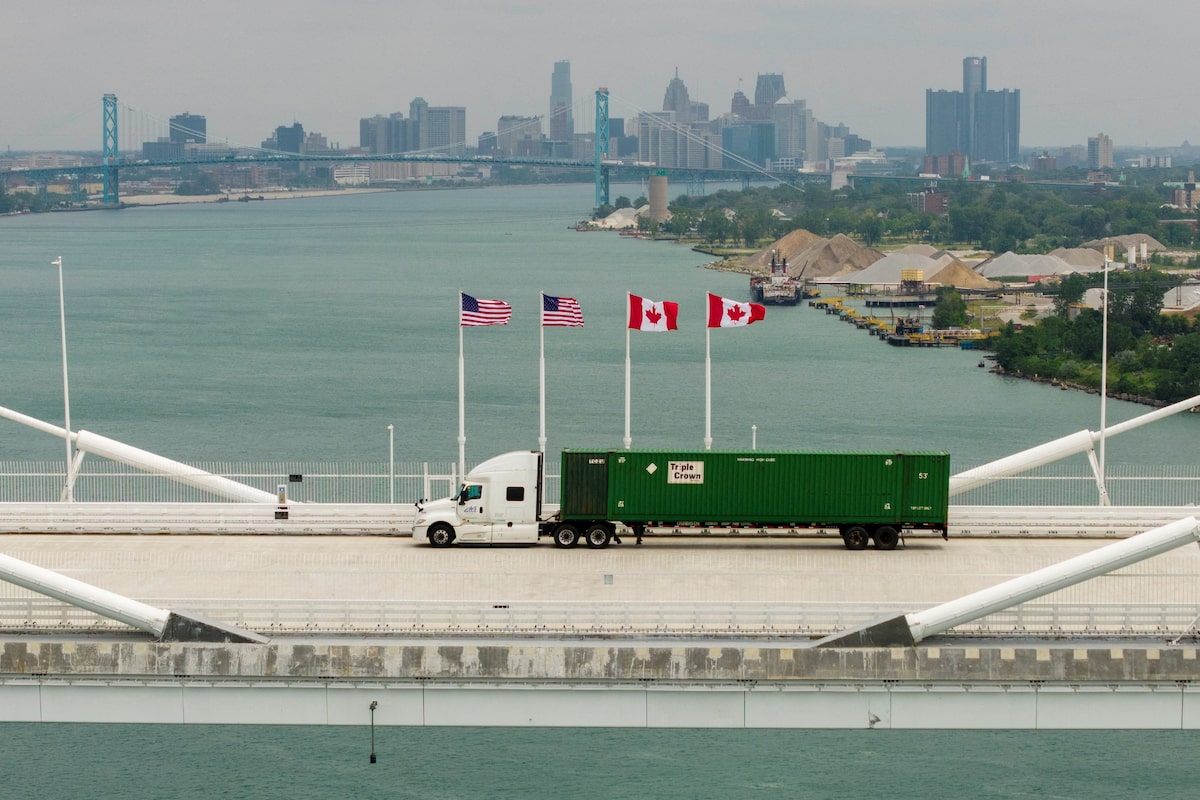
Open this photo in gallery:A truck crosses the Gordie Howe International Bridge between Windsor and Detroit at the Canada-U.S. border.Carlos Osorio/ReutersThe collapse late Friday of the Canada-U.S. trade talks did not surprise trade lawyers and officials inside and beyond Canada, some of whom warned that escalating retaliatory tariffs could be highly damaging to both countries. In an interview, Lawrence Herman, international trade lawyer at Herman & Associates of Toronto, said that he warned the Expert Group on Canada-U.S. Relations last week that the talks probably would end in acrimony. “Even with valiant efforts by Canadian negotiators being railroaded by the U.S. side, the real surprise would have been any deal that Canada could live with,” Mr. Herman said. “Even then, we could have gotten an interim truce only, a short respite before being faced with a new set of Donald Trump diktats.”After the talks went up in smoke, Prime Minister Mark Carney vowed “dollar-for-dollar” retaliation on the new 50-per-cent tariffs imposed just after midnight on US$28-billion of Canadian exports on goods ranging from plywood and cement to hockey sticks and wine. On Saturday, Mr. Carney said Canada’s retaliatory measures will be revealed in the coming days and will take effect Sept. 8.Some trade observers said this retaliation by both sides was inevitable. “Canada told the Americans in advance that if these tariffs landed, it would stop negotiating and retaliate,” Barry Appleton, senior fellow at the Center for International Law at New York Law School, told the Associated Press. “The American trade representative said publicly he would not tolerate retaliation. Both sides have now committed themselves in public, which is how escalation stops being a choice.”Read the latest on U.S.-Canada trade escalationMr. Trump is no stranger to escalation. In early 2025, he slapped 10-per-cent tariffs on China and then doubled them a month later. China retaliated, triggering a rapid tit-for-tat tariff war that saw the U.S. tariffs hit 125-per-cent. Shortly thereafter, most of the tariffs on both sides were paused or rolled back.“Canada likely wanted further sector-specific relief than the U.S. was willing to offer, or Canada’s concessions did not go far enough,” Ryan Majerus, a partner at Atlanta’s King & Spalding law firm, told AP. “Either way, I think both sides will be under immense pressure in the coming days to find an off-ramp. But if Canada has agreed to impose [retaliatory] tariffs, the off-ramp may be even hard to find.”On X, James E. Thorne, chief market strategist at Canada’s Wellington-Altus, an investment dealer, said retaliation might be no-win strategy for Canada. “Canada does not need another era of Pierre Elliott Trudeau-style progressive theatre,” he said. “[Retaliation] is not a strategy. It is an emotional response masquerading as economic policy…Tariffs do not raise productivity. They do not attract investment, reduce regulatory costs or make Canadian business more competitive.”The Trump-Carney spat and trade talks breakdown were broadly covered in the European press, though the stories were short, not prominently played and generally devoid of comment. TransAtlantic trade issues have largely dropped out of the European news cycle since the heated negotiations of 2025. Last year’s EU-U.S. trade battle generally went in the U.S.’s favour. The EU offered tariff concessions to lock in a U.S. tariff ceiling and avoid a retaliatory trade war. The EU dropped most of its tariffs on U.S. goods and accepted 15-per-cent tariffs on most of its exports.
Retaliatory tariffs could be dangerous for both Canada and U.S., trade experts warn
Full Article
Original Source
Read the full article at Theglobeandmail →KhanList aggregates and links to publicly available news content. We do not host full articles from third-party sources. Always verify important information with original sources.