
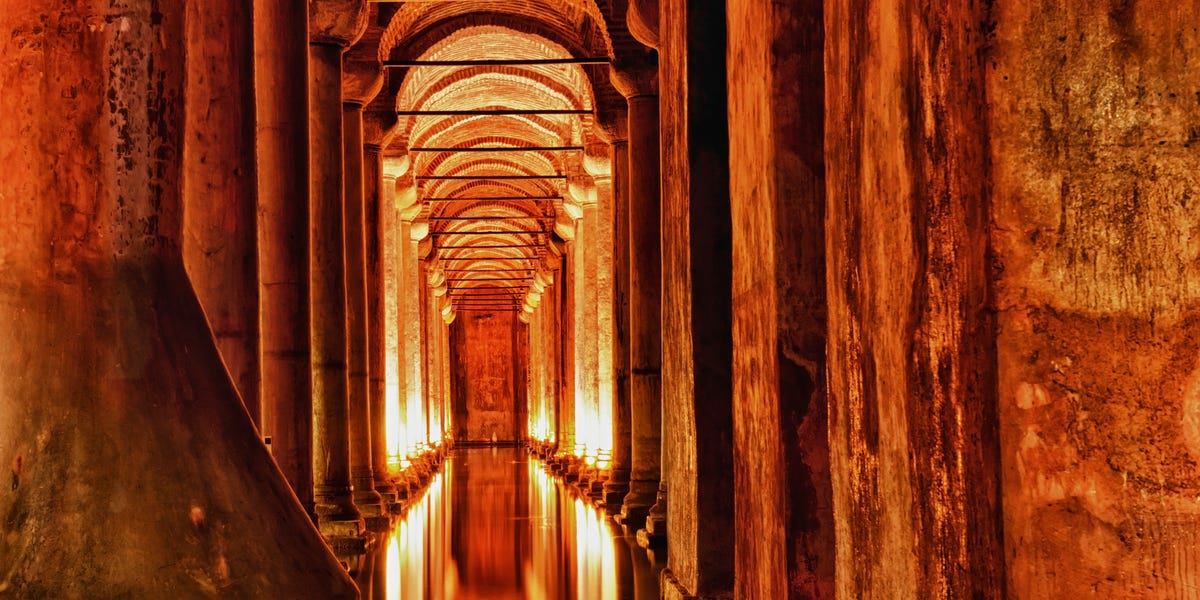
4 min readHere’s what you’ll learn when you read this story:New research into the labyrinth of tunnels under Istanbul’s Hagia Sophia reveals a system much grander than previously known.Crews continue to explore, expecting to find lost stretches of tunnels throughout the area.Most of the tunnel system carried water for public and ceremonial use, but some tunnels’ purposes remain a mystery.The tunnels beneath Istanbul’s famed Byzantine-era Hagia Sophia just got a great deal more interesting. Earlier archaeological work had traced a few hundred feet of passages under the cathedral-turned-mosque. New research has now exposed another 5.6 miles of them—and no one’s sure what all of it was for.Restoration efforts at the site, built between 532 and 537 C.E. under Byzantine Emperor Justinian I, ultimately took crews below ground, Turkey’s Ministry of Culture and Tourism said. Their findings span centuries. According to a new study published in Open Archaeology by Professor Hasan Fırat Diker, the tunnels date to the earlier years of the Byzantine era, when wooden structures stood on the site before succumbing to fire.As crews descended under the Hagia Sophia for a cleaning operation, archaeologists found spaces and tunnels never previously known to exist. The work required crews specialized in mining operations due to the challenges the space presented. “The cleaning process involved the removal of debris from spaces that were, in some cases, extremely narrow, dark, and poorly ventilated,” Diker wrote. Still, the team pulled 300 tons of soil and rubble from the passages, exposing previously unknown tunnels along the way.“As the cleaning process advanced, previously unknown subterranean structures were revealed,” Diker wrote. “This process has yielded remarkably valuable data concerning the multilayered and complex underground system beneath the atrium of Hagia Sophia.”It all resulted in “highly significant discoveries.”Diker documented the finds with 3D mapping, cataloging structures that were, for the most part, built to carry water. One chamber stood out, though. It held seven separate conduits, which Diker says reflects a site repeatedly reworked to serve its users’ changing needs.The mosque in Istanbul continues to intrigue archaeologists. Earlier this year, the Turkish Ministry of Culture and Tourism announced the discovery of seven new tunnels, all of which were connected. Those tunnels, though, collectively spanned just a few hundred yards. At the time, the team, led by Diker, said the system likely connected to the water management system, and they pledged to continue searching for other tunnels.And they found what they were looking for. The newly discovered tunnels are vastly more expansive than anything the researchers imagined. “These additional underground elements, whose existence, orientation, and interrelations could not have been foreseen at the outset, are expected to significantly expand current understanding of Hagia Sophia’s substructure once their cleaning is complete,” Diker wrote.Of the six main structures the exploration uncovered, Diker singled out Structure 6 as the most significant—and the most “enigmatic.” Earlier surveys had documented part of it, but the cleaning revealed something new: a connection to Structure 1. “Unlike the more linear and clearly defined plans of the other subterranean structures discussed above, Structure 6 displays a complex and irregular layout—resembling an open-ended frame with multiple attached branches,” he wrote. An archway near the junction of Structures 1 and 3 marks where it begins.Past the archway, a vaulted passage gave way to a tunnel that led the team to more arches and a previously undocumented wall. Much of what lies along the structure’s many branches is still a mystery. In one section, eight rectangular niches line the walls beneath vaulting of unusual craftsmanship. Notably, there are no terracotta pipes—a strong hint that this passage served some purpose other than carrying water.“It is particularly notable that this tunnel appears to have been connected at both ends to a parallel tunnel, likely during a later construction phase, forming a route running in the northwest-southeast direction,” Diker said.Hagia Sophia has worn many identities. Built as a Christian cathedral, it became a mosque after the Ottoman conquest in 1453, a museum in 1935, and a mosque again in 2020.Diker said that finding distinct water conduits running in multiple directions and dated to different periods “demonstrates not only the ceremonial significance of the atrium’s superstructure but also the critical water distribution role played by its infrastructure.” The sheer number of tunnels points to a dense settlement overhead, one that consumed water on a substantial scale.And there’s still more to find. Much of the network remains choked with mud and debris from old collapses, and the archaeologists expect additional passages to emerge as the clearing continues.Tim Newcomb is a journalist based in the Pacific Northwest. He covers stadiums, sneakers, gear, infrastructure, and more for a variety of publications, including Popular Mechanics. His favorite interviews have included sit-downs with Roger Federer in Switzerland, Kobe Bryant in Los Angeles, and Tinker Hatfield in Portland.
Restoration Crews Uncovered Over 5 Miles of Hidden Tunnels Beneath a Cultural Landmark
Full Article
Original Source
Read the full article at Popularmechanics →KhanList aggregates and links to publicly available news content. We do not host full articles from third-party sources. Always verify important information with original sources.