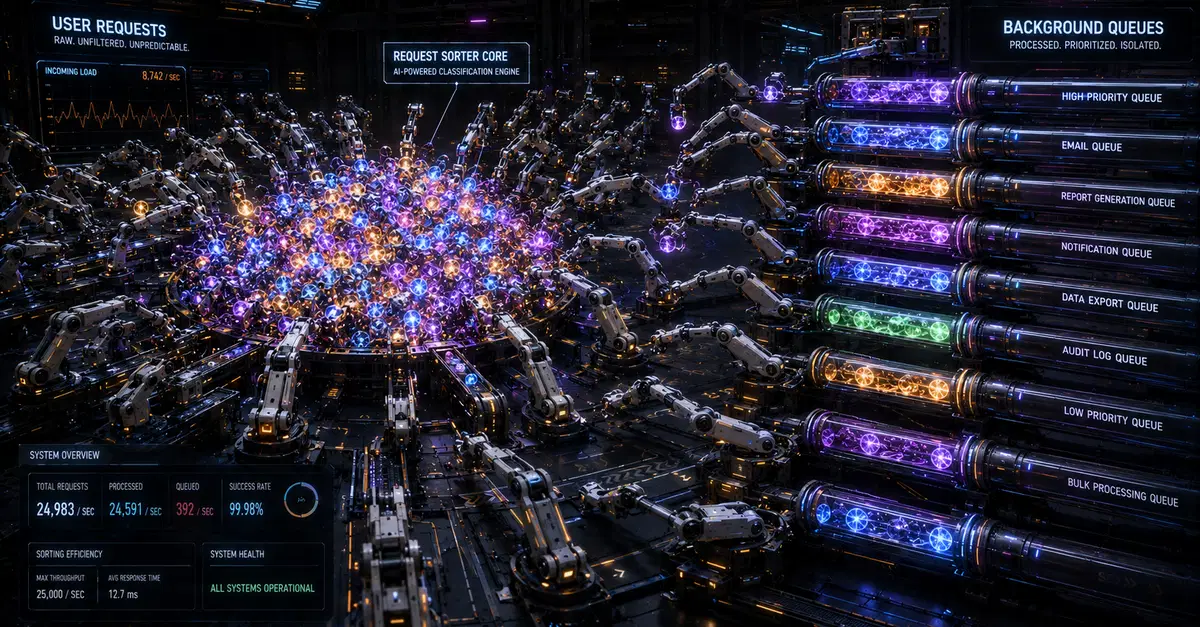
The Synchronous Bottleneck When an application scales, forcing users to wait for backend processes to finish synchronously is a major architectural flaw. If a user clicks "Generate Report," and the server spends 15 seconds querying a database and compiling a PDF, the HTTP request will likely time out, and the user experience degrades. At Smart Tech Devs, we ensure that heavy workloads never block the HTTP response cycle. We achieve this by leveraging robust queue-driven background processing. By utilizing Redis or RabbitMQ alongside Laravel Horizon, we create asynchronous execution pipelines. The Solution: Asynchronous Processing The core philosophy is simple: Queues separate "user experience" from "heavy work". A web request should only ever write a job to the queue and instantly return a 202 Accepted response to the user. From there, background workers pick up the heavy lifting. Step 1: Offloading the Work To ensure maximum latency reduction, operations like imports, exports, emails, PDFs, integrations, and data processing are async. namespace App\Http\Controllers; use App\Jobs\GenerateHeavyReport; use Illuminate\Http\Request; class ReportController extends Controller { public function store(Request $request) { // ✅ THE ENTERPRISE PATTERN: Instant HTTP resolution // Dispatch the job to a dedicated background queue GenerateHeavyReport::dispatch($request->user())->onQueue('reports'); // Return immediately to the client return response()->json([ 'status' => 'processing', 'message' => 'Your report is being generated and will be emailed shortly.' ], 202); } } Step 2: Designing for Failure (Idempotency) When workers process jobs in the background, network failures and timeouts are inevitable. Therefore, jobs are idempotent and retriable. This means that if a job fails halfway through and is retried, it will not duplicate data or charge a customer's credit card twice. namespace App\Jobs; use Illuminate\Bus\Queueable; use Illuminate\Contracts\Queue\ShouldQueue; use Illuminate\Foundation\Bus\Dispatchable; use Illuminate\Queue\InteractsWithQueue; use Illuminate\Queue\SerializesModels; class GenerateHeavyReport implements ShouldQueue { use Dispatchable, InteractsWithQueue, Queueable, SerializesModels; public $tries = 3; // Automatically retry 3 times on failure public function handle() { // 🔒 Ensure idempotency: check if the report already exists before generating if (Report::where('user_id', $this->user->id)->whereDate('created_at', today())->exists()) { return; } // ... heavy PDF generation logic here ... } } The Engineering ROI By enforcing a queue-driven architecture, your web servers remain stateless and fast, capable of handling massive concurrency. Heavy processing is decoupled, strictly monitored via Horizon, and safely retried when upstream services temporarily degrade.
Resilience at Scale: Queue-Driven Architecture in Laravel ⚙️
Full Article
Original Source
Read the full article at Dev →KhanList aggregates and links to publicly available news content. We do not host full articles from third-party sources. Always verify important information with original sources.