
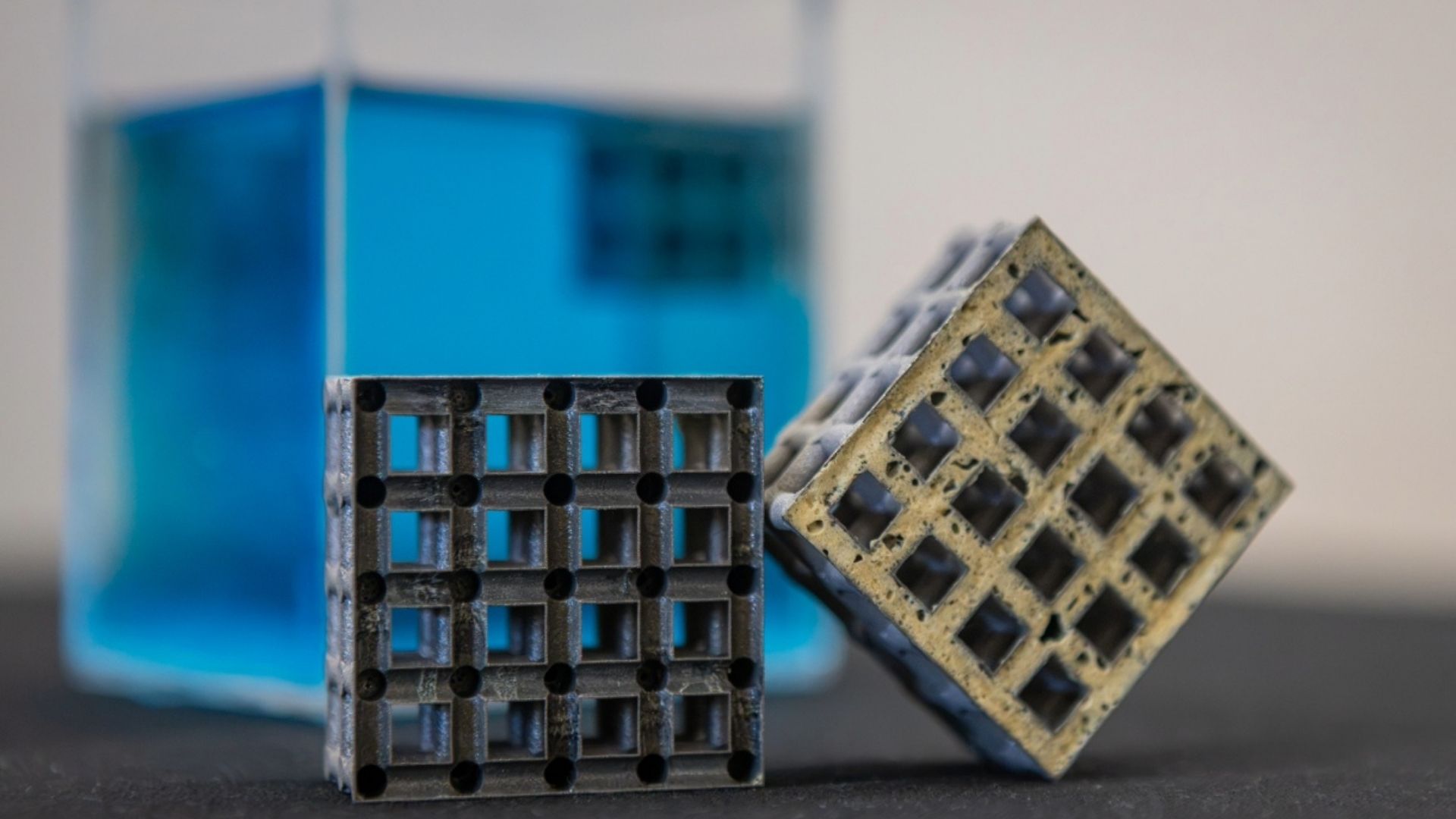
A titanium structure that lets water pass through its openings could offer a new approach to building buoys, jetties and floating sensors. Researchers led by RMIT University have developed a foam-filled metal lattice that floats despite damage and outperforms common marine materials at the same overall density. The study describes a 3D-printed framework of hollow, interconnected titanium struts filled with polyurethane foam. Samples remained afloat in freshwater for more than two months, while seawater tests examined corrosion resistance and a prototype buoy’s stability. Metallic lattices can be light, but their open spaces present a problem: water enters the framework, causing it to sink. The researchers addressed this by filling only the hollow struts with foam, leaving the larger openings available for water to flow through. “By filling only the hollow titanium struts with polyurethane foam, we created a structure that allows water to flow through it while remaining buoyant even after significant cracking and damage,” said Dr. Jordan Noronha, lead researcher on the project. The team developed a measure called skeletal density to predict flotation. Unlike conventional density calculations, which include the lattice’s open spaces, this measure considers only the titanium walls and foam-filled channels that exclude water. If their combined skeletal density is below that of the surrounding liquid, the structure can float even when water occupies its external openings. Strength survives seawater exposure At the same overall density, the titanium structure was 70% stronger than the stainless steel or high-density polyethylene commonly used in marine applications. Short-term corrosion testing involved immersing the lattice in natural seawater from Melbourne’s Port Phillip Bay. After two weeks, it had lost 0.15% of its mass, while its strength declined by less than 1%. The structure also remained buoyant after cracking, damage at key connections and the fracture of an entire lattice layer. It sank only after severe crushing and compaction. “Tiny, sealed cells in the foam trap gas and prevent water from flooding the hollow struts,” Noronha said. That distributed protection helps explain why damage did not immediately cause sinking. Conventional hollow marine structures, by comparison, can flood rapidly when their walls crack. Prototype points toward larger trials To demonstrate the design, the researchers produced a marine buoy that remained stable in a turbulent seawater tank rotated up to 45 degrees. It required no sealed casing, protective coating or additional flotation. Project leader Distinguished Professor Ma Qian said the next steps include making larger demonstration parts and evaluating long-term performance under realistic marine and deep-sea conditions. Those trials will extend beyond the short-term seawater exposure reported so far. The researchers also see potential outside marine infrastructure, including energy absorption, thermal management and vibration control, by changing the material inside the titanium framework. RMIT’s Centre for Additive Manufacturing led the research in collaboration with the Conservatoire National des Arts et Métiers in France. The research was published in the Advanced Materials journal. Get the latest in engineering, tech, space & science - delivered daily to your inbox.Atharva is a full-time content writer with a post-graduate degree in media & amp; entertainment and a graduate degree in electronics & telecommunications. He has written in the sports and technology domains respectively. In his leisure time, Atharva loves learning about digital marketing and watching soccer matches. His main goal behind joining Interesting Engineering is to learn more about how the recent technological advancements are helping human beings on both societal and individual levels in their daily lives.
Researchers unveil floating titanium lattice 70% stronger than steel at equal density
Full Article
Original Source
Read the full article at Interestingengineering →KhanList aggregates and links to publicly available news content. We do not host full articles from third-party sources. Always verify important information with original sources.