
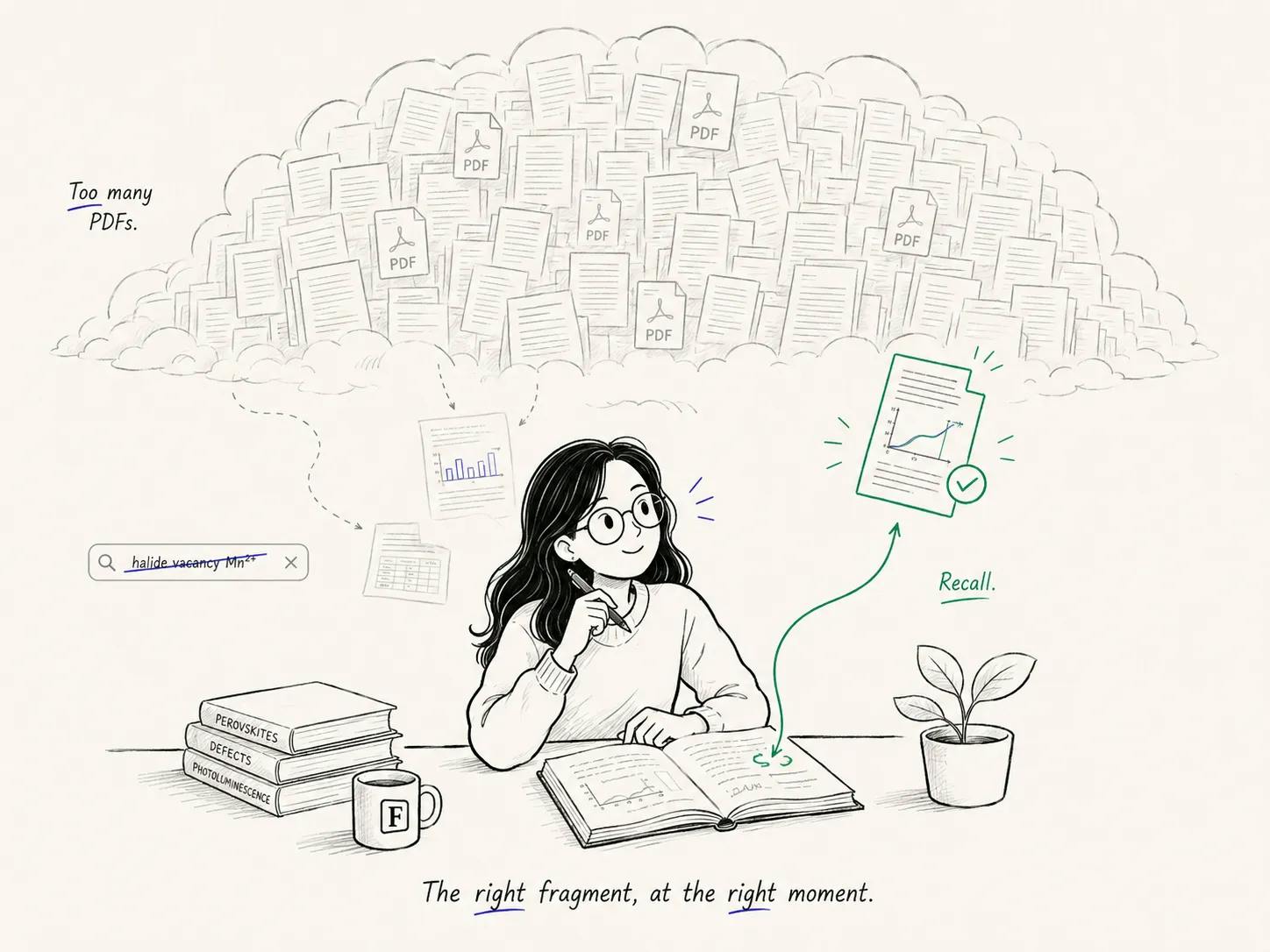
After working in the same research area for a few years, I started running into a very mundane problem: I often remembered that I had read something relevant, but could no longer remember enough to search for it properly.Take a chemistry example. Suppose I am writing about why doping improves photoluminescence in a perovskite system. Somewhere in my library, I vaguely remember a paper discussing a similar effect. I remember that it had something to do with defects, perhaps vacancies, perhaps non-radiative recombination.So I start trying keywords:dopant defect passivation perovskiteToo broad.Mn vacancy perovskiteThe results look closer, but still not quite right. One paper is about a different material system. Another uses Mn²⁺, but discusses luminescence tuning rather than the mechanism I remember.The frustrating part is that I may actually have read the right paper already. It may even be sitting in my local library. I just cannot reconstruct the right query from the few fragments I still remember.This is the first problem I have with literature search during writing: sometimes I know I want to search, but I do not know what to type.Search itself can become the interruptionThere are already ways to make this kind of fuzzy retrieval better. Semantic search, embeddings, and various plugins can all help when the keywords are incomplete.But while writing, I gradually found another problem more annoying.To search, I still have to decide to search.I am halfway through a paragraph, trying to keep the argument in my head. Then I stop, switch to another interface, think about how to describe what I need, inspect several results, open a PDF, and eventually come back to the manuscript.Sometimes that detour is worth it. But doing it repeatedly is a surprisingly effective way to lose the thread of a paragraph.And there is an even harder case: sometimes I never initiate the search at all.Suppose I am explaining an increase in photoluminescence and currently thinking about defect passivation. Somewhere in my library there may already be a passage showing that a similar treatment also changed stability under continuous excitation.If I remembered that result, I might stop and ask a different question: could the change in efficiency and the change in stability be related?But why would I search for “stability” at that moment?Nothing in the paragraph has told me to do so yet. I may not know enough about this particular problem to realise that stability is relevant. Or I may simply have forgotten that the paper exists.This is where better fuzzy search alone stops being enough. A search tool can help after I decide what I want to look for. It cannot help much with the moment when I do not yet know that there is something worth looking for.Let the library come into the writing flowThat has gradually made me think that literature retrieval inside a writing tool should not always begin with a search box.While I am writing, the manuscript already contains a lot of useful signals. The current paragraph tells us the material system, the result being discussed, the mechanism under consideration, and where the argument is heading.That context could be used to quietly retrieve a few passages from my own library and place them beside the paragraph.Most of them do not need to be used.Perhaps one is irrelevant and I ignore it. Another reminds me of an experiment I had forgotten. A third makes me open the original paper because it changes how I am thinking about the paragraph.The important part is that I did not have to leave the paragraph, invent a query, or even know in advance that this particular piece of literature was relevant.The library gets a chance to remind me first.This is slightly different from the way I usually think about literature search. Search starts with an intention: I need to find something about X.During writing, I also want the reverse possibility: given what I am writing right now, is there anything in my own library that I should probably see?Some tools are beginning to explore parts of this workflow. Jenni brings PDFs and reference-manager sources into AI-assisted academic writing. Flowing goes further toward contextual resurfacing, using the manuscript being written to bring relevant snippets from a researcher's own library back into view.For me, that is the more interesting direction.There will always be times when I know exactly what I want and search is the fastest tool.The harder moments are the ones where I remember only half of what I need — or where I do not yet know enough to realise that there is something worth remembering.
Research Writing: How Our Memory Gets Buried Under Thousands of PDFs
Full Article
Original Source
Read the full article at Hackernoon →KhanList aggregates and links to publicly available news content. We do not host full articles from third-party sources. Always verify important information with original sources.