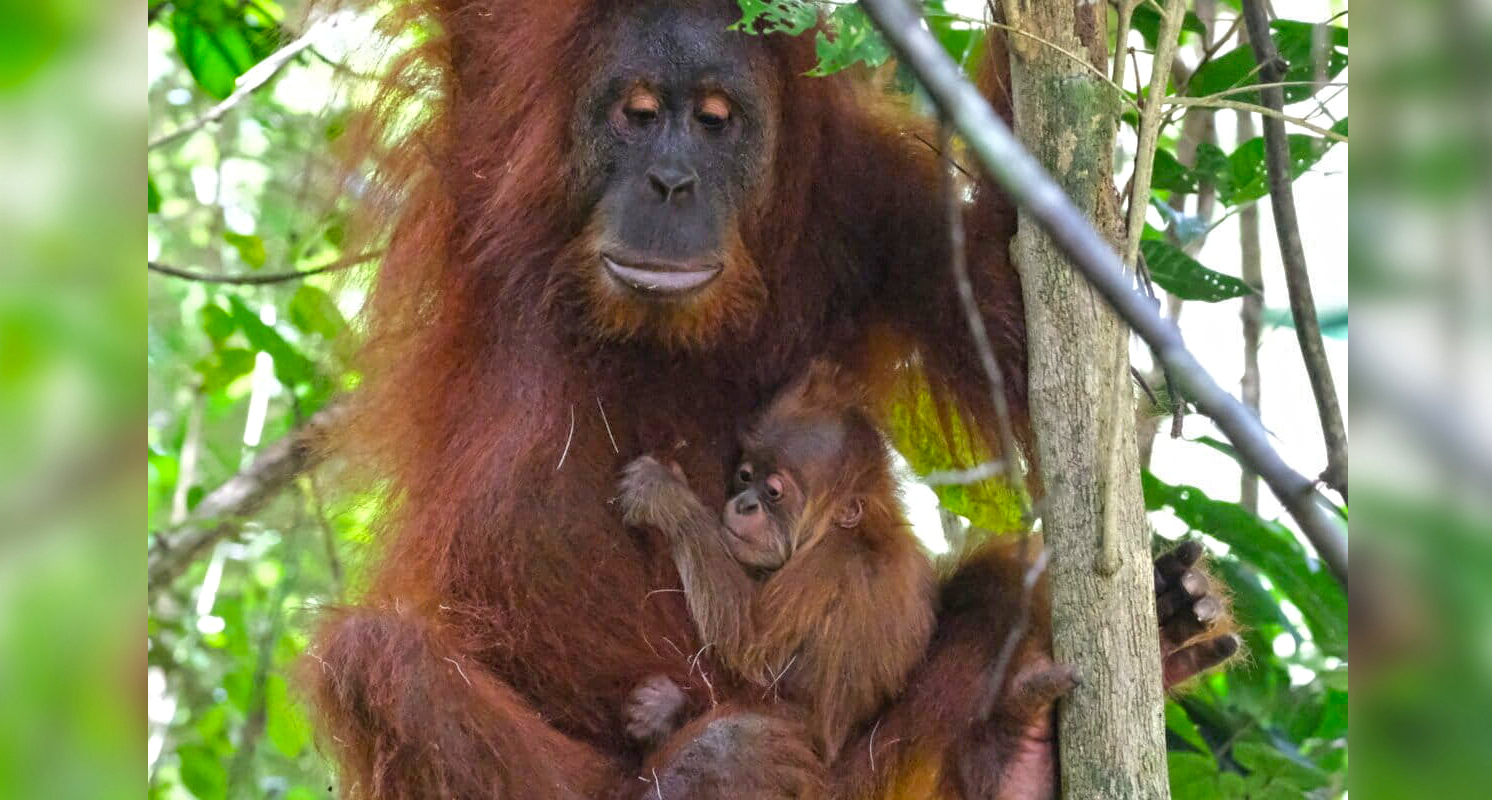
Fieldworkers at the Jantho orangutan release forest in Aceh, Indonesia’s westernmost region, have recorded the 10th birth by orangutans successfully released back into the wild from a charity-run rehabilitation center.Indonesia’s forestry minister named the baby Badar, which means a full moon, and highlighted the need for consistent protection of orangutan habitats in Borneo and Sumatra islands, which are home to Indonesia’s three species of orangutan.However, a new study on Sumatran orangutan populations published in the September issue of “Global Ecology and Conservation” concluded that surviving populations likely declined by nearly 20% between 2011 and 2023. Seven years after being returned to the forests of northern Sumatra from a rehabilitation facility, a female orangutan rescued from traffickers has been found nurturing a baby in the wild, giving new encouragement that reintroduced apes can establish breeding populations. “From victim of illegal wildlife trafficking to a mother in the wild, Bulan’s journey demonstrates the long-term value of orangutan rehabilitation and reintroduction,” said M. Yakob Ishadamy, conservation lead at the Lestari Ecosystem Foundation, an organization that manages the Jantho reservation in partnership with Indonesia’s forestry ministry. Fieldworkers confirmed the birth of the Sumatran orangutan (Pongo abelii) on May 22 this year after seeing Bulan moving across the forest canopy cradling a male infant believed to be about a month old. Indonesia’s forestry minister named the baby Badar, a Malay word with Arabic origin meaning “full moon.” The mother’s name, Bulan, also means “moon” in Indonesian. “This birth is proof that through consistent habitat protection, we can restore populations of endangered endemic species,” Forestry Minister Raja Juli Antony said in a statement. “Hopefully, Badar can thrive in the wild and bring a new glimmer of hope for the sustainability of our invaluable forest ecosystem.” Diana is a female orangutan who is expected to begin her new, independent life at the Jantho Nature Reserve alongside 103 other orangutans. Image by Junaidi Hanafiah/Mongabay Indonesia. Indonesia established the Jantho Orangutan Release Area within the Jantho Nature Reserve in Aceh province, on the northern tip of Sumatra, in 2011. It serves as a reintroduction site for rehabilitated Sumatran orangutans recovered from the illegal wildlife trade and instances of conflict with humans. Rescued orangutans have typically endured significant trauma, both at the time of capture and the ongoing experience of captivity. The program aims to establish self-sustaining wild populations by returning healthy animals to a reservation habitat. The Jantho forest sanctuary contains a high density of fig trees, which provide the primary food source for orangutans, and is connected to the Leuser Ecosystem, where the vast majority of remaining Sumatran orangutans live. Castri Delfi Saragih, spokesperson at the Lestari Ecosystem Foundation–Sumatran Orangutan Conservation Programme, said Badar was the 10th confirmed birth in the Jantho Orangutan Release Area since the program began 15 years ago. However, a new study published this year estimates that just 11,694 Sumatran orangutans remain in the wild, a 19.5% decline from 2011 to 2023. While deforestation remains by far the main threat, populations in some areas have fallen faster than forest loss alone can explain, the researchers concluded, pointing to human conflict and habitat fragmentation as additional pressures. With her habitat destroyed, this female Sumatran orangutan is trapped within a palm oil plantation area in Langkat, North Sumatra. Image by Ayat S Karokaro/Mongabay Indonesia. “This is a warning that must be met with concrete action,” said Syafrizaldi Jpang, executive director of the Lestari Ecosystem Foundation–Sumatran Orangutan Conservation Programme. “With this data, we know exactly what challenges we face.” Ujang Wisnu Barata, head of the Aceh provincial conservation agency, said Bulan’s journey from wildlife trafficking victim to mother in the wild showed rehabilitation efforts could help support orangutan populations. “This birth demonstrates how orangutans, once victims of the wildlife trade, can be given a second chance to live and reproduce in the wild,” Ujang said. “Successes like this can only continue if their habitat remains protected.” Banner image: Bulan and Badar. Image by Andi Saputra/YEL-SOCP. This story was first published here and here in Indonesian on July 7 and Aug. 5, 2026. Flames reach edge of orangutan rehabilitation center, with fire season set to intensify See an orangutan, take a photo, earn some money: A viable conservation model? Citation: Hadi, A. N., Siregar, J. P., Anugrah, N., Kuswanda, W., Boang Manalu, J. H., Nasution, N., … Buckley, B. J. (2026). Population status of Sumatran and Tapanuli orangutans: A comprehensive assessment 2021–2023. Global Ecology and Conservation, 69, e04302. doi:10.1016/j.gecco.2026.e04302 Credits Topics
Rescued from traffickers, reintroduced orangutan becomes mother in the wild
Full Article
Original Source
Read the full article at News →KhanList aggregates and links to publicly available news content. We do not host full articles from third-party sources. Always verify important information with original sources.