
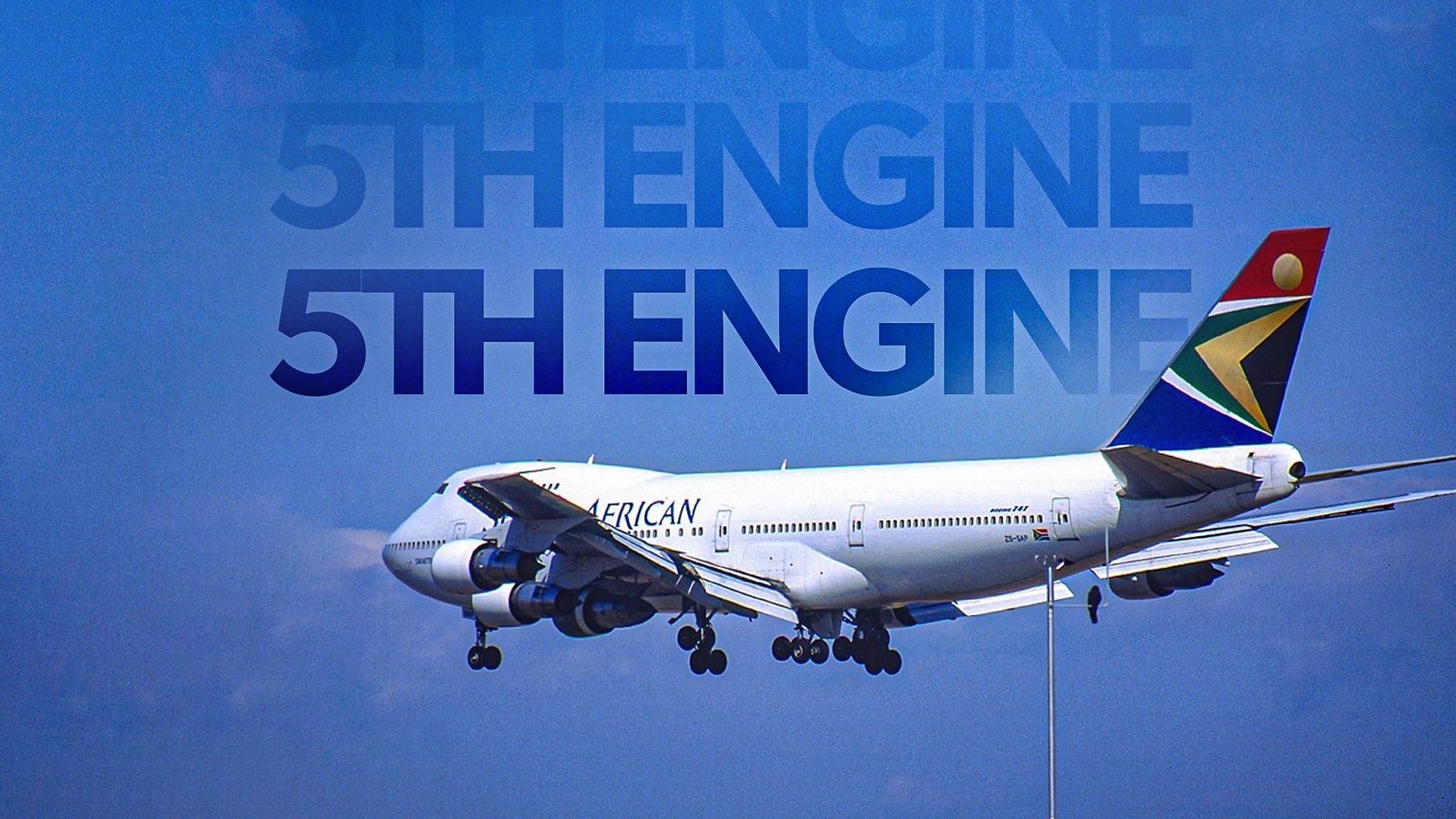
Picture a legendary widebody aircraft thundering down a runway with five massive powerplants bolted beneath its wings, where only four of them are burning fuel and generating thrust. It may seem like an engineering experiment or a futuristic testbed flight, but this was a real logistical lifeline used during the height of the classic jet age. When a commercial airliner suffered a catastrophic engine failure at a remote airport thousands of miles from home, operators did not wait weeks for maritime freight or transport charters; instead, they simply strapped a spare, fully assembled jet engine directly under the wing and flew it there themselves. Such an extraordinary capability centered around the Boeing 747's unique fifth-engine mounting system, an engineering marvel designed to rescue stranded airframes when conventional global supply chains failed. Why did Boeing incorporate a dedicated structural hardpoint specifically for hauling dead-weight turbofans across oceans, and how did flight crews manage the immense aerodynamic penalties of a multi-ton pod? What Happens In The Event Of An Engine Failure On The Ground? When the 747 entered commercial service in 1970, early high-bypass turbofans like the Pratt & Whitney JT9D and Rolls-Royce RB211 were revolutionary in fuel efficiency but notoriously temperamental compared to today's powerplants. If a widebody suffered a catastrophic engine failure at a remote international outstation, such as a distant hub in Asia, Africa, or the Middle East, airlines were met with a huge logistical problem. Standard cargo aircraft of the era frequently lacked the main-deck cargo door dimensions or payload capacity needed to transport a fully assembled, multi-ton turbofan core across continents. The incompatibility created crippling Aircraft on Ground (AOG) delays that could strand a flagship aircraft out of service for weeks while awaiting maritime shipping or rare charter flights. To overcome this vulnerability, aviation pioneers drew upon operational precedents established during the dawn of the jet age. Analysis from Simple Flying notes that as early as 1959, Qantas began outfitting its Boeing 707 fleet with external mounting hardware to ferry replacement powerplants across international networks, a resourceful practice later adopted by operators of the Douglas DC-8 as well. Recognizing that the much larger 747 would encounter identical outstation risks on expanding global routes, Boeing engineered a permanent solution directly into the aircraft's baseline wing architecture. They did so by building a dedicated hardpoint into the port wing so that the Queen of the Skies could act as its own heavy-lift delivery truck. The Fifth-Pod System Mechanically, the fifth-pod system was based on a precision-engineered hardpoint located exclusively on the port wing, positioned inboard between the fuselage and the number two engine pylon. This location was deliberately chosen because it placed the massive secondary weight close to the aircraft centerline, minimizing structural stress on the outer wing spars. Technicians secured the replacement powerplant to a dummy strut designed to withstand extreme shear loads during takeoff, cruise, and landing without distorting the wing's aerodynamic profile. Unlike the aircraft's active operating engines, the fifth-pod unit was entirely non-functional and carried purely as dead-weight freight. It featured zero plumbing, no fuel feed lines, no electrical wiring, and no hydraulic connections, meaning it contributed nothing to forward propulsion. In order to prevent catastrophic windmilling and structural bearing damage from oncoming airflow, ground crews removed the forward fan blades or locked them securely, wrapping the core in streamlined aerodynamic fairings and nose-cone caps. Positioning the multi-ton spare engine close to the fuselage root, engineers minimized dangerous center-of-gravity shifts that could compromise aircraft stability. Despite that, even with the weight efficiently distributed, strapping an exposed turbofan shell under one wing created a significant amount of parasitic drag that massively altered the aircraft's aerodynamic balance. Heavier On One Side When an unpowered turbofan is slung beneath the port wing, the resulting parasitic drag creates a persistent yawing tendency that flight crews must actively manage from takeoff to touchdown. The fifth pod sits exclusively on the left side, so the aircraft naturally wants to pull to the left, needing constant rudder deflection and precise trim adjustments to maintain coordinated flight. The reality was that even though the sheer mass of the airframe dealt with much of the disturbance, the asymmetric resistance needed unyielding pilot attention during initial climb phases and crosswind approaches. To keep the aircraft flying straight and level within safe structural envelopes, flight manuals mandated strict operational limitations, including a maximum cruise speed reduction to around Mach 0.78 or lower to prevent aerodynamic buffeting around the mounting pylon, as noted in discussions from PPRuNe. Furthermore, the added weight of roughly 13,228 lb (6,000 kg) combined with increased drag penalized fuel consumption by 10% to 15%, slashing normal range capabilities. For multi-thousand-mile rescue operations, this heavy fuel burn resulted in using strategic refueling stops, such as touching down at Perth Airport (PER) before attempting the long Indian Ocean crossing to Johannesburg, as noted in Qantas newsroom breakdowns. The huge operational penalty made many of these standard delivery routes become carefully choreographed logistical hurdles, which not every airline ended up being able to manage. So which global airlines actually mastered this intricate procedure, and how did they complete the most famous rescue missions of the classic jet era? The Airlines That Made Engine Ferry Flights Possible The technical and aerodynamic penalties were, of course, formidable, though only a select group of international legacy operators mastered the fifth-pod procedure. During the classic widebody era of the 1970s, 1980s, and 1990s, airlines such as British Airways, Singapore Airlines, South African Airways, Aer Lingus, and Trans World Airlines kept certified engineering protocols to haul spare engines across their far-flung networks. Among these operators, Qantas emerged as the absolute master of the craft, making use of its geographical isolation at the bottom of the world to perfect fifth-pod logistics across decades of 707 and 747 operations. The defining modern case study of this capability occurred on January 6, 2016, when Qantas deployed Boeing 747-438 registration VH-OJS on flight QF63 from Sydney Kingsford Smith Airport (SYD) to Johannesburg O.R. Tambo International Airport (JNB). Making a crucial technical refueling stop at Perth Airport (PER), the aircraft carried a massive Rolls-Royce RB211 turbofan tucked beneath its port wing to rescue a grounded sister aircraft, registration VH-OJU, which was stranded without heavy maintenance support in South Africa. The meticulous operation skipped weeks of complex maritime shipping and unavailable cargo freighter charters, demonstrating the unmatched operational agility of a passenger jet acting as its own heavy-lift supply truck. Even as flight QF63 proved that an airline could successfully rescue a stranded widebody using its own passenger fleet, the global aviation landscape was undergoing a transformation in the background. We no longer see these engine ferry flights, mainly because newer aircraft were never designed with the ability to attach an engine like this, so why is that the case? Engines Are Now Too Reliable? The decline of the fifth-engine ferry system is a direct testament to the extraordinary reliability of modern aviation powerplants. In the 1970s, early turbofans experienced frequent mechanical hurdles that necessitated self-rescue solutions at remote international outstations. Today, advanced high-bypass turbofans achieve dispatch reliability rates exceeding 99.9%, as detailed in Simple Flying analysis, making mid-route engine failures at isolated hubs vanishingly rare and shifting airline operational risk profiles entirely. Furthermore, the globalization of heavy air cargo networks ended the logistical necessity of external wing transport. Purpose-built super-transporters and modern nose-loading freighters, such as the Boeing 747-8F and the Antonov An-124, can easily accommodate fully assembled fan cases and engine cores within their main cargo decks. It is also vital to distinguish these utilitarian cargo ferry pods from dedicated engine testbed aircraft, such as Pratt & Whitney's famous Boeing 747SP testbeds, which mount active powerplants on the forward fuselage or tail for in-flight engineering trials rather than commercial cargo transport. Eventually, twin-engine widebodies came to dominate global long-haul routes and passenger 747s faded into retirement, and so the underwing hardpoints vanished from active airline fleets. Now that modern aviation looks toward ultra-long-range point-to-point networks, how will operators handle rare logistical emergencies when support is thousands of miles away? The Evolution Of Safety Philosophy The disappearance of the fifth-pod capability is really showing the end of an era when long-haul flight operations required sheer mechanical improvisation. When an aircraft could strap a six-tonne jet engine beneath its wing and power across oceans to rescue a stranded sister ship, it demonstrated an aviation philosophy built on frontline self-reliance. Today, that raw frontier spirit has been supplanted by predictive maintenance algorithms, digital supply chain tracking, and global logistics networks that move parts faster than any passenger flight ever could. With passenger 747-400s being phased out of commercial service among operators, and modern twinjets like the A350 and 777X lacking any structural provision for external wing cargo, the hardpoints that once defined jumbo jet versatility exist now only in aviation museums and archival photographs. Comparing and contrasting this era and the current era of modern engine manufacturing really shows how far safety and design excellence has come, and leaves us wondering where the industry may head next.
Rescue Missions: The Untold History Of The Boeing 747's Unique 5th Engine Mounting
Full Article
Original Source
Read the full article at Simpleflying →KhanList aggregates and links to publicly available news content. We do not host full articles from third-party sources. Always verify important information with original sources.