
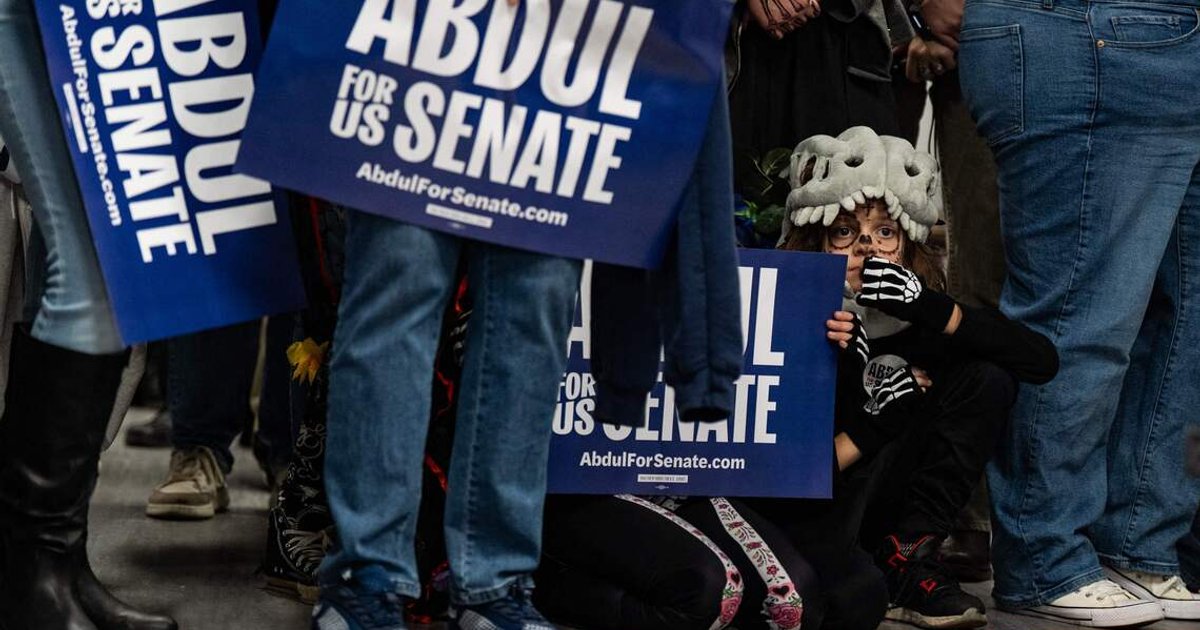
WASHINGTON, United States – Dharminder Dargan used to be an enthusiastic Republican voter. The Indian-American engineer, who lives near Houston, knocked on doors for GOP candidates, planted their signs in his yard and backed Donald Trump. But not this year.Dargan, who has been a US citizen and voter for 15 years, said anti-South Asian rhetoric from some Republicans – and what he sees as the party’s silence in response to recent violence, including an attempted mass shooting at a Hindu temple – has pushed him away.“The wind is changing, and I’m very disappointed in the GOP,” said Dargan, who’s in his late 50s.Across the US, people of South Asian descent say anti-Indian and anti-South Asian hostility that once seemed confined to corners of the internet, is spilling into workplaces, campuses and everyday life. In addition to the temple attempt, a Sikh truck driver in Wyoming was beaten and stabbed at a rest stop, while a Montana man faces a felony charge for allegedly telling a person of South Asian descent to “go back to his country”. For immigrants working on H-1B visas, rapidly changing immigration policies have added another layer of concerns.Indian Americans account for about 1% of the US population, and are concentrated in key parts of several battleground states, including Texas, Michigan, Georgia and North Carolina, making them an important voting bloc.In the final days before the midterms, South Asian groups are organising rallies and other events for Democratic candidates. Races in some areas are so tight, that turnout from the Indian community may change the outcomes, rally organisers say.Voters of South Asian descent have generally backed Democratic candidates, but in narrowing margins over recent years. Now, Democrats are jumping at the chance to have them back. Among South Asian registered voters, 25% of those who supported Trump in 2024 plan to back Democrats in Congressional midterm races, according to a national poll by Indian American Impact, a progressive nonprofit.At a Diwali-themed rally on Oct 31, hundreds of people of South Asian descent gathered in the Detroit suburbs to show support for Abdul El-Sayed, Michigan’s Democratic candidate for the US Senate. El-Sayed, who is locked in a closely watched race against Republican Mike Rogers, attended two events geared toward South Asian voters that evening.There were booths selling sweets and traditional clothing, and a closing performance by an Indian folk dance troupe. Michigan’s Secretary of State Jocelyn Benson, who is running for governor, and other local politicians lit candles to mark the Hindu festival of lights. The event was co-hosted by Indian American Impact and SAATH, another progressive nonprofit focused on South Asians.El-Sayed urged the crowd not to be intimidated by what he described as a growing backlash against Indian and Muslim communities. Other local leaders spoke about rising hate speech and other incidents they say were fuelling discrimination against South Asian people.Democratic candidate for the US Senate Abdul El-Sayed speaking at a campaign cookout ahead of the midterm elections in Pontiac, Michigan, on Oct 31. PHOTO: REUTERS“I’ve seen a very strong shift in the discourse among the Indian American community,” said Ranjeev Puri, the minority leader of the Michigan House and one of the highest ranking South Asians in US state politics. “The political rhetoric is at an all-time low,” he added. “As recent as yesterday I was told to go back home. And I quipped back that ‘I was born in Wisconsin, and I don’t know where you want me to go.”Experiences like these are galvanising voters around the country. In Georgia, Texas and North Carolina, some Indian-American voters who skipped the 2022 midterms are looking for new ways to get involved, said Chintan Patel, executive director of Indian American Impact. At an event in Austin, Texas, attended by about 70 people, many were new to political organising, and wanted to do more than just vote, volunteering to knock on doors or make calls for candidates.“We’re seeing more energy because of what is happening,” Patel said.In all, 92% of Indian Americans who are registered to vote plan to take part in the midterms, according to a recent poll by APIA Vote and AAPI Data. And 70% say racism, racial discrimination and hate crimes are “very” or “extremely” important to them, with most saying Democrats are doing a better job of addressing those issues than Republicans.Some of the rhetoric has come directly from the Trump administration. A Department of Homeland Security post on X this fall showed a cyborg warrior staring down a Sikh man and urging him to leave the country. Trump has also moved to overhaul the H-1B programme, whose beneficiaries are overwhelmingly Indian, claiming it has allowed foreign workers to displace US citizens.“Some of the hate itself, the discrimination, is coming from some of the highest reaches in political office,” Patel said. “Many of our elected leaders (are) stepping up and are calling out this hate and condemning it. But then we didn’t see that from the president. We didn’t see it from the vice president, either.”A White House spokeswoman said the X post was referring to a specific Sikh truck driver accused of causing a fatal accident, and added that Trump had condemned violence against Hindus in 2017 and 2024.“Violence has no place in America,” White House Spokesman Davis Ingle said in an email. “President Trump is Making America Great Again for Americans of every race, religion, colour, and creed.”Still, the bigotry has surfaced in this year’s elections. Bo French, the Republican nominee for Texas Railroad Commissioner, posted a photo of South Asian students celebrating a University of Texas football victory on X and wrote that “the problem is now obviously far worse than anyone imagined.”In a later post, he said: “Social media is exposing how many Americans have been displaced by foreigners.” The posts drew bipartisan criticism, though the Education Department later appeared to echo French’s sentiment, posting a photo of White people at a football game captioned “Make College Football Great Again.”Right-wing commentators have also seized on the issue. In early October, Christopher Rufo, a Manhattan Institute fellow, co-hosted a podcast episode titled “The Indian Question”. Rufo’s co-host, Matthew Keeperman, said the phrase reflected concerns among “ordinary people” about growing South Asian populations in suburban Dallas, New Jersey and Illinois, and whether immigration had reached a tipping point.The number of posts expressing hate for South Asians on the social media site X more than tripled between January 2024 and June 2026, according to a study by the Centre for the Study of Organised Hate.Dargan, the Houston-area voter, said children of his immigrant peers are coming home from college with stories of hateful encounters on campus. At Diwali celebrations and other gatherings, he said, rising anti-Indian sentiment is a frequent topic.In Troy, Michigan, Suril Patel sees a different picture. The engineering consultant says Indian Americans play a prominent role in the state’s Republican Party.“The national mood or the national media landscape might paint it as Trump is racist, but the co-chair of the Michigan GOP is Indian and Hindu and proud of it, and talking about that,” he said.He added that the state party’s recently elected youth chair is Indian and Hindu, while an Indian-American Christian serves as Michigan’s national committeewoman on the Republican National Committee.Patel said he believes Michigan’s Indian-American and Hindu communities are more supportive of Republicans than polls suggest. He praised the state’s GOP gubernatorial candidate, John James, for posting a video condemning the recent Hindu temple attack.Rohan Soni, a law student at Emory University, is founder of SAATH, which matches South Asian volunteers in their teens and 20s with political campaigns in states including Florida, Georgia, Virginia, Michigan and Texas.For Soni, a speaker the Detroit-area rally on Oct 31, the debate is who gets to be considered fully American. He pointed to former Republican President Ronald Reagan’s argument that newly naturalised citizens are just as American as people whose families have been in the country for generations.“What we are seeing in this country right now, especially with the South Asian community, is a redefinition of what it means to be American,” Soni said. BLOOMBERG
Republicans risk losing South Asian voters over anti-Indian rhetoric
Full Article
Original Source
Read the full article at Straitstimes →KhanList aggregates and links to publicly available news content. We do not host full articles from third-party sources. Always verify important information with original sources.