
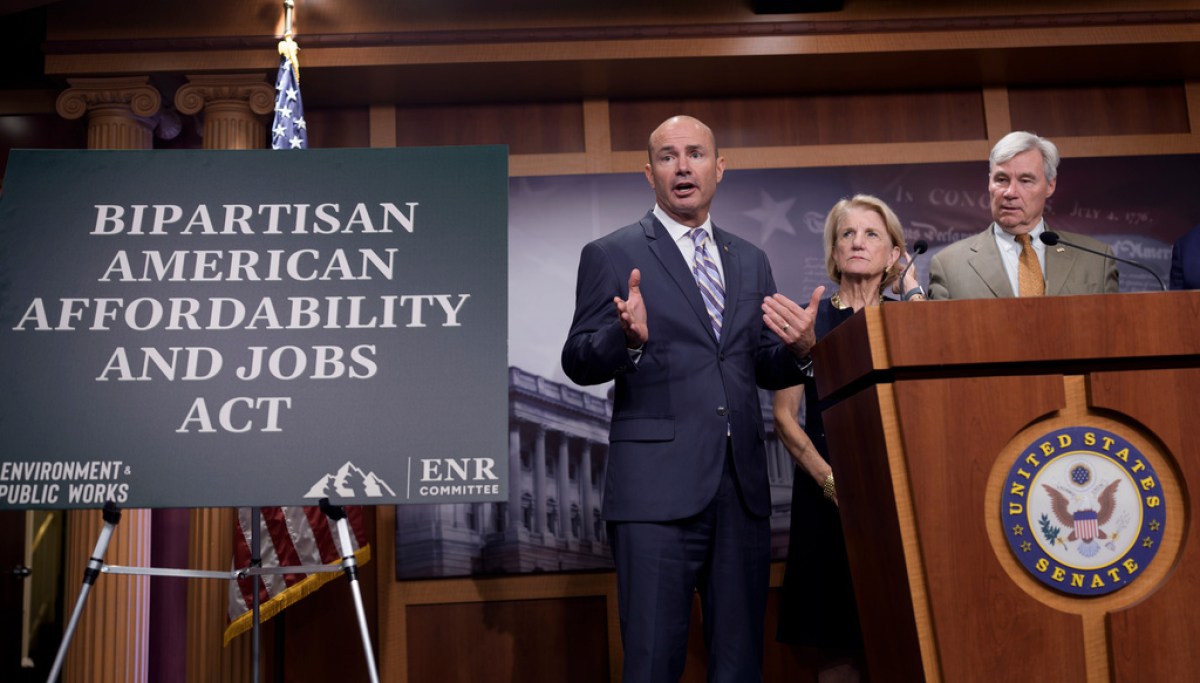
The Senate is poised to put its bipartisan energy and infrastructure permitting bill to a final vote this week, but not before Republicans attempt to soften a key Democratic priority aimed at deploying more wind and solar projects.Several Republican senators have introduced amendments that would scale back on provisions expanding the federal government’s authority to approve of interstate power lines. Republicans have long been wary of backing such projects over concerns that they socialize transmission costs, forcing GOP-led states to pay for infrastructure that later sends energy to Democrat-led states.Removing these provisions from the Bipartisan American Affordability and Jobs Act could very easily cause on-the-fence Democrats to vote against advancing the bill to the House, upending the legislation and leaving it with the same fate as other permitting reform deals that failed in recent years. Accelerating the development of transmission infrastructure has one of the top concerns for Democrats, who say expanded and upgraded power lines would make it easier to connect renewable energy projects to the electric grid and tackle decarbonization.BAAJA has significant bipartisan support in the Senate, with 73 lawmakers, including 22 Democrats, voting in favor of advancing the legislation toward a final vote last week. However, not all who voted in favor have committed to supporting the final passage.The bill faces a tougher battle toward passage in the House, as many Democratic members wish to delay negotiations until the next Congress, when they will hold the majority in both chambers. And across the aisle, several Republicans have brought up concerns about the transmission provisions with administration officials.Some Republicans are specifically seeking changes to the measures that give federal regulators more power in approving and blocking interstate transmission projects.As written, if a state fails to approve certain transmission lines within one year, BAAJA would grant the Federal Energy Regulatory Commission the authority to step in and approve the project if it is deemed to have “national interest.”The projects must mean certain standards for FERC to get involved, including having a minimum voltage threshold of 230 kilovolts or higher. Most interstate, long distance, high voltage transmission lines meet this threshold.With concerns circulating in the House, several Senate Republicans have introduced amendments aimed at weakening the transmission provisions.Sen. Josh Hawley (R-MO) introduced four amendments last week, with the overall aim at expanding landowner protections.The amendments, if adopted, would increase compensation rates for landowners whose land is taken away through eminent domain, extend the timeline for states to consider transmission applications before federal regulators get involved, and provide federal regulators with more flexibility regarding backstop authority.The amendments would also limit the number of projects that federal regulators could exercise eminent domain over, by increasing the minimum voltage threshold to 765 kilovolts.Hawley has long opposed large-scale transmission projects that use eminent domain to seize “generational land” in Missouri. Last year, he pushed the Trump administration to cancel a loan guarantee for a massive multistate transmission project that was anticipated to produce upward of 5 new gigawatts of energy across four states, including Missouri.Sen. Ted Budd (R-NC) filed a similar amendment last week that would limit the type of projects FERC gets involved in, by increasing the minimum voltage threshold to 345 kilovolts.Other Republicans, including Sen. Eric Schmitt (R-MO), are aiming to require FERC to obtain more input from landowners when considering transmission projects.Additionally, Sen. Bill Hagerty (R-TN) is looking to exempt the Tennessee Valley Authority, the largest public power provider in the United States, from FERC’s backstop authority. As written, only the Electric Reliability Council of Texas is exempt.At least one Democrat in the Senate is joining Republicans and calling for changes to the existing BAAJA transmission provisions.Sen. Tammy Duckworth (D-IL) introduced multiple amendments to the transmission section of the bill, pushing for increased landowner protections, more landowner and public participation in agency decisions, and more explicit citing considerations. She is also seeking to narrow transmission interconnection requirements.There is no guarantee all of these amendments receive a vote in the coming days. Senate leaders and rank-and-file members are working to determine if any of the amendments proposed in the last week will be considered.MAJOR BILL TO CUT RED TAPE FOR ENERGY PROJECTS CLEARS SENATE HURDLEIt remains to be seen whether Senate leaders will appeal to House Republicans’ concerns regarding the transmission provisions, at the risk of losing Democratic votes.Advocates for the bill have said at least 15 to 20 Democrat votes are needed to back the bill in the Senate in order to whip votes in the House.
Republicans look to weaken transmission reforms in bipartisan permitting bill
Full Article
Original Source
Read the full article at Washingtonexaminer →KhanList aggregates and links to publicly available news content. We do not host full articles from third-party sources. Always verify important information with original sources.