
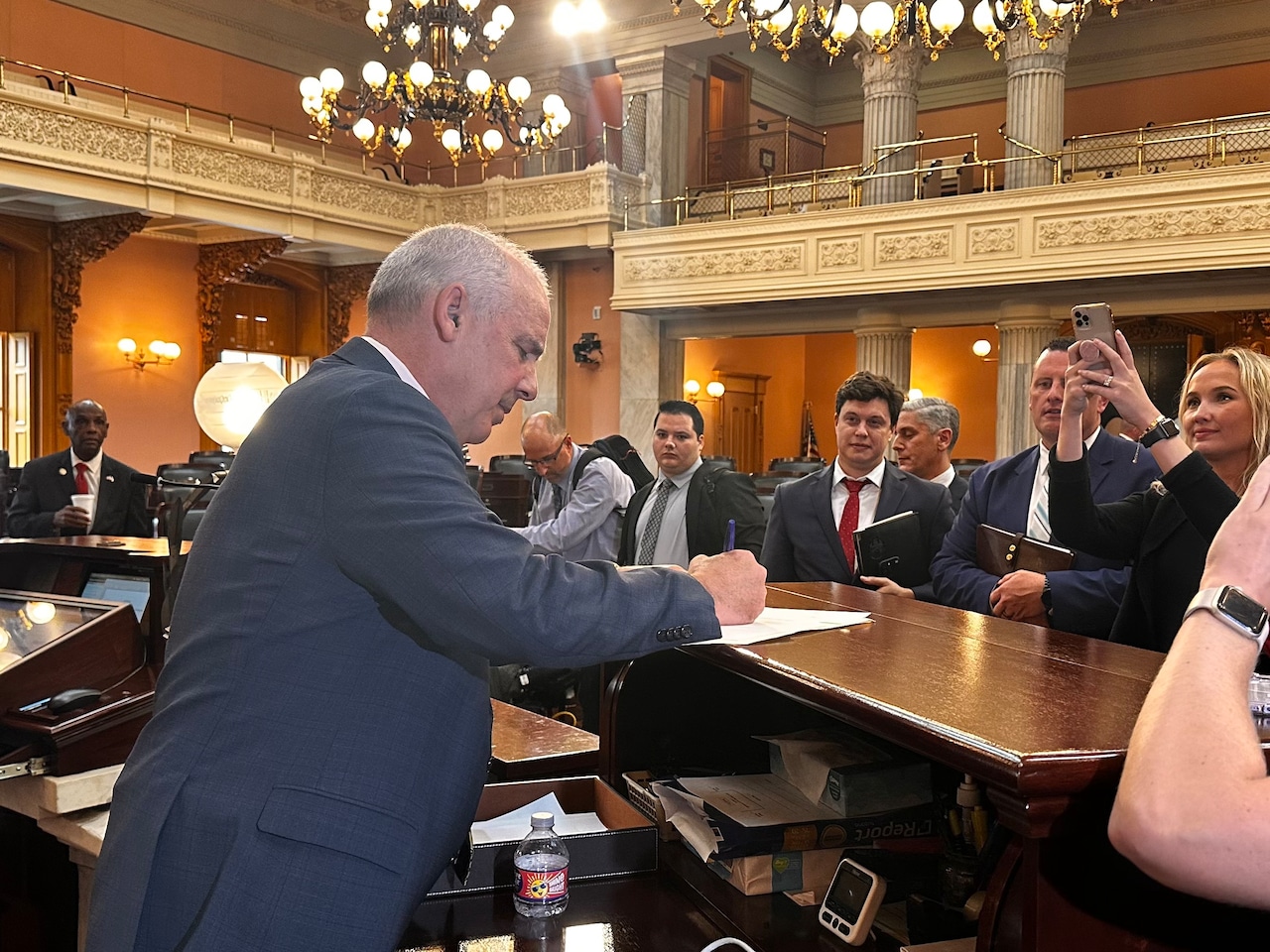
NewsOhio House Speaker Matt Huffman, a Lima Republican, signs the legislation to suspend the state's gas tax for 90 days.Anna StaverCOLUMBUS, Ohio -- Ohio lawmakers returned to the Statehouse on Wednesday to pass a three-month gas tax holiday, but Democrats wanted to talk about a lot more than gas.They tried to offer plans for utility bill relief, a bigger child tax credit and a larger homestead exemption. They also wanted to debate the war in Iran and whether Ohio should redirect money set aside for sports stadiums into checks for ratepayers.House Minority Leader Dani Isaacsohn, a Cincinnati Democrat, said Democrats came to the special session with a broader affordability plan that would tap money earmarked for the new Cleveland Browns stadium for funding.“We proposed a plan that would provide real relief,” Isaacsohn said.One lobbying group which is working toward putting a data center moratorium on the ballot had urged lawmakers to use the special session to pass a moratorium on new facilities.Republicans, who control both chambers with supermajorities, blocked them from doing any of it.The House and Senate used procedural moves to keep the special session focused on one bill: suspending Ohio’s 38.5-cent-per-gallon gas tax for three months.Senate President Rob McColley, a Henry County Republican who is running for lieutenant governor, closed debate before Democrats could even speak on the merits of the gas tax bill. “We were very clear with everybody. We were coming here to vote on this issue, and this issue only,” McColley said. “And the Democrats should have realized that as well.”McColley said Democrats’ attempts to raise other issues could have put the gas tax holiday at risk, “and our caucus thought it was important to get in, get the job done on behalf of Ohioans across the state.”Democrats, many of whom voted for the gas tax suspension, said the problem isn’t that this would provide some relief but that it would not do enough to help those struggling with rising costs. The average driver could save as much as $55 over the 90 days, according to estimates from the nonpartisan Legislative Service Commission.Isaacsohn said Democrats wanted to debate other forms of relief for consumers -- a broader affordability plan that included a gas tax holiday, utility bill relief and property tax relief.He said Democrats wanted to pay for it with Ohio’s budget surplus and money lawmakers set aside for sports stadiums, including $600 million for the Haslam Sports Group’s proposed Cleveland Browns stadium in Brook Park and another $400 million for a future sports project.“The money is there,” Isaacsohn said. “The Republicans in the legislature have just so far chosen to give $600 million to the Haslams for the Browns stadium and $400 million to a yet-to-be-named sports team owner.”Senate Minority Leader Nickie Antonio, a Lakewood Democrat, said Senate Democrats also wanted to introduce a resolution calling on President Donald Trump to end the war in Iran. They said the war is a major reason gas prices have risen.“Until we end the war in Iran, which no one on the Republican side had the courage to call for today or even mention, until we take seriously the actual underlying issues driving up gas prices, they are going to continue to be high,” Isaacsohn said.Gas prices are only one part of the broader affordability debate shaping this election cycle. Candidates and lawmakers are also talking about grocery prices, rent, property taxes and utility bills.That includes data centers, which have become a major fight over future electric costs.Conserve Ohio, a group gathering signatures for a proposed ban on most new data centers, urged lawmakers to use the special session to pass a moratorium on new facilities.Lawmakers did not take that up Wednesday. When asked why, McColley said Gov. Mike DeWine had already created what amounted to a de facto moratorium by refusing to approve new sales tax exemptions for data center projects through the end of the year.“No big data centers are likely to proceed unless they can at least have an opportunity to have that discussion,” McColley said, adding that Senate Republicans want “sensible” regulations in place before moving forward with future data center policy.“We hear their complaints, we hear their issues, we hear their concerns, and we’re committed to addressing them,” he said.As a statehouse reporter for Cleveland.com, I write about all things Ohio politics with a focus on elections, marijuana policy, social issues, budgets, redistricting, public pensions, immigration in Ohio and...
Republicans block Ohio Dems’ broader relief plans - data centers and utility bills, property taxes
Full Article
Original Source
Read the full article at Cleveland →KhanList aggregates and links to publicly available news content. We do not host full articles from third-party sources. Always verify important information with original sources.