
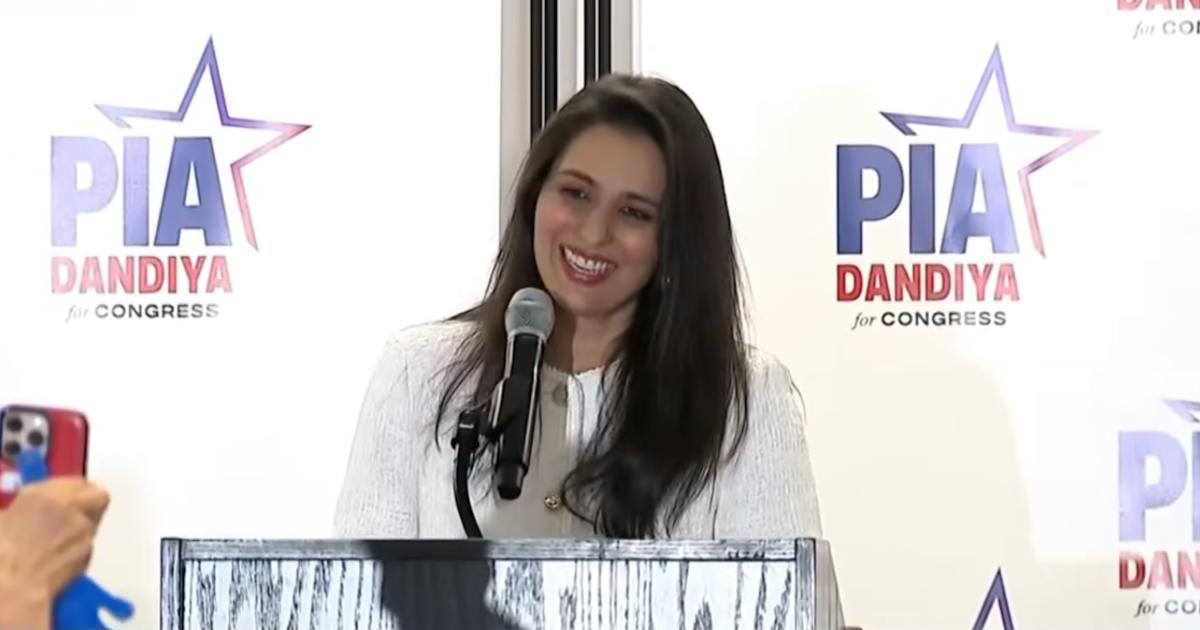
It looks like Republicans have just played themselves in Florida. As midterm election results rolled in Tuesday night, it quickly became clear that GOP gerrymandering in the Sunshine State had seriously backfiredDemocrat Kathy Castor held onto her seat in Florida’s 14th congressional district, fending off a challenge from Republican Mike Beltran. Republicans purposefully redrew that district to get rid of Castor, by including a lot less of Tampa and a lot more of its outlying rural counties. In 2024, President Donald Trump won the areas making up this new district by 11 points. In Florida’s 22nd congressional district, Democrat Pia Dandiya defeated Republican Casey Askar, after Governor Ron DeSantis’s gerrymandering efforts created an open seat for the Republicans to steal. The state’s current 22nd district is represented by Democrat Lois Frankel, who is now running in Florida’s 23rd district. In the race for Florida’s Senate seat, Democratic socialist Angie Nixon was defeated by Republican incumbent Ashley Moody—but when the race was called at 84.3 percent of the vote reported, Moody led Nixon by only 0.7 percentage points. The Republican won, but not by nearly as much as expected for a historically red state. Democrats are projected to retake control of the House of Representatives for the first time in four years.Decision Desk HQ projected Democrats will seize the chamber from Republicans. It is not yet clear which party has taken control of the Senate.Republicans gained control of the House two years ago during the 2022 midterm elections. While there was no “red wave” as widely predicted, Republicans were able to flip 19 districts from blue to red. Ahead of the midterm elections Tuesday, Republicans held only a slim four-seat majority over Democrats. The latest polls had heavily indicated that Democrats would retake control of the House. While America’s authoritarian era likely won’t end in a day, the results of the House midterm elections are a searing indictment on Republicans’ rule and the first two years of Trump’s second term.Read more about the House:Midterm election predictions are not looking good for Republicans in battleground states.Garrett Archer, a data analyst for an Arizona ABC News affiliate, shared messages Tuesday from an unnamed GOP analyst that don’t bode well for their party.“God all my models are already projecting doom. And it’s 8am,” the text messages read.ScreenshotConservative campaigns around the country are feeling similar pressure as their candidates were forced to thread the needle between kowtowing to the president’s fragile ego and distancing themselves from his wildly unpopular military and economic policies.Politico reported Friday that some Republicans are bracing for “a brutal evening,” expecting major losses in both chambers of Congress.“Once the dominoes start falling it becomes hard to stop them,” a senior GOP strategist told the newsroom.Donald Trump has already started surveying the landscape of his Cabinet for potential fall guys should the elections go south. Last month, Trump reportedly called several close confidants to assess the job performance of White House chief of staff Susie Wiles, his former campaign manager and famed “Ice Maiden,” as a potential scapegoat for a major midterm bust. He’s also made the rounds to assess current attitudes about Defense Secretary Pete Hegseth and Joint Chiefs of Staff Chairman Gen. Dan Caine as the Iran war drags on into its eighth month.Republicans, meanwhile, know exactly where to point their fingers. “We all know who the problem is. It’s Trump,” a GOP strategist involved in midterm races across the country told Politico Monday.That same strategist was unsure about how the Republican Party might reform itself if the party sustains major losses on Tuesday.“Look, a lot of Republicans have held their tongues. A lot of Republicans who have real problems with the way things have gone the last two years have been good soldiers,” they said. “But what happens if we lose 35 House seats and six Senate seats?”President Donald Trump is taking drastic steps to investigate Alaska’s Senate election, with the Department of Justice sending criminal target letters to about 20 leading Democrats. The New York Times reported on Election Day that Marc Elias, a Democratic elections lawyer whose firm represents Alaska Democratic Senate nominee Mary Peltola, has received a letter. So has at least one official at the Democratic Senatorial Campaign Committee. The letters tell the recipients that they could be targets in the DOJ’s investigation into the recruitment of a candidate with the same name as incumbent Republican Senator Dan Sullivan. The DOJ is investigating possible donor fraud and conspiracy charges as well, an anonymous source told the Times. According to the publication, it’s not known when the letters were sent or if every intended recipient got them. Trump has been raving about the Alaska contest for days, accusing the Democratic Party of election fraud and repeatedly attacking Elias and Senate Minority Leader Chuck Schumer. Trump told Fox & Friends Tuesday morning that Elias “was a bad guy, very bad guy” who “should go to jail, in my opinion.”On Monday night, Trump made a series of Truth Social posts claiming that independent candidate Daniel J. Sullivan was “missing in action” and suggesting that he had been kidnapped. He speculated that “the Dumocrats are trying to steal this Race by putting a FAKE Daniel J. Sullivan, Jr. on the Ballot. People will not be able to figure it out, and many Votes will be lost.” That, along with the target letters, could be a hint that Trump will try to take action in the event that Peltola wins the race. He’s openly said that he would consider a “redo” of the election if that happens, although he lacks the legal backing to make such a move, especially considering Alaska has ranked-choice voting. He’d end up sowing confusion and undermining confidence not just in Alaska, but in the entire country. Read more about the race:Schools that reject Google’s AI services apparently won’t be allowed to use Google at all.The company announced Tuesday that it will turn off search engine access for K-12 schools that toggle off its AI tools as soon as next year. Google executives claim the decision is based on the technologies’ recent fusion.“Search and AI are deeply integrated,” Chris Phillips, vice president for education at Google, told The New York Times, adding that students at schools that have banned AI “will not have access to search, and they’ll see a message from their school that indicates it’s not available.”Many schools across the country have already invested in Google’s technologies, purchasing low-cost Google Chromebooks to assist educational instruction. Beyond that, Google’s search algorithm has led the industry for the last two decades, besting its competitors to the point that its mere name has become synonymous with research.Lina Khan, the former chair of the Federal Trade Commission, argued in a statement on X that Google had used its “search monopoly to coerce schools” into adopting AI tools. She noted Google has been found legally liable multiple times for antitrust law violations.“This latest move shows it remains unchastened,” Khan wrote. “As the public increasingly pushes back against the use of AI in schools … Google is making clear it will punish those who don’t fall in line.”Studies conducted over the last several months have indicated that the risks attached to the use of AI in schools outweigh the potential benefits. A January report by the Brookings Institution’s Center for Universal Education found that AI can “undermine children’s foundational development,” and that “the damages it has already caused are daunting.”New skill development and problem-solving abilities are among the chief concerns when it comes to early-age AI dependence. Children can easily fall into a catch-22 in which they continually offload their work onto the AI, diminishing their self-confidence and self-reliance in the process, according to the Brookings Institution report.“When kids use generative AI that tells them what the answer is,” Rebecca Winthrop, one of the report’s authors, told NPR, “they are not thinking for themselves. They’re not learning to parse truth from fiction. They’re not learning to understand what makes a good argument. They’re not learning about different perspectives in the world because they’re actually not engaging in the material.”
Republicans’ Attempt to Rig the Map Backfires Big-Time in Florida
Full Article
Original Source
Read the full article at Newrepublic →KhanList aggregates and links to publicly available news content. We do not host full articles from third-party sources. Always verify important information with original sources.