
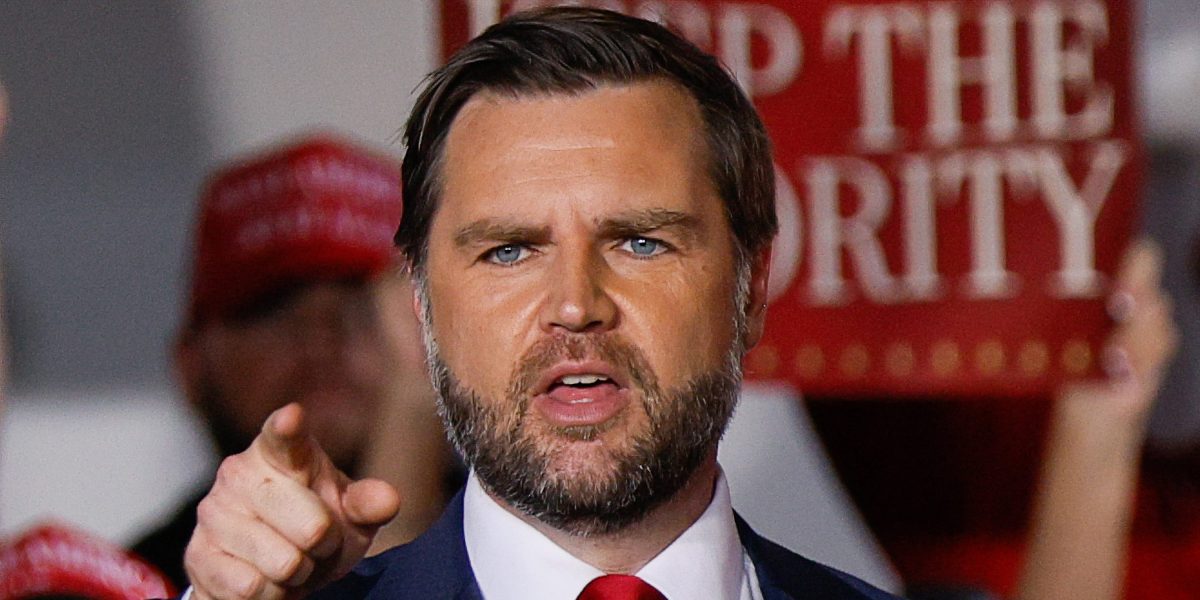
Vice President JD Vance delivers remarks during a midterm campaign rally at JRJ Construction on Oct. 29, 2026, in Weatherford, Texas. Photo: Evan Vucci-Pool/Getty Images Alain Stephens is an investigative reporter covering gun violence, arms trafficking, and federal law enforcement. To say that Americans were pissed off is an understatement. On Tuesday, Democrats didn’t just seize control of both houses of Congress. They redrew the American political map, capturing offices that had remained reliably Republican for generations, from the Deep South to Kansas and Texas. The Lone Star State alone, with its 40 Electoral College votes, now raises the possibility of a seismic shift in the calculus of future presidential elections. The sheer scale of the historic Democratic surge delivered an unmistakable rebuke to America’s supposedly populist president. The message was clear and simple: We do not like you. Much of Americans’ rapid disillusionment with the Trump administration can be traced to a single word — Iran — and the cascading economic hardships Americans have endured as the war has dragged on. The Iran war has gone from a Republican loyalty test to a political albatross. For the GOP, the threat is existential. The war has gone from a Republican loyalty test to a political albatross for many of its former supporters, one that many Republicans are now jettisoning themselves away from to salvage their own political futures. By Wednesday, it had become the chief explanation for the party’s sweeping electoral defeat, with Vice President JD Vance declaring unequivocally on X that “the reason we lost is the war.” “If you’d like to argue it was worth it, that losing the Senate for the next 6 years was worth it, then do so. Argue it was a worthwhile cost to pay. Agree or disagree, that’s at least honest,” he wrote. “But everyone knows why we lost. And any honest conversation about where we go from here must start there.” Coming from Trump’s own vice president, it was a striking about-face. The tirade also raised an awkward question ahead of the 2028 presidential race: How does a potential successor to the MAGA mantle campaign against a war waged by his own administration? Trump, however, has not gone nearly as far as his VP. Although the president acknowledged the war hurt Republicans, he still defended it on its merits. Speaking with reporters Wednesday after expounding at length about his White House ballroom, Trump said, “The Iran thing we had to do, and we continue to do it.” Where Did All the Warmongers Go? But on the campaign trail, Republicans were not completely oblivious to Americans’ collective frustration with the Iran war. In September, ABC News identified 17 Republican lawmakers and candidates who had called for ending the war through public statements or votes. Much of the pressure came in competitive midterms races, as the conflict’s effects on oil, diesel, and fertilizer prices reached American households. In Iowa, Republican Senate candidate Ashley Hinson called for a “successful and immediate end” to the war in September, warning that voters were paying the price at gas pumps and grocery stores. Yet she voted six times against House measures directing Trump to halt the attacks. During an October 25 ABC interview, Hinson said she would not rule out a post-election U.S. offensive and said she trusted Trump and the military to choose the right timetable. Despite the president praising her weight loss at a recent rally, tepidly breaking with Trump wasn’t enough to get Hinson over the line, and she lost to Democrat Josh Turek by 4.5 percentage points. Michigan also had its share of Iran backtrackers. Republican Senate hopeful Mike Rogers described Iran as an “imminent threat” when the bombing began on February 28. In May, he called the conflict a potential “win-win-win.” But with the midterms fast approaching, Rogers released a campaign ad declaring “the war with Iran needs to end” quickly and warned Michigan families could no longer afford the economic fallout. Rep. John James, the Republican candidate for Michigan governor, likewise praised Trump’s use of force early in the war, saying the president “had the balls” to “assure the survival and success of liberty.” He voted against six House war-powers resolutions, including as recently as September. Days after that vote, he said the war needed to wrap up “quickly.” He went on to declare in an interview, “the position has always been, I hate war.” Both Rogers and James lost their races. Even Florida Gov. Ron DeSantis, a possible contender in the Republican Party’s next presidential contest who could reportedly be up for Pete Hegseth’s job, warned Monday that the war was a “big, big drag” on his party. Trump, DeSantis pointed out, campaigned against another Middle Eastern war. Now voters are dealing with higher fuel costs, and Republicans who refuse to acknowledge the connection are “gaslighting” them. But back in spring, DeSantis defended the strikes on Iranian leadership, describing its government as “a fanatical, apocalyptic, militant Islamist regime.” The polling helps explain the Republican panic. An Associated Press poll found roughly 6 in 10 voters believed the U.S. made a “wrong decision” in attacking Iran. And it’s not as though Republicans weren’t warned. A handful within their own ranks, including Thomas Massie and Rand Paul, opposed the war from its earliest days and backed efforts to rein it in. But those criticisms seemed to fall on deaf ears. A Hasty Retreat With plenty of blame to go around, the criticism has gone beyond candidates and into the conservative media ecosystem. During the network’s primetime Election Night coverage, Fox News host Sean Hannity told his colleague Bret Baier that the results would have been different without the Iran war. Conservative commentator Matt Walsh called the war a betrayal of America First principles, demanded new Republican leadership, and labeled the conflict a “catastrophically stupid decision.” Former Rep. Marjorie Taylor Greene called Trump breaking his promise not to start another foreign war his “biggest betrayal” and said “Americans are fed up with it.” Other commentators placed the responsibility squarely on Trump himself for sucking his own party into a political quagmire. In The Federalist, senior editor John Daniel Davidson blamed the party’s collapse on Trump’s undermining of a GOP coalition built upon rejecting the interventionist politics of the George W. Bush era. Some prominent Republican operatives are sure to be thrown under the bus by their own party in the retreat. The first to get the boot may be none other than Hegseth, America’s chief “warfighter,” who has been one of the war’s most enthusiastic, and public, cheerleaders. The defense secretary responded to the criticisms in a nearly six-minute-long video posted online on Thursday, in which he seemed to make the case for keeping his job, touting his elimination of the “Marxist ideology” of diversity, equity, and inclusion initiatives and tarring transgender troops as having a “mental illness.” “Regardless of how people care about the war, which I believe is a courageous and historic effort that will ensure Iran never gets a nuclear weapon, we need to continue, as President Trump did in his first term, to rebuild our military,” he said. “This is not about me, but of course, the other side, in case you noticed, they’re obsessed.” Already facing growing Republican dissatisfaction and a ballooning roster of disgruntled and ousted senior military officials, Hegseth now faces the prospect of investigations by a Democratic-controlled Congress and an impeachment effort led by Massie. And while Trump has so far publicly defended his defense secretary, he has also reportedly consulted allies about whether to hit the ejector seat on Pete. Tuesday’s results show voters are increasingly willing to hold politicians accountable for needless war. But while Republicans and Democrats read polls and calculate the political currency of war and economic hardship, the human cost cannot be measured in votes. At least 3,636 people had been killed in Iran as of early April, including 1,701 civilians and 254 children, according to human rights monitors. More fighting has followed and likely driven that number far higher. At least 23 American service members have died in operations connected to the war, with almost 900 wounded by enemy fire. But these are estimates, and the Trump administration has worked to actively obfuscate the true casualty rates of the war. These are not electoral statistics. They are lives lost, families shattered, and consequences that will endure long after administrations swap office spaces. For Republicans now scrambling to distance themselves from a deeply unpopular war, the political consequences may be harder to escape than their own voting records. Tuesday’s results show voters are increasingly willing to hold politicians accountable for needless wars, and the suffering inherited from them.
Republicans Are Desperate to Pretend They Never Supported the War With Iran
Full Article
Original Source
Read the full article at Theintercept →KhanList aggregates and links to publicly available news content. We do not host full articles from third-party sources. Always verify important information with original sources.