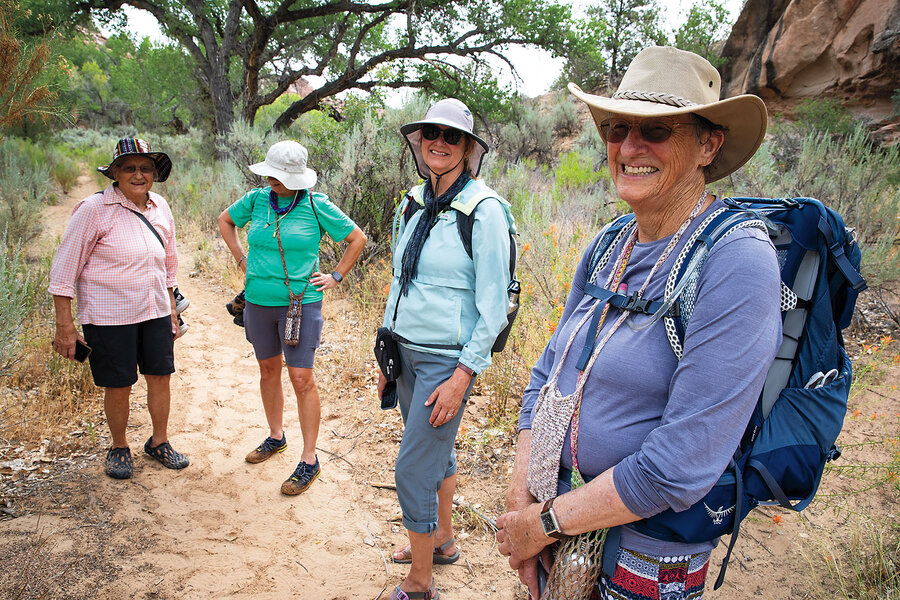
Last summer, a moment of bipartisan pushback broke through the party-line policymaking that often dominates Washington.It had to do with a provision in a spending bill that would have allowed the federal government to sell off public lands. The opposition cut across not just politics but also identity: conservatives and liberals, ranchers and environmentalists. A flood of social media videos, many posted by outdoorsmen influencers wearing camouflage, urged politicians to protect America’s wild spaces. Congress ultimately scrapped the proposal.“Whether you’re a greenie like me who’s a mountain biker and loves the outdoors for multiple reasons, or you’re a conservative hunter – we all have a shared love of public lands, and we all use them,” Michael Carroll of The Wilderness Society told me at the time. “It sounds cliché, but public lands are the common ground for everyone.” Why We Wrote This Our story about the newest fight over public lands in Utah reveals longstanding debates over who controls the West. It also shows a common ground that unites Americans across political party. In this week’s magazine, Story Hinckley explores the nuances that exist alongside that common ground. She and photographer Melanie Stetson Freeman reported from Utah.In July, President Donald Trump moved to cut by some 90% two national monuments there – a move supported by the state’s Republican leaders.When President Bill Clinton established Utah’s 1.7 million-acre Grand Staircase-Escalante National Monument in 1996, he described the land in sweeping terms.“God’s handiwork is everywhere in the natural beauty of the Escalante Canyons and in the Kaiparowits Plateau, in the rock formations that show layer by layer billions of years of geology, in the fossil record of dinosaurs and other prehistoric life, in the remains of ancient American civilizations like the Anasazi Indians,” he said.President Barack Obama designated the Bears Ears National Monument in 2016, after years of lobbying from tribal nations, many of which have deep ancestral and sacred ties to the area.During his first term, President Trump moved to shrink both. President Joe Biden then restored them.Mr. Trump has a pattern of reversing what can be described – depending on one’s political perspective – as either the good works or the excesses of prior administrations.But this political back-and-forth can mask deeper questions – and unity.It can be hard for people on the East Coast to understand just how much land the federal government owns. More than 90% of U.S. federal lands are in the West, with almost half the land there under federal ownership. There are differing views about how this land should be used and controlled.But peel away the layers of policy and politics, as well as the debates about ownership and access, and you’re left with the soaring red canyons and deep green valleys that Melanie captures alongside Story’s writing.There are many places of beauty around the world. Telling their stories can bring a sense of shared purpose and humanity.
Reporting on public lands and common ground
Full Article
Original Source
Read the full article at Csmonitor →KhanList aggregates and links to publicly available news content. We do not host full articles from third-party sources. Always verify important information with original sources.