
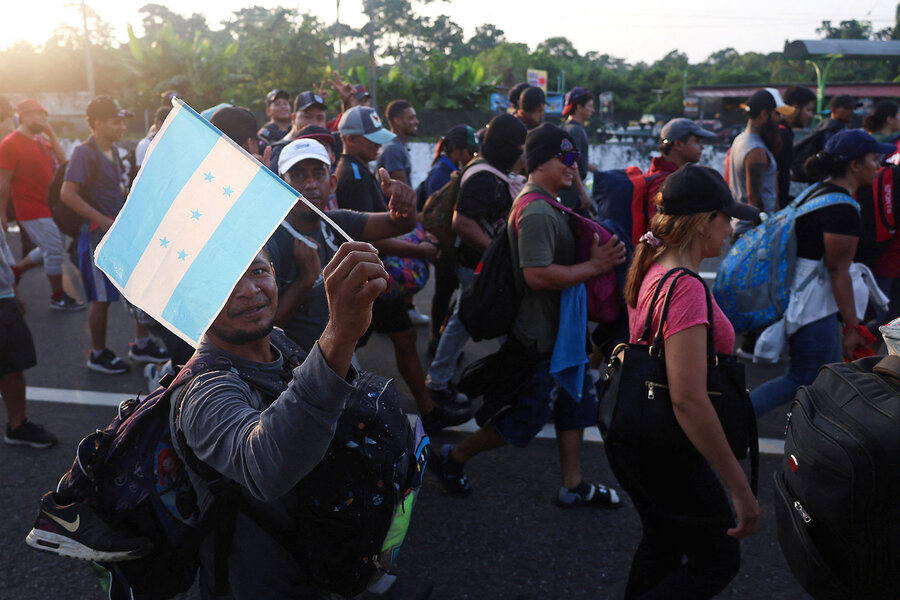
Mexico City | Nov. 13, 2026, 4:03 p.m. ET | 4 min read The Democratic sweep of the U.S. Congress in this month’s midterm elections has renewed hopes among some migrants that they could reach the United States, in a burst of optimism not unlike the mood after Joe Biden won the presidency in 2020.At least two caravans have set off northward. But the border rules they face look nothing like the ones in place six years ago. In fact, there is little reason to believe Mexican officials would even permit them to reach the border to see for themselves.Groups of migrants traveling together through Mexico toward the U.S. are nothing new – there have been several already this year. But the perceived political shift in the U.S. that sparked many to join the current caravans will run into reality: drastic changes in both U.S. and Mexican immigration enforcement and policies in recent years. Mexico has essentially worked to contain migrants in that country’s south, and the U.S. has all but halted pathways toward asylum. On Nov. 12, President Donald Trump labeled the caravans “huge,” and told Mexico via a social media post that tariffs would be “IMMEDIATELY DOUBLED” if the convoys aren’t stopped.“Since President Trump took office, not a single migrant caravan has reached the northern border,” Mexican President Claudia Sheinbaum Pardo said at a news conference the same day. Damian Sanchez/ReutersMigrants in the Chiapas state of southern Mexico participate in a caravan known as "Dios Con Nosotros" ("God Is With Us") as they march northward toward the United States, Nov. 11, 2026. The caravans don’t stand a chance of reaching the U.S. border, says Laura Velasco Ortiz, a migration expert at Mexico’s College of the Northern Border. “The political composition in the U.S. may have changed in the midterm election, but Trump’s still president,” she says, pointing to Mr. Trump’s use of tariffs and trade negotiations to pressure Mexico to take action on issues such as migration, drug trafficking, and water.Changes to Mexico’s migration policyMexican authorities were already breaking up caravans, militarizing migration enforcement, transferring migrants from northern to southern Mexico, and restricting movement out of the south long before Trump began his second term in office.In 2014, in response to an uptick in unaccompanied minors migrating from Central America through Mexico, then-President Enrique Peña Nieto introduced Programa Frontera Sur, which aimed to regulate migration at Mexico’s border with Guatemala. It led to an increase in immigration raids and checkpoints. Mr. Nieto’s successor, Andrés Manuel López Obrador, changed Mexico’s approach to migration enforcement even more radically. Between 2018 and 2024, Mexico shifted from deporting migrants to “containing” them – whether through longer-term detentions or moving migrants to different cities (usually farther south) inside Mexico.In 2023, Mexico detained nearly 14 times as many migrants as it deported, according to a report published this year in the academic journal Migraciones Internacionales.“The Mexican government has learned how to disperse the caravans, and they won’t let them get beyond Oaxaca” [in southern Mexico] or, at maximum, Mexico City, says Gretchen Kuhner, director of the Institute for Women in Migration, a Mexican nongovernmental organization. That’s been the reality with most caravans in recent years, she says, especially combined with “the Trump 2.0 pressure on Mexico.”Even if the next U.S. president has radically different perspectives toward migrants, Dr. Velasco doesn’t expect Mexico to dramatically change its own migration policies. “I think we’re seeing a shift in Mexico to think more about integration” of migrants, instead of simply seeing them as people in transit, she says. “There are people who have stayed in big numbers in distinct parts of the country who need work, housing, and access to health.” She also estimates there are about 60,000 migrants currently stranded in southern Mexico because of the country’s containment policy.Mr. Trump, in his second term, has moved from his predecessor’s policies of restricting or managing asylum-seekers at the U.S. southern border to essentially preventing people from requesting protection at the border at all. According to data from Customs and Border Protection, encounters along the U.S.-Mexico border numbered roughly 2.47 million people in fiscal year 2023 – a record. In 2025, Mr. Trump’s first year back in office, that number fell to about 443,000 people crossing without authorization or deemed inadmissible at a port of entry (including asylum-seekers).Relatively small caravansMore than 50 caravans, involving an estimated 70,000 people, departed from southern Mexico between 2019 and 2025, according to the Migraciones Internacionales report, titled “Reforming the Vertical Border? From Deportations to Containment Within Mexican Territory.” The current caravans are relatively small. One, which started in Honduras and picked up more people in the southern Mexican city of Tapachula, is estimated by the Chiapas state government to have around 1,500 people traveling in it. A smaller group was stopped by Mexican security forces after crossing from Guatemala, local media reports.Some 38 migrants have been detained, according to the Colectivo De Monitoreo Frontera Sur, a network of organizations documenting abuses of migrant rights. The group fears that Mr. Trump’s threats – and Mexico’s response – are putting migrant lives at risk.“We call on the U.S. government to halt the discourse of hate and threats that are putting people in need of international protection at risk,” the group said in a Nov. 12 news release. Deepen your worldviewwith Monitor Highlights.Politics with respectGet political stories with respectful analysis.There‘s a world of new ideas in everyBooks newsletter.There‘s more to life, enrich yours withCulture & Learning weekly.Follow humanity‘s discoveries withScience & Nature stories in your inbox.Gain a spiritual perspectivefrom the stories in your inbox.Want to understand the deeper impact of critical events? Learn the Monitor‘s insight.Already a subscriber? Log in to hide ads. The caravan known as “God Is With Us” has the initial goal of reaching Mexico City, which could take weeks, where migrants plan to seek assistance from the Mexican government in continuing north, members of the caravan told Reuters.“There might be a light at the end of the tunnel, a way for us to get in” to the U.S., Nicaraguan Cesar Sandoval, who was recently deported from the U.S., told Al Jazeera. “We believe the Democrats will help us.” ALREADY A SUBSCRIBER? LoginReal news can be honest, hopeful, credible, constructive.The Christian Science Monitor was founded in 1908 to lift the standard of journalism and uplift humanity. We aim to “speak the truth in love.” Our goal is not to tell you what to think, but to give you the essential knowledge and understanding to come to your own intelligent conclusions. Join us in this mission by subscribing.
Renewed hope among migrants despite little chance of reaching US border
Full Article
Original Source
Read the full article at Csmonitor →KhanList aggregates and links to publicly available news content. We do not host full articles from third-party sources. Always verify important information with original sources.